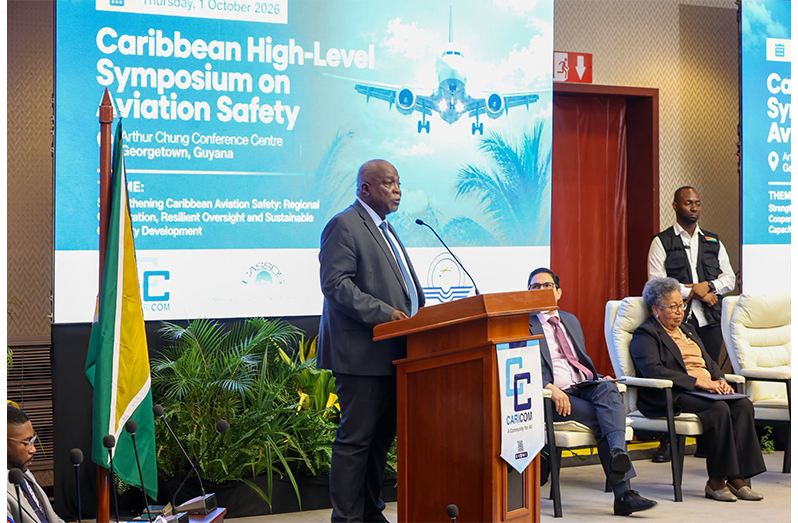
-regional partners urged to strengthen institutions, co-operation as air traffic expands
AS Guyana’s aviation sector continues to expand, Prime Minister, Brigadier (Ret’d) Mark Phillips and Minister of Public Utilities and Aviation Deodat Indar are calling for stronger safety oversight, institutional capacity and regional co-operation to ensure the growth of the industry is matched by the systems needed to maintain safe air transport.
Speaking at the Caribbean High-Level Symposium on Aviation Safety hosted by the CARICOM Secretariat and the International Civil Aviation Organization (ICAO), PM Phillips highlighted the sharp increase in passenger traffic, international flights and aircraft registered in Guyana, while Indar stressed that infrastructural development must be supported by capable personnel, reliable data and effective regulatory institutions. Their calls come as Guyana continues to modernise its aviation infrastructure, strengthen its regulatory capacity and take on a greater role in regional aviation safety through its chairmanship of Caribbean Aviation Safety and Security Oversight System (CASSOS) for the 2026 to 2028 term.
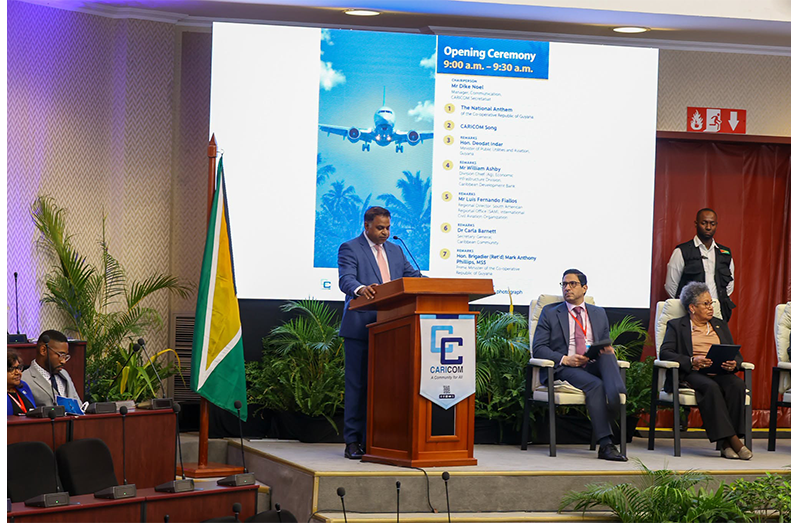
Speaking to the gathering of ministers, officials, and industry leaders, he noted that the symposium comes against the backdrop of a strong history of aviation development and collaboration in the region.
He noted that CARICOM launched the CASSOS in Guyana in 2009 to help member states meet international aviation standards and strengthen regional oversight. Since then, Phillips noted that Guyana’s aviation sector has seen significant growth. He highlighted that international passenger traffic increased from just over 200,000 to more than 1 million people over the past five years.
“Domestic passenger traffic has more than doubled. International flights increased by more than 5,000 from 2020 to 2025, while the number of aircraft on the register grew from 78 to 109. These figures demonstrate how much more is now being asked of the people who operate and regulate our aviation system,” he said.
However, with the rapid rise in visitor numbers, Guyana must also develop its aviation and support systems to match the rate of growth. Phillips noted that the expansion of visitor numbers needs to be backed by development in infrastructure and aviation safety precautions and systems.
Highlighting this, he noted, “While an increase in traffic is readily visible in a terminal, the corresponding increase in safety oversight work is less visible. Additional aircraft require inspection. Similarly, new routes and operators bring an increase in demands for certification and surveillance, while more flights place greater demands on air traffic services, airport facilities, and emergency preparedness. Regulators also need the authority and the personnel to carry out that work thoroughly.”
The prime minister also cited recent steps by President, Dr Irfaan Ali, in which he outlined a 10-point plan for Guyana’s aviation sector that includes upgrading air navigation and air-traffic management, modernising regulatory standards and strengthening safety oversight. Moreover, the Head of State also called for technical partnerships with international aviation bodies.
To this end, the Government of Guyana has invested in the sector, with efforts geared at developing safety and capacity within the fast-growing industry. The prime minister noted, however, that investment in aviation must include sustained investment in the institutions responsible for its safe operation. The Guyana Civil Aviation Authority serves as central responsibility in this regard, with the PM noting that through its aviation safety division, the agency undertakes certification, inspection, and continuing surveillance, including oversight of aerodromes and airport operators.
Moreover, Phillips noted that the government has invested efforts in policy frameworks and resources to bolster the authority and the sector at large. “The government is committed to providing the policy support and resources that will allow the authority to perform those duties properly and will respect the professional judgement on which credible regulation depends,” he said.
Moreover, Phillips cited health, safety, and environmental standards as increasingly important aspects as Guyana’s economy and aviation activity expand. “These concerns include safe working conditions for ground personnel, procedures for handling hazardous materials, emergency preparedness, and attention to the effects of operations on surrounding communities,” he added.
GREATER COLLABORATION NEEDED
Meanwhile, Minister of Public Utilities and Aviation Deodat Indar also used the forum to highlight Guyana’s aviation growth and make the call for greater regional collaboration.
He noted that Guyana is currently investing in aviation infrastructure more than ever before, resulting in the modernisation of almost 60 hinterland airstrips. Additionally, Guyana has expanded its international gateway with an additional US$65 million in funding, the minister noted. However, Indar was keen to note that safety in the sector needs to be supported by more than just infrastructure.
“Infrastructure alone does not deliver safety. It must be matched by capable people, sound oversight, dependable data, and institutions’ preparedness to adapt,” he said.
He added that aviation remains critical to the region, connecting communities, supporting tourism and trade, bringing families together and delivering essential services, particularly during emergencies. “For our region, aviation is not a luxury. It connects island and mainland communities, supports tourism and trade, and brings families together and helps deliver essential services. When hurricanes, floods, and other emergencies strike, reliable air transport can be a lifeline,” he said adding, “That makes safety a public responsibility and a foundation for development. Connectivity that is not safe cannot be sustained.”
Minister Indar further stressed the need for practical co-operation among Caribbean states, noting that no country can address the challenges facing the sector alone. He said regional co-operation must include shared expertise, stronger pathways, timely exchange of safety information and harmonised regulation where practical, with CASSOS playing a key role in strengthening oversight across member states.
Guyana has accepted responsibility for chairing CASSOS for the 2026 to 2028 term, which Minister Indar said would be used to advance stronger compliance with ICAO standards and a safer regional aviation system.
He noted that the forum would also consider a CASSOS roadmap and action matrix to 2035, addressing the sustainability of civil aviation authorities, regulatory harmonisation and air transport services within CARICOM. “These discussions must be candid and practical. We should leave with clarity on who will lead, what must be done, and how progress will be measured, and how the work will be financed, which is very important at this juncture of CASSOS,” he added. “The declaration before us should capture commitments that government regulators, regional institutions, industry, and development partners can carry forward together.”