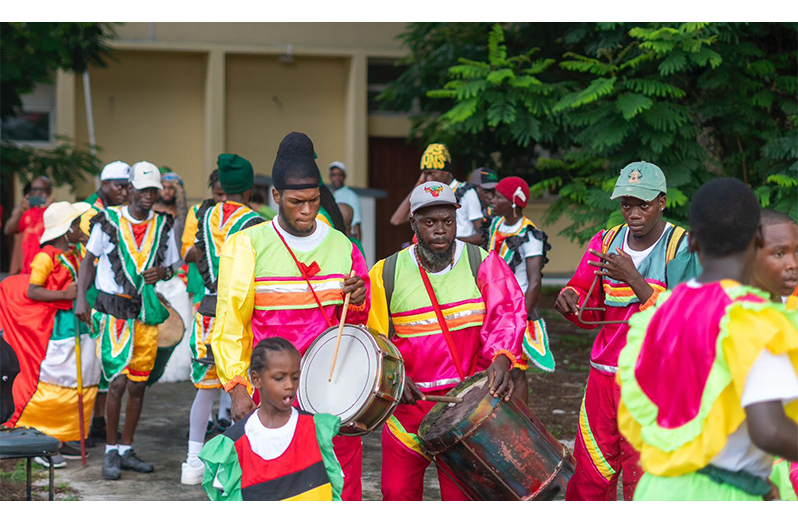
How the Masquerade Association of Guyana is championing year-round recognition, education, and development of one of Guyana’s most iconic art forms
MOST Guyanese would agree that the sound of Masquerade is the sound of Guyana; the rhythmic call of the flutes, the steady hum of the drums, and the passionate movements of the dancers, or “flouncers”, brought to life by the familiar characters of the Mad Cow, Long Lady, and Mother Sally. Together, they help shape a truly Guyanese holiday season. But the Masquerade Association of Guyana Inc. (MAG Inc.) believes the art form should be more than a seasonal pastime. Instead, it should stand as a major cultural expression celebrated year-round. Speaking with Pepperpot Magazine this week, Chairman of the association, Jocelyne Josiah, outlined ongoing efforts to develop Masquerade, the partnerships reinforcing its cultural importance, and the next steps towards ensuring the tradition echoes across Guyana well beyond the Christmas season.
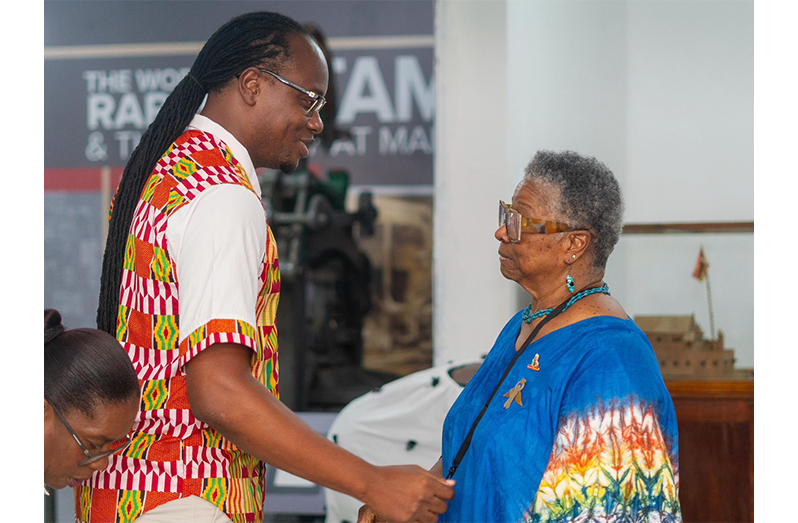
Josiah is no stranger to the arts. An accomplished communications specialist and international public servant, she says she became chair of the association because of her interest in Masquerade, its history, and the possibility of preserving the art form. She explained that she was first asked to take on the role through her position as a board member at Merundoi, an association that also emphasises Guyanese authenticity in the performing arts. “I got involved in the association simply out of interest. I sit on the board of Merundoi, and we needed somebody to help move the process forward,” she said. “It was mainly because of interest, and not just interest, but also a desire to know more and more about the history of our people here in Guyana, of Black people, and of each of the other peoples who are here in Guyana right now.”
While the dances and sounds of the Masquerade that most Guyanese see today tell the story of the nation, Josiah said the art form carries a much deeper historical narrative. Masquerade traditions can be found throughout the Caribbean, each with its own dances, sounds, names, and past. “Masquerade is a cultural tradition in Guyana. Masquerade is a particular art form. It is an integral part of Guyana’s culture that needs to be studied, needs to be known, needs to be practised, and needs to be propagated to the point where everybody is proud of Masquerade.” Getting there, she acknowledged, will require sustained effort, with education as the first critical step in cultivating a deeper appreciation for the tradition.
As Josiah highlighted, Masquerade, like Guyana’s food and music, tells the story of a people. Stressing the importance of public awareness and education, she noted that there is far more to masquerade than what many commonly see, with historical references to the art form found in caves thousands of years old. “We do not know what masquerade is, where it came from, its origins, how it developed, and what it has come to be,” she said. “All we see is people flossing on the streets and picking up money, and we don’t know the significance of all of those things. So we need to study and do research with other people into what all of those things mean.” She added that Masquerade did not simply emerge in Guyana. “It came here with the enslaved, from across West Africa, but it existed eons before the slave trade. There are artefacts and paintings in caves on the African continent that date back to 8,000 years before Christ.”
This deep historical and cultural relevance is one of the reasons the association has garnered growing support. Backed by a team of passionate advocates, Josiah said the association is actively working to partner with leading historical and cultural organisations, both locally and internationally. “In terms of our partnership with the Ministry of Culture, Youth and Sport, the Ministry responsible for cultural development in Guyana, we have been working closely with them,” she said. “We have also been working with the Ministry and, through UNESCO, the United Nations Educational, Scientific and Cultural Organisation, on two levels. First, to examine and explore the possibilities of Guyana signing on to the UNESCO 2003 Convention on Intangible Cultural Heritage.”
The association is also seeing increasing interest from young people, many of whom are eager to join masquerade bands. “We have definitely been seeing interest from young people, and that is one of the most important aspects of this,” Josiah noted. “We are advocating for training from childhood all the way through.” But interest alone, she said, is not enough. Education at the school level remains critical. “We have been working with the University of Guyana’s early childhood department to complete and introduce a workbook prepared by one of our specialists on masquerade,” she explained. “It’s similar to a colouring book, but at the same time, it is meant to make children more aware of what masquerade is all about.”
Although the association is only a few months old, having been launched earlier this year, Josiah said there are robust plans to develop the art form, beginning with structured training. “There are all kinds of training that need to take place, not only within the art form itself, such as the dances, the music, and costume design,” she said. “But we would also like to provide training that enables masquerade bands emerging from communities to earn a sustainable livelihood from this.” She added that this could include collaborations with institutions such as the Burrowes School of Art and training in areas that support income generation. “These are things that could be marketed and would help masqueraders become more independent.”
Looking ahead, Josiah envisions Masquerade as a living, evolving expression of Guyana’s diverse cultural identity, shaped by African roots while absorbing influences from Indigenous, European, Indian, and Chinese traditions along the way. It is this evolution, she said, that allows Guyanese masquerades to stand apart from similar traditions across the region. With plans to engage multiple ministries, integrate Masquerade into major national events, expand museum exhibitions, and strengthen documentation and archiving, the association is working to firmly position Masquerade within Guyana’s national cultural lexicon.
By listening to practitioners, involving masqueraders themselves, and pursuing regional collaboration and potential UNESCO recognition, Josiah believes the tradition can gain the respect and visibility it deserves. “It’s not just a band of people jumping up on the street,” she said. “There’s a story. There’s a history.” And once Guyanese truly understand that story, she added, the Masquerade can be embraced not only as a symbol of Christmas, but as a proud and enduring expression of national identity.