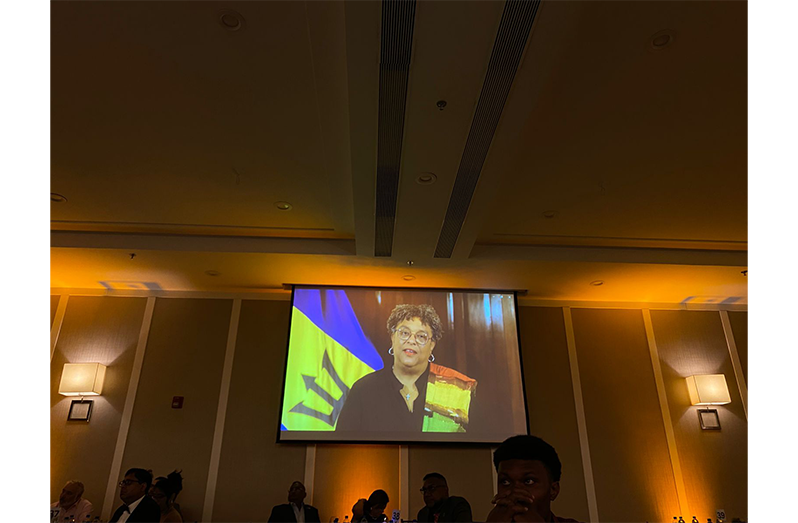
–PM Mottley tells GCCI’s awards and gala, says CARICOM sister state a market shaper
–urges Guyanese businesses, innovators to continue fostering regional growth, collaboration
SEEN as a beacon of development in the Caribbean region, Guyana’s economic ascent has positioned the country as an “exceptional bright spark” amid global uncertainties, Barbados Prime Minister Mia Mottley has said.
Addressing the 136th Georgetown Chambers of Commerce and Industry (GCCI) annual awards and gala virtually on Thursday evening, the regional leader noted that Guyana’s expansive growth is not only the strength of its own economy, but fundamentally the strength of the entire Caribbean region, representing the core of regional integration and the Caribbean community (CARICOM) family.
“Guyana’s story; your story is one of tremendous resilience and potential indeed. With an average GDP [gross domestic product] growth of exceeding 45 per cent over the past three years, you are an exceptional bright spark in a challenging global space,” she said, adding: “Barbados and your regional partners do not just observe this journey; we’re invested in it, and have been for many, many, many decades. Indeed, one might even say centuries.”
Prime Minister Mottley further noted that as the region looks to confront global challenges, economic policies must be shaped to ensure the region’s resilience. With this objective in mind, she commended the country’s efforts in supporting investments in strengthening the region.

“There is one undeniable reality that confronts us all, from Guyana in the south to the Bahamas in the north. My friends, the world that we knew has changed. There was a time when we were treating security and economic policy as separate lines on a budget. We saw security as a necessary cost, and growth as an eventual reward. I say to you, this mindset is outdated, and in fact, possibly dangerous,” she warned, stressing that the region’s greatest investment will be in its economic future and well-being of citizens.
“We must recognise that our solidarity is not merely a diplomatic legacy, it is a fundamental act of economic self-preservation,” she added.
CLIMATE CHANGE
Shifting her focus to the region’s vulnerability to climate change, Prime Minister Mottley noted that the regional bloc faces a collective risk. Citing statistics, she pointed out that major disasters cost Caribbean economies an average of two per cent in GDP annually.
This figure, she explained, further raises to four per cent in the eastern Caribbean, and when Caribbean nations are hit by catastrophes like the recent Category Five Hurricane Melissa that ravaged sections of Jamaica, it takes up five per cent of that State’s GDP.
“With this in mind, we continue to hold our brothers and our sisters in Jamaica in our prayers, and offer the support that they need for when a third of their country effectively has been affected. In terms of their population, 900,000 persons, three times the population of my own country, and close to your population, and indeed, 1,000 households either destroyed or damaged,” she said.
Mottley noted that the region, as a collective, must shift their focus on how they build not only for the physical losses, but economic deficits.
“We cannot only build stronger physical walls to safeguard ourselves in this climate crisis, but we must also build stronger financial [capacity]; our resilience must be strengthened.
“We can secure every coastline, but if our economic culture remains built on sand, if the foundation of global finance is inherently rigged against our vulnerability, then all our security gains are temporary,” she added.
OPERATIONAL SECURITY AND REGIONAL COLLABORATION
The Barbadian politician cautioned that while Guyana is surging, some sections of the wider region are facing challenges, but to remedy this, she believes Guyana can be seen as more than just a regulator in the region’s economy.
She said: “We must be honest about the trends. While Guyana surges, the wider region faces sluggish long-term productivity. To fix this, we must reimagine the State, not just as a regulator, but as a market shaper.”
Leveraging the country’s potential, a key element will be investing in efforts to address the existing transportation gaps.
To this end, she said that a government-alone approach will not see the region meeting its ambitious targets to improve regional integration.
She stressed that greater public-private partnerships across the region will be needed.
“We need you, the private sector. We need to unlock public-private partnerships, working with partners like the IFC (International Finance Corporation) and the IDB (Inter-American Development Bank), to construct the transactions that build our future, working equally with our commercial banks, and ensuring that we can use certain savings collected by our population [which] will also ensure that that growth, when it happens, is not skewed only in favour of those who have wealth, but in fact, is an opportunity for all to participate in the prosperity that we want,” she said.
Mottley stressed that security is the bedrock of the region’s socio-economic development, and while governments like Guyana’s are providing planforms through policies, private sector support remains integral.
“I challenge you tonight to move beyond simply requesting government,” Mottley said, stressing that the moment demands leadership from the private sector as well as governments.
She said: “Move to a position now where you can lead and design our new economy, in partnership, in partnership with our labour unions, in partnership with our governments, in partnership with us at the regional level, to drive the CARICOM single market and economy, so that we may leverage at a collective scale.”