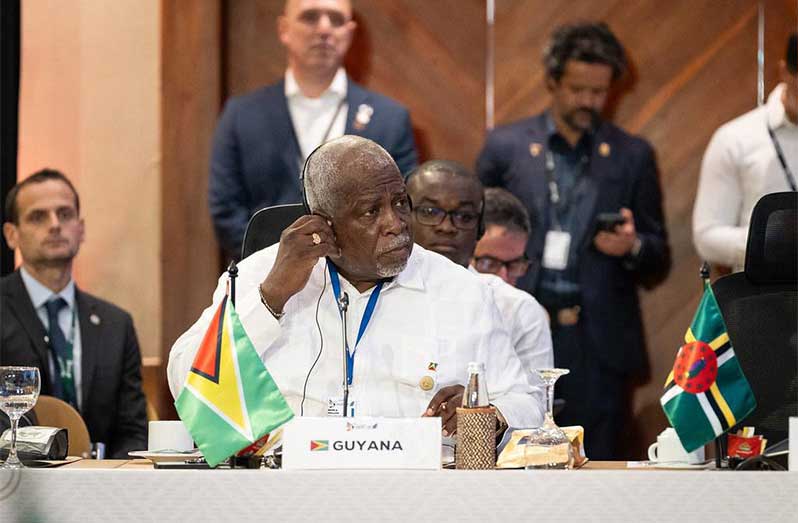
PRIME MINISTER, Brigadier (Ret’d) Mark Phillips, has called for strengthened bi-regional co-operation and renewed multilateralism to tackle some of the world’s most pressing challenges, including climate change, food insecurity, and transnational crime.
Speaking on Sunday at the IV CELAC–EU Summit in Santa Marta, Colombia, Prime Minister Phillips joined Heads of State and Government from the Community of Latin American and Caribbean States (CELAC) and the European Union (EU) in discussions aimed at deepening the partnership between the two regions and advancing joint responses to global crises.
In his address, the Prime Minister underscored that despite geographical separation, CELAC and EU nations share interconnected destinies shaped by common values and threats.
“Guyana considers that the present CELAC–EU partnership, built on shared values — democracy, the rule of law, respect for the UN Charter and international law — provides an ample framework for enhanced co-operation to address the global issues which sit at the heart of our collective efforts to engender peace, sustainable development and the full enjoyment of human rights and fundamental freedoms by all our peoples,” he stated.
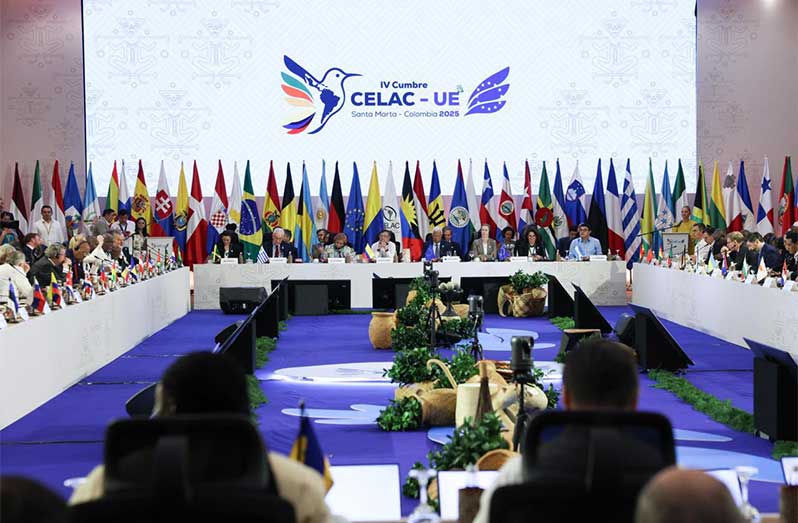
Highlighting climate change as the foremost concern, Prime Minister Phillips described it as “an existential threat of grave and growing proportions.”
He expressed solidarity with countries affected by Hurricane Melissa, including Jamaica, Haiti, Cuba, and The Bahamas, and reaffirmed Guyana’s support for regional recovery efforts.
He warned that small states remain especially vulnerable to climate impacts and reiterated the call for greater fiscal space and access to climate finance.
“A redoubling of effort is imperative to keep 1.5 degrees Celsius within reach,” the Prime Minister urged, noting that too many global commitments under the Paris Agreement remain unfulfilled.
Outlining Guyana’s response, he cited the Low Carbon Development Strategy (LCDS) 2030 as a national framework for balancing economic growth with environmental protection. The country’s energy transition, he said, is guided by investments in natural gas, hydropower, solar, wind, and biomass to ensure universal access to affordable and sustainable energy.
He also echoed President Dr. Irfaan Ali’s call at COP30 in Belém, Brazil, for a “just energy transition” that balances development and environmental goals.
Turning to food security, Prime Minister Phillips said Latin America and the Caribbean must pursue more resilient and sustainable food systems.
He highlighted CARICOM’s Agri-Food Systems Agenda, led by Guyana, as a model for transforming the region’s approach to production, affordability, and food access.
“We aim to modernise the regional agri-food sector, enhance production of quality food at affordable prices, end hunger, and promote regional food and nutrition security,” he said, emphasising openness to international partnerships that strengthen regional capacity.
The Prime Minister also drew attention to the growing threat of transnational crime in Latin America and the Caribbean, describing it as a major obstacle to governance and development.
“Developing adequate resilience and response capability and strengthening our collective security must be a common cause for all member states,” he asserted.
He reaffirmed Guyana’s commitment to maintaining Latin America and the Caribbean as a zone of peace, and to deepening partnerships that bolster regional security.
Prime Minister Phillips welcomed ongoing EU–CELAC co-operation initiatives such as the EU Global Gateway and the Digital Alliance, expressing optimism that these programmes will help align global development priorities with national needs. He also endorsed the 2025–2027 Roadmap as a vital instrument for implementing agreed areas of co-operation.
In conclusion, the Prime Minister reiterated Guyana’s full commitment to the CELAC–EU partnership and to advancing shared goals for sustainable development and prosperity.
“Guyana remains steadfast in working with partners to strengthen the bi-regional relationship and to ensure that our collective efforts yield expanded opportunities and tangible benefits for all,” he affirmed.