






-Grades 6, 8, 9, 10, 11 and 12 to have everyday face-to-face classes
ALL learners in Grades Six, Eight, Nine, 10, 11 and 12 will attend daily face-to-face classes when school reopens for the Easter term on January 3.
The remaining grades and nursery schools will have either online or face-to-face classes on a rotational basis, according to the new school reopening plan released by the Ministry of Education (MoE) on Friday.
January 3 is the date set for the commencement of classes for all levels except Grade Seven, which will begin on January 10.
For nursery schools a shift system will only be used for Grade A schools, which are larger in size, while schools will use a rotation or shift system only if all children cannot be accommodated in accordance with social-distancing guidelines
“The school will inform parents when each group should attend. Most nursery [children] will be taught for four hours per day and the amount of time will be determined by each school. Schools using the shift system may teach each group of learners for less than four hours per day,” the ministry said in its remarks which are documented on the schedule.
At the primary school level, only large schools will be allowed to rotate the Grade Six pupils so as to facilitate attendance of those in Grade Five. The ministry made it clear that Grade Six pupils will be given preference to attend face-to-face classes, followed by a descending order of priority for each preceding grade.
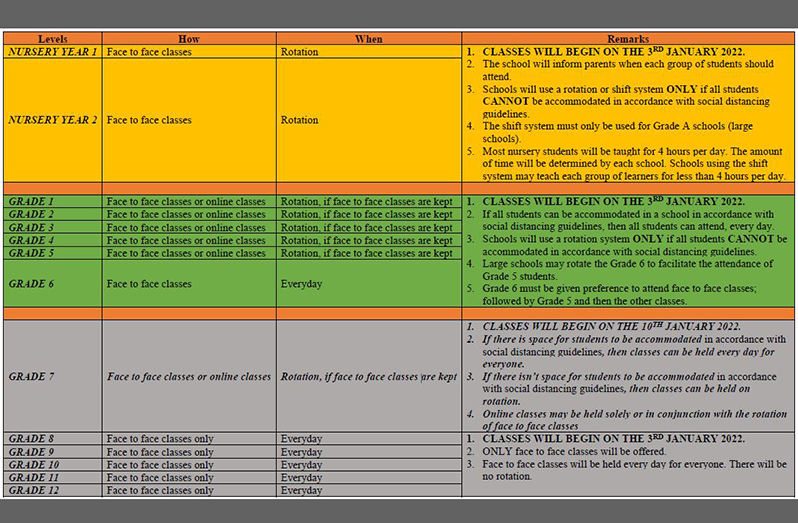
For secondary schools, physical classes for Grade Seven students could be held every day if there is enough space in keeping with social-distancing guidelines.
In cases where there isn’t space for students to be accommodated, then classes can be held on rotation. Online classes may be held solely or in conjunction with the rotation of face-to-face classes, the ministry added.
This new plan marks the beginning of the return to normalcy for public schools which were closed to physical classes in March, 2020, due to the COVID-19 pandemic. Since that closure, public schools have utilised various means to deliver education, including virtual teaching and rotated face-to-face classes.
Given the magnitude of learning loss among children worldwide, governments have been eager to see schools reopen physically. In Guyana, the MoE has felt encouraged to reopen schools following the government’s acquisition of the Pfizer-BioNTech COVID-19 vaccine for children aged 12 to 18, and the subsequent roll out of a countrywide vaccination campaign.
There are also plans to soon offer vaccination to those in the five to 12 age group.
Minister of Education, Priya Manickchand, had said earlier this month that the ministry doesn’t want to continue keeping children away from the classroom.
The minister had noted that reopening is being premised on the basis that most learners are given the option to get vaccinated, and those who have chosen thus far not to get the vaccines are doing so by choice.
“My thinking behind reopening fully in these levels is whoever was going to take the vaccine could have taken it by now… if persons are not going to take the vaccine, then we cannot keep our children out of school and it is unfair to the children who took the vaccine that they’re unable to access schooling,” Minister Manickchand had said at a press conference earlier this month.



