
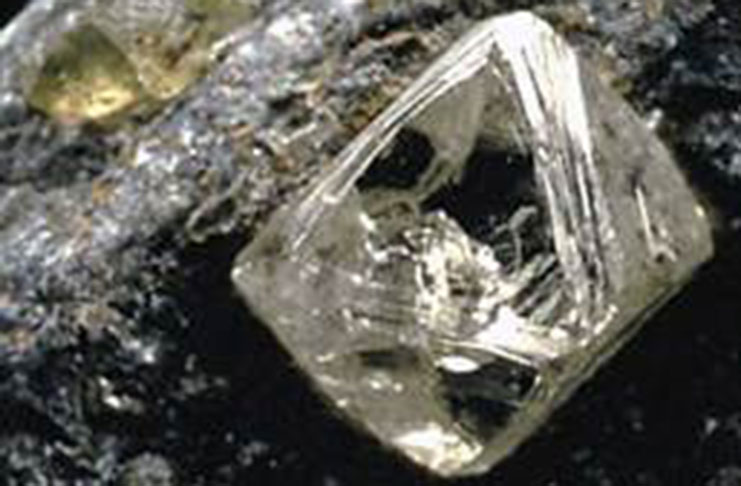
ALTHOUGH gold production has risen to greater prominence, reports from the Guyana Geology and Mines Commission (GGMC) have revealed that diamond production has been on the climb for the past five years, with some 99,000 carats being the latest production figure up to the end of November.Minister of Natural Resources, Raphael Trotman, disclosed earlier this month that for the first quarter of this year, Guyana’s diamond production and declaration were already 38% ahead of the expected target of 61,380 carats, being recorded at 99,000 carats.
With the industry experiencing a renaissance; with the Netherlands, Belgium and the Arabian countries remaining big buyers of Guyana’s diamonds; and with the country maintaining a clean slate in the industry, it is expected that more miners will develop an interest in diamond production even as Government moves to push production levels higher.
The Mineral Production records of the Guyana Geology and Mines Commission (GGMC) show that Guyana’s diamond industry has been experiencing a steady climb over the past five years, after falling from 52,273 carats in 2011 to 40,764 in 2012. The year 2013 saw a declared production of 55,928 carats, while 99,950.50 carats were produced in 2014. By the end of this year, it is hoped, diamond production will surpass last year’s figure of 118,450.79 carats.
The diamond industry performed better between 2001 and 2009, when more than 2,558,000 carats were produced of the 3,555,270 carats produced between 1979 and 2015. The diamond industry was at its best in 2004, when in that year alone Guyana produced 444,940 carats.

The industry experienced a significant fall in production in 2010, when production fell from 143,982 carats to a mere 49,920 carats. According to the GGMC 2010 Mineral Review, the industry experienced a decrease in declarations, and diamond output had declined by 65.3 per cent. The report stated that though there was no fall in demand and price for diamond on the world market, there was a steady “reallocation of resources from diamond production to gold production, due to the attractive gold price.”
Diamond price had indeed increased by 4.7 per cent with an average value of US$156.09 per carat of Guyana’s rough diamonds in 2010, the same year production fell significantly and overseas trade in diamonds decreased significantly by 51.2 per cent: from 94,831 metric carats in 2009 to 46,253.21 metric carats in 2010.
Belgium and the United Arab Emirates have been faithful buyers of Guyana’s diamonds.
Guyana had since not been able to reach the 100,000 mark, until last year, when it produced 118,450.79 carats of the precious stone.
Guyana has been declared a model country in the Kimberly Process, producing some of the most trusted diamonds in the world; and it is believed that, should production increase significantly, the country may have a chance at reaping much greater economic rewards in the industry.
“The checks and balances are good, but the dealers who have to comply with the checks and balances of the Kimberly Process would always say that it’s onerous. And part of the reason is that it takes a little time for us to confirm and to satisfy ourselves that what they have submitted to us is genuine,” a reliable GGMC source told the Guyana Chronicle.
The source said anyone exporting diamonds must produce documentation and proof to show where the minerals came from, and GGMC officers would investigate to confirm.
“If where you said these diamonds come from there is no evidence that the operation has been going at the point and time when you said, that’s the end of your diamonds; because we’re gonna seize them,” the source told this newspaper.
He said that while Government is working to significantly raise production levels in the industry, and companies question why GGMC is undertaking to prove that diamonds are not ‘corrupt diamonds’ or ‘blood diamonds’ smuggled at the tripartite-border state, Guyana is also interested in preserving its ‘model country status by the Kimberly Process. The source said GGMC has this year seized small portions of diamonds from diamond producers on ground that it was not established that the diamonds came from the place mentioned by the producers. “We have seized on the ground of (their) not being able to establish (that the diamonds came from the place mentioned by the producer)…where we were unable to establish from the reporting that a certain amount can be established. And what we try to do is find some mechanism of extracting,” the source said.