






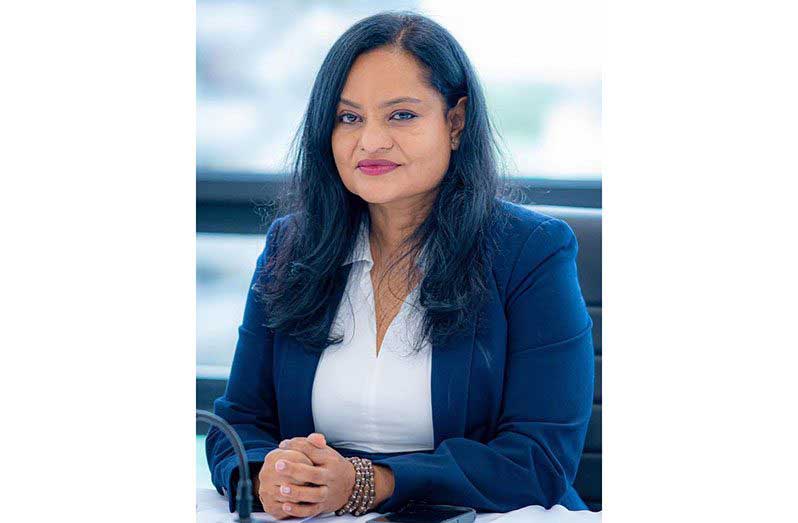
MINISTER of Human Services and Social Security, Dr Vindhya Persaud, has called for greater accountability across Guyana’s justice and support systems in addressing gender-based violence, stressing that ending violence against women and girls requires coordinated action from every sector of society.
As Guyana joined the global observance of the 16 Days of Activism Against Gender-Based Violence on November 25, Dr Persaud emphasised that accountability must extend beyond perpetrators to include every institution and official responsible for protecting survivors and ensuring justice.
She challenged the nation to examine how it could build a unified system that inspires public confidence, noting that everyone has a personal and moral responsibility to advocate for an end to violence and demand justice for victims and survivors.
The minister stressed that every link in the response chain must function effectively, from the initial medical assessment and reporting of abuse to police investigations, prosecution and the independent determination of cases by the courts.
She explained that the Ministry of Health has an important role in assessing injuries, preparing medical reports and working alongside the Ministry of Human Services to address the psychological impact of abuse.
The Guyana Police Force, she said, must take every report seriously, conduct thorough investigations and prepare comprehensive case files to ensure prosecutors have the necessary evidence to pursue cases in court. The judiciary, in turn, must independently assess the evidence and apply the law.
Dr Persaud said her ministry has established a comprehensive framework to support survivors, encompassing community education, counselling, Hope and Justice Centres, free legal assistance, survivor advocates and emergency shelters.
Efforts are also being strengthened to improve reporting mechanisms and ensure that survivors receive continued support after disclosing abuse.
Providing an update on the ministry’s interventions, the minister disclosed that between January and September this year, survivor advocates directly assisted approximately 1,600 survivors and provided support in more than 1,000 court cases.
During the same period, the 914 hotline received more than 7,600 calls, while 425 persons accessed free legal assistance through the Legal Pro Bono Programme.
The country’s three Hope and Justice Centres recorded 336 cases, bringing essential services closer to individuals experiencing violence.
Shelter services have also been expanded, with emergency shelters now operational in Regions One and Three. Beyond immediate protection, the ministry provides counselling, financial assistance, housing support, skills training and economic empowerment opportunities to help survivors rebuild their lives.
Dr Persaud pointed to legislative reforms as another critical component of the government’s response, identifying the Family Violence Act of 2024 and amendments to the Sexual Offences Act in 2026 as significant measures aimed at strengthening protection and accountability.
She said prevention remains equally important, noting that the ministry has more than quadrupled its community sensitisation reach compared with the corresponding period in 2025.
More than 15,000 persons were engaged through community outreach initiatives, including over 11,000 students. Training was also delivered to more than 800 law enforcement officers, while outreach activities reached over 2,500 Indigenous persons.
Through the BRAVE Programme, which focuses on engaging men and boys, approximately 245 participants were reached with messages promoting healthy relationships, accountability and positive masculinity.
The ministry is also working with the private sector to improve workplace standards through its National Gender Equality and Empowerment Seals. Six private sector companies received accreditation this year as part of efforts to advance gender equality and prevent sexual harassment in the workplace.
Dr Persaud said public confidence in the system depends not only on the availability of services but also on how institutions respond when survivors seek assistance.
People must be able to trust that someone will answer their calls, explain the next steps and follow through on commitments, she emphasised.
The minister also identified digital violence as an increasingly urgent concern, warning that online platforms have given abuse an expanded reach, with anonymity shielding perpetrators, algorithms amplifying humiliation and manipulated images circulating beyond national borders.
She said Guyana must use this year’s 16 Days of Activism to facilitate a comprehensive national conversation on digital violence, paving the way for appropriate policy and legislative responses.
Dr Persaud further called for accountability frameworks for technology companies, including transparent reporting mechanisms, independent oversight and meaningful consequences for failures to prevent and address abuse on their platforms.
As the campaign progresses, she urged the public to ensure that its message translates into practical action, particularly when someone discloses that they are experiencing violence.
Her hope, she said, is that long after the campaign concludes, people will remember how to respond when a woman asks for help by listening, staying with her and helping her contact the relevant support services.
She stressed that those receiving reports must also take responsibility for ensuring that cases are properly addressed and that survivors are not left without assistance.
The minister said the campaign’s continued importance lies in reaching people who may not know where to turn for help, as well as encouraging families and communities to recognise the warning signs of abuse.
She called for collective responsibility in holding both perpetrators and public officials accountable, maintaining that ending violence against women and girls cannot be achieved by any single institution or individual, but requires sustained national commitment.




