






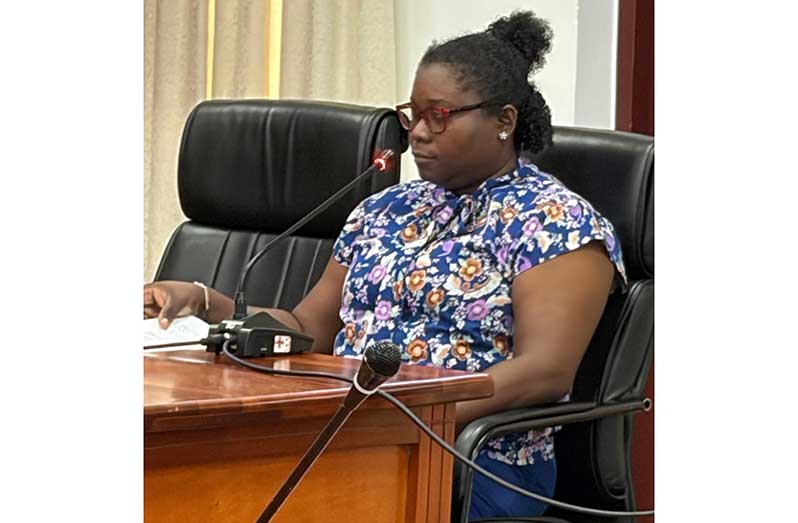
TWO Transport and Harbours Department (THD) cashiers told the Presidential Commission of Inquiry (CoI) into the sinking of the MV Barima on Wednesday that they could not explain large gaps between official records and what was actually loaded aboard the vessel on July 18.
The commission is trying to establish the procedures for managing passengers boarding the vessel and for managing cargo loaded onto it. Neither matter has been presented as the cause of the sinking, but the testimony at the Arthur Chung Conference Centre pointed to gaps across both systems.
Ticketing clerk Atasha Washington said she collected no cash for any additional passengers and could not account for their boarding. She worked inside the ticketing office and said she could not see who was boarding.
Commissioners questioned her about passenger records, changes to the booking system and arrangements for accommodating additional passengers once tickets were exhausted.
After cross-checking lists, removing duplicates and excluding persons she said were not booked, the examination arrived at 116 documented passengers for Port Kaituma and Morawhanna.
A commissioner pointed out that a manifest provisionally received by the inquiry listed only 100 names. Evidence before the commission suggested about 160 people boarded. Washington said the manifest was generated automatically by the system and the discrepancy was not explained.
The booking allocation comprised 85 spaces for Port Kaituma, 25 for Morawhanna and 15 reserved for pensioners travelling to either destination. Morawhanna passengers could obtain tickets only on departure day and could not book online.
For the July 18 voyage, bookings opened on Tuesday, July 14, and ran through Friday, July 17. MMG customers booked and paid through the app and presented their booking information on departure day. Walk-in customers paid Washington directly. MMG passengers received only a boarding pass. Others received both a boarding pass and a cash ticket.
Washington said no copies of boarding passes are kept, and that the online booking system shuts off at departure time.
She described a booking-system change that allowed only one name to be entered for a group, with the other travellers recorded as numbered passengers. She said her supervisor called it an upgrade, and that it made her work “a bit easier”. Individual names could be recorded through the point-of-sale process. After the tragedy, she was tasked with contacting MMG customers to establish the names behind group bookings.
Washington said her immediate superior is Goods Superintendent Delon Granderson. She said additional passengers had previously been processed after management approval.
On July 18, she reported that tickets were exhausted and was told by management to “hold on”. She received no later authorisation to process an additional allocation.
A commissioner observed that no single person verified that those who boarded matched what had been issued. According to her written submission, Washington was placed on paid administrative leave after the sinking.
Cargo cashier Kenese McLean, who has worked at THD for 19 years, collected freight slips from customers and took payment on July 18. She told the commission that the manifest is supposed to represent everything that goes aboard, and that nothing is entered without a slip from a checker. McLean said she herself does not load the vessel or inspect what goes on board.
Commissioners put the figures to her: The electronic cargo records list 101 gas cylinders, but a commissioner said a review of CCTV footage found 213 loaded, more than double.
The commissioner also pointed to two barrels of oil totalling 450 gallons listed on the manifest when 10 had been loaded. McLean said she could not account for the discrepancies.
The manifest does not price cargo by weight, and McLean said charges are set by computer software. The THD cited a total of 268 tons of cargo for the Barima’s final voyage.
When asked who collected fees on unrecorded items, McLean said the checkers’ logbooks would show it. The CoI gave her an overnight task to compare the two. McLean also agreed to provide five years of cargo revenue records when she returns to the CoI on Thursday.




