






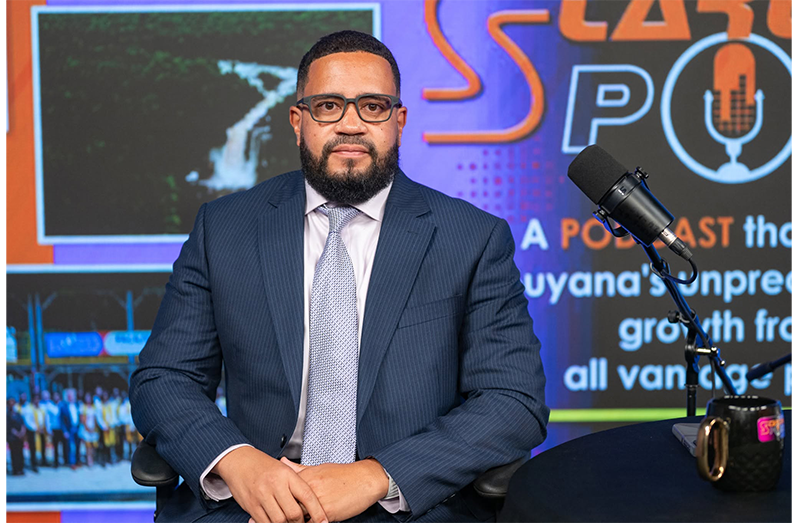
—MOPUA Director General says listening to public concerns and incorporating feedback into policy decisions major part PPP/C governance
DIRECTOR General of the Ministry of Public Utilities and Aviation (MOPUA), Alfonso De Armas, has rejected claims that citizens who openly criticise the government or give unfavourable feedback face punishment, push back, or repercussions.
In a teaser ahead of episode release of the weekly Starting Point Podcast shared on Saturday, De Armas maintained that the People’s Progressive Party/Civic (PPP/C) government’s approach to governance is focused on listening to the population, understanding their concerns and incorporating those views into policy decisions.
De Armas said the government’s willingness to engage directly with citizens and receive criticism, including feedback that may be difficult for public officials to hear, is not only a vital aspect of the party’s leadership, but is also a distinctive factor between the PPP/c’s approach and what he described as the previous administration’s failure to remain connected to the people during its time governing between 2015 and 2020.
The director general was also keen to argue that decisions made without sufficient engagement and input from citizens can create, policies, initiatives and leadership that overlooks their actual needs and interests.
Emphasising that the current administration has placed considerable emphasis on going into communities and hearing directly from residents, De Armas added, “I have seen, in 2015 to 2020, that many people made the mistake, many of the leaders that [sic] made the mistake of governing behind the gilded ivory desk. They did not listen to their population, to the citizens of Guyana, and they took decisions that were not in their best interest,” he said.
Moreover, De Armas pointed to the regular Cabinet outreaches led by President, Dr Mohamed Irfaan Ali as an example of the government’s strategic emphasis to maintaining contact and building trust with citizens, explaining that these engagements allow officials to hear about the challenges affecting different communities and take those concerns back into the decision-making process.
According to De Armas, the engagements are not simply opportunities for officials to meet residents, but an important means of understanding what is happening on the ground and see where government policies and initiatives could be improved.
“The hallmark of what we do, the president, for example, has Cabinet outreaches almost every month. We go out to the different regions and talk one on one, go on the ground and talk with our citizens, listen to them, understand what the issues are, and when we go back, we incorporate those things into our policy decisions,” he added, “Now, that is tremendously important.”
Against that background, De Armas spoke on the perception that offering honest feedback or criticising the government could result in some form of punishment.
He dismissed the suggestion, insisting that the administration monitors public concerns and listens closely to what people have to say, even when the feedback is unfavourable. While acknowledging that criticism can sometimes be uncomfortable for those in public office, he maintained that hurt feelings should not be confused with retaliation against citizens who express dissatisfaction.
“There is no punishment. We monitor and we listen very keenly, very closely to everybody. Sometimes the feedback hurts and it hurts feelings,” he said. De Armas also drew on his own experiences with criticism on social media, saying that he has been the subject of memes on Facebook and has been tagged in comments that can be considered disrespectful.
However, he said such interactions are part of the responsibility that comes with holding public office and should not be taken personally or used as a reason to penalise those expressing their views. De Armas maintained that public officials must be prepared to deal with scrutiny, including criticism directed at them, as part of their responsibility to the people they serve.
“People have started to make memes of me on Facebook. I think it is hilarious, or they tag me quite maybe disrespectfully on social media. But you know what? It is part of the job,” he added, “You have to have a thick skin in this. And believe me when I say, nobody in our government that has any sort of say takes these things personally and institutes repercussions on people who complain.”
The director general further pointed to the establishment of Citizen Connect and the continued Cabinet outreaches as evidence of the government’s clear and overwhelming intention to encourage public participation by providing avenues through which citizens can truthfully raise concerns.
De Armas argued that these initiatives would serve little purpose if people were discouraged from speaking openly about their experiences, or were made to fear consequences for bringing complaints to the attention of the authorities.
“If that were the case, then we would not have created Citizen Connect. If that were the case, then the president would not have started the Cabinet outreaches where we go to every region and listen and ground with our people,” he said.
Furthermore, the director general stressed that the Cabinet outreaches should not be viewed as ceremonial visits or engagements designed simply to receive praise for the government’s work. Instead, he described them as difficult exercises during which officials are often confronted with strong criticism from residents, including concerns that may require further attention and or even immediate action.
According to De Armas, the value of those engagements lies in the government’s ability to take the concerns raised and use them to create plans and improve its services and responses to the needs of communities. “These are not pat-on-the-back tours. These are difficult, very often quite difficult tours where we go and we listen to the harsh criticism in many cases, and go back and formulate plans to do better.”
For De Armas, the willingness to receive criticism, including when it is uncomfortable, is an essential part of the responsibility of governing. He maintained that public engagement must go beyond officials simply communicating decisions to citizens, but must also involve listening to what people have to say and allowing those concerns to greatly impact and shape the way the government approaches its work, polices and governance. “It is part of governance. It is part of responsible governance and I am just happy to be part of it.”




