






- women account for 74 per cent of participants as Guyana prepares workforce for green economy
THE Board of Industrial Training (BIT) has implemented or commenced 52 green-skills training projects between 2020 and 2026, benefitting 751 persons, approximately 74 per cent of whom are women, as Guyana strengthens its workforce capacity to support the transition to renewable energy and sustainable transportation.
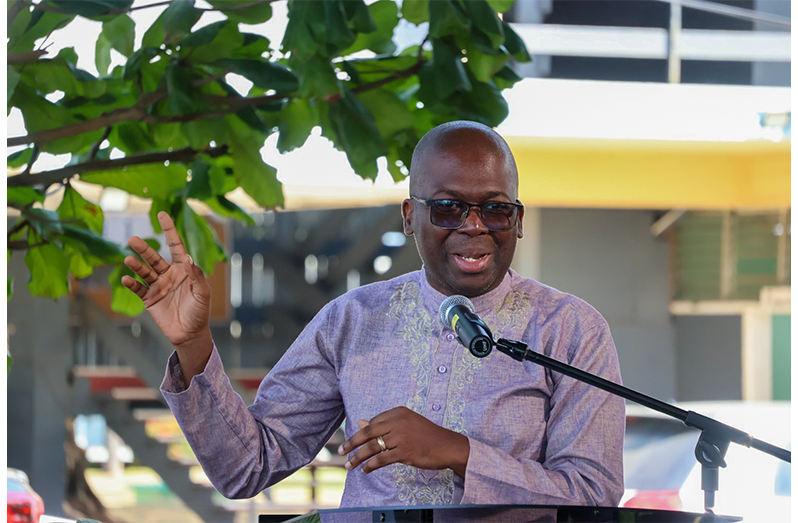
The figures were disclosed by BIT Chief Executive Officer, Richard Maughn, on Thursday, during the commissioning of solar-powered electric vehicle (EV) charging infrastructure at the University of Guyana’s Turkeyen Campus.
Addressing the gathering, Maughn said the country’s transition towards a green economy must be accompanied by sustained investments in technical and vocational education and training (TVET), to ensure that Guyanese possess the skills needed to participate in emerging industries.
He noted that while the commissioning represented an important investment in Guyana’s energy future, equal attention must be given to developing the people responsible for installing, operating and maintaining the new technologies.
“A transition cannot be considered truly just if we invest in modern technologies without simultaneously equipping our citizens with the competencies required to participate meaningfully in the emerging economy,” Maughn said.
The BIT’s chief executive explained that the agency’s green-skills interventions cover solar photovoltaic installation and repairs, agro-processing, sustainable farming and electric mobility.
Among the initiatives highlighted was a 2022 collaboration between BIT, the Guyana Energy Agency (GEA) and the Inter-American Development Bank (IDB), which facilitated solar photovoltaic installation and repair training for 78 women from Regions Seven and Nine.
In 2026, the agency continued expanding its training opportunities through photovoltaic installation programmes in Region Nine, agro-processing initiatives targeting women, and sustainable farming programmes involving persons with disabilities.
Maughn said these interventions reflect BIT’s commitment to ensuring that women, young people, persons with disabilities and hinterland communities benefit from the employment and entrepreneurial opportunities emerging from Guyana’s green transition.
He also highlighted the partnership involving the United Nations, through the Joint SDG Fund, the United Nations Development Programme (UNDP), the International Organization for Migration (IOM), and the GEA, which supported the development of specialised technical training in electric mobility and renewable energy.
Under the initiative, a Training-of-Trainers programme was implemented to build local expertise in electric vehicle maintenance and repairs, solar photovoltaic systems, and the installation and maintenance of EV charging infrastructure.
In June 2026, 22 trainers, comprising 17 men and five women drawn from six administrative regions, graduated from the programme.
The initiative also produced two training curricula to support the continued delivery of structured technical programmes in the emerging fields.
According to Maughn, the significance of the programme extends beyond the initial group of graduates, since the trainers are expected to transfer their knowledge and competencies to additional technicians across the country.
He described the Training-of-Trainers approach as an important mechanism for developing national expertise that can be expanded and sustained, particularly as Guyana increases its investments in renewable energy and electric mobility.
Maughn said BIT would continue strengthening the country’s technical training capacity, supporting industry-relevant occupational competencies and working with development partners to widen access to green-skills training.
He stressed that the long-term success of investments in modern energy infrastructure would depend on the availability of a suitably trained workforce.
“Our objective must therefore be not only to introduce green technologies into Guyana, but to ensure that Guyanese are equipped to install them, maintain them, improve them and train others to do likewise,” he said.
The commissioning forms part of broader efforts to advance Guyana’s transition towards cleaner energy and sustainable transportation, in keeping with the objectives of the Low Carbon Development Strategy 2030. Further, the initiative also highlights the importance of aligning infrastructural development with human-capital investment so that local workers can access the opportunities created by the country’s evolving energy sector.




