






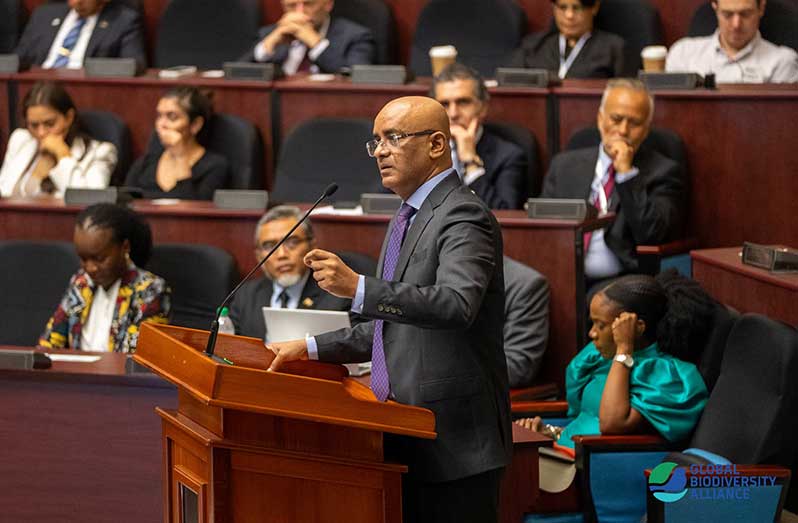
VICE-PRESIDENT Dr. Bharrat Jagdeo has called for technical working groups to give negotiators practical evidence and analysis on climate and biodiversity policy.
Addressing the 2nd Global Biodiversity Alliance Conference and Financing Forum held here in Georgetown on Friday last, Dr. Jagdeo pointed to Project Catalyst, a climate think tank established in 2008, as an example of how expert support can help negotiators address complex issues.
He said the project provided briefing notes to decisionmakers and helped advance discussion of forest carbon.
Jagdeo proposed applying a similar approach to biodiversity credits, with working groups examining how such schemes could be designed and what safeguards they would require.
He said proponents would need to address concerns including additionality, permanence, leakage, Indigenous rights and the accountable use of funds.
“We need now to give answers to those, like we did in that period when we were working out this instrument of a carbon credit for the forest,” he said.
That experience, he said, showed how technical support could help explain complex policy ideas to the people responsible for negotiating them. “We need to get back to quiet work,” he said, proposing that new working groups could continue the approach and develop analysis relevant to biodiversity credits.
A central task for such groups, he said, would be to establish what conditions a biodiversity-credit system would need in order to be credible.
Jagdeo compared the questions being raised about biodiversity credits with earlier debates over forest-carbon credits. He said those proposals faced objections and concerns about whether emissions reductions were genuinely additional, whether benefits would last, whether activity would simply shift elsewhere, and how Indigenous rights and funds would be protected.
The Vice-President linked that argument to the relationship between climate funding and biodiversity protection. Conserving tropical forests, he said, can deliver climate benefits while also protecting the distinctive ecosystems and species they contain. He urged participants not to treat climate and biodiversity objectives as separate when funding or designing conservation programmes.
He urged global leaders to rebuild the sense of urgency to help galvanise climate action.
He pointed to what he described as a lack of established financing for biodiversity; this is an issue Guyana is hoping to address with partners through the alliance.
He stressed that public funding was not available at the scale required, with a financing gap of about US$700 million, and that international discussions had yet to settle on a final definition of a biodiversity credit.
Recalling work by economists and climate researchers at the time, he said the cost of acting early had been estimated at about 1 per cent of global GDP, compared with five per cent if action was delayed.
He warned that current pledges, even if implemented, would leave the world facing warming of about 2.6°C above pre-industrial levels.
Guyana had Guyana first entered the forest carbon market in 2009, when it signed the Guyana–Norway forest-protection partnership under its first Low Carbon Development Strategy.
Later in 2022, the country became the first to issue and sell jurisdictional ART-TREES forest carbon credits, with Hess Corporation.




