





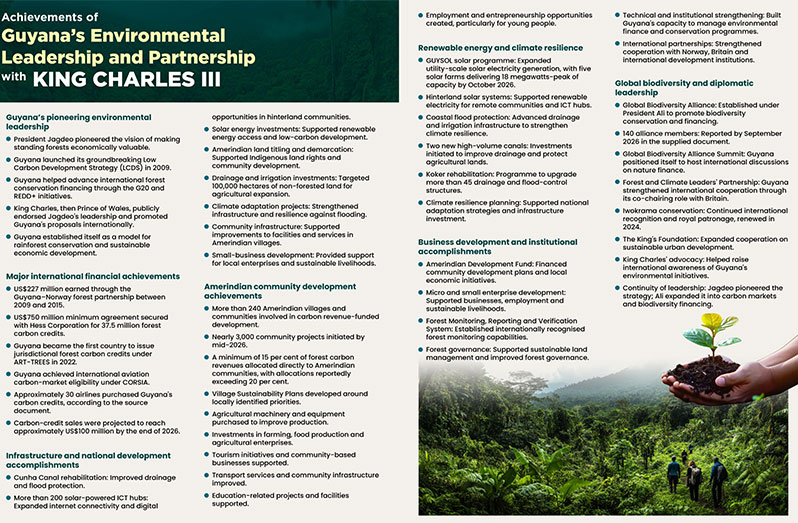
Guyana’s environmental partnership with King Charles III yields major gains
GUYANA’S environmental partnership with King Charles III has contributed to international conservation financing, renewable energy development and community-based initiatives, with investments and programmes spanning forest protection, climate resilience and Indigenous development.
Guyana’s Low Carbon Development Strategy (LCDS), launched in 2009, established a framework for balancing economic development with forest conservation, positioning the country to pursue international financing for protecting its forests.
The document credits King Charles, then Prince of Wales, with publicly endorsing then President Dr Bharrat Jagdeo’s leadership and promoting Guyana’s proposals internationally.
Among the major financial achievements, the most notable is the US$227 million earned through the Guyana-Norway forest partnership between 2009 and 2015. The document also cites an agreement with Hess Corporation worth a minimum of US$750 million for 37.5 million forest carbon credits.
In 2022, Guyana became the first country to issue jurisdictional forest carbon credits under the ART-TREES standard. Its carbon credits have also attracted international interest, including from the aviation sector through the Carbon Offsetting and Reduction Scheme for International Aviation (CORSIA).
Carbon-credit sales are projected to reach approximately US$100 million by the end of 2026.
RENEWABLE ENERGY AND CLIMATE RESILIENCE
Guyana’s renewable energy drive is another success story, particularly the expansion of solar electricity generation and efforts to improve access to energy in hinterland communities.
The GUYSOL solar programme has expanded utility-scale solar generation, with five solar farms delivering a combined peak capacity of 18 megawatts by October 2026.
More than 200 solar-powered information and communications technology (ICT) hubs have also expanded internet connectivity and digital opportunities in hinterland communities, while hinterland solar systems support electricity access in remote areas.
There have also been investments in drainage and irrigation, including the rehabilitation of the Cunha Canal, climate adaptation infrastructure and initiatives to protect agricultural lands from flooding.
Two new high-volume canals are also listed among investments intended to improve drainage and protect agricultural areas. Meanwhile, the Koker Rehabilitation Programme is expected to upgrade more than 45 drainage and flood-control structures.
These initiatives form part of broader efforts to strengthen climate resilience and support agricultural production amid changing weather patterns.
INDIGENOUS DEVELOPMENT AND COMMUNITY INVESTMENT
Indigenous communities are identified as major beneficiaries of initiatives linked to forest conservation financing and sustainable development.
More than 240 Amerindian villages and communities have been involved in carbon revenue-funded development, with nearly 3,000 community projects initiated by mid-2026.
The document also states that a minimum of 15 per cent of forest carbon revenues is allocated directly to Amerindian communities, with allocations reportedly exceeding 20 per cent in some cases.
The projects include village sustainability plans, agricultural machinery and equipment, investments in farming and food production, tourism initiatives, transport services and improvements to community infrastructure.
Education-related projects and facilities have also received support, alongside small-business development intended to expand employment and sustainable livelihoods.
These investments are aimed at strengthening local economies while supporting Indigenous land rights and community development.
BUSINESS DEVELOPMENT AND INSTITUTIONAL STRENGTHENING
The environmental partnership has also been linked to efforts to expand entrepreneurship and strengthen institutions responsible for managing conservation programmes.
The Amerindian Development Fund has financed community development plans and local economic initiatives, while micro and small enterprises have received support to improve employment opportunities and sustainable livelihoods.
Guyana has also strengthened its forest monitoring, reporting and verification capabilities through an internationally recognised system, supporting the country’s capacity to monitor forest resources and improve forest governance.
GLOBAL BIODIVERSITY AND DIPLOMATIC ENGAGEMENT
Guyana’s role in international biodiversity discussions is another key area.
The Global Biodiversity Alliance was established under President Dr Irfaan Ali to promote biodiversity conservation and financing. By September 2026, the alliance reportedly had 140 members, while Guyana was positioned to host international discussions on nature finance through the alliance’s summit.
Guyana has also strengthened international co-operation through its co-chairing role in the Forest and Climate Leaders’ Partnership, working alongside Britain to advance forest protection and climate action.
The Iwokrama conservation programme has continued to receive international recognition, with royal patronage renewed in 2024, while Guyana also co-operates with The King’s Foundation on sustainable urban development.
King Charles’ advocacy has helped raise international awareness of Guyana’s environmental initiatives, while the continuity of leadership under Dr Jagdeo and Dr Ali has supported the country’s continued engagement in carbon markets and biodiversity financing.
Together, the initiatives outlined in the document reflect Guyana’s efforts to link forest conservation with economic development, community investment and international co-operation, while positioning environmental protection as a central component of its long-term development strategy.





