






 -GUYSOL programme recognised in Panama after delivering five solar farms with 18MWp of renewable energy capacity
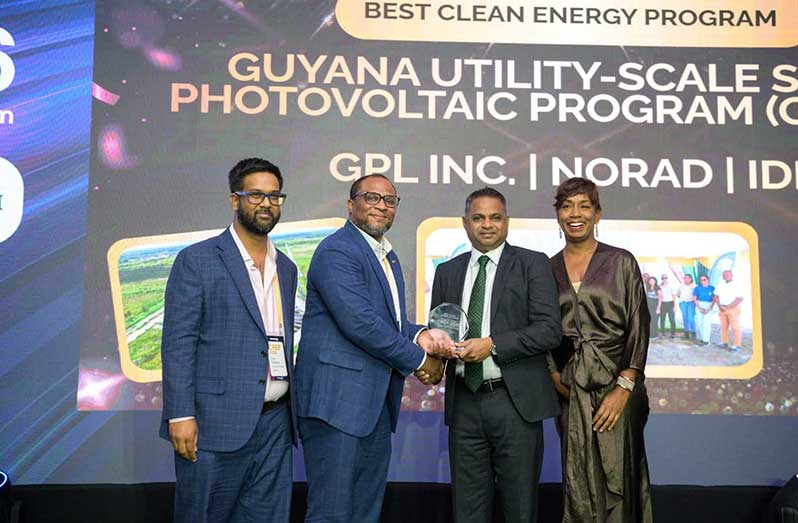
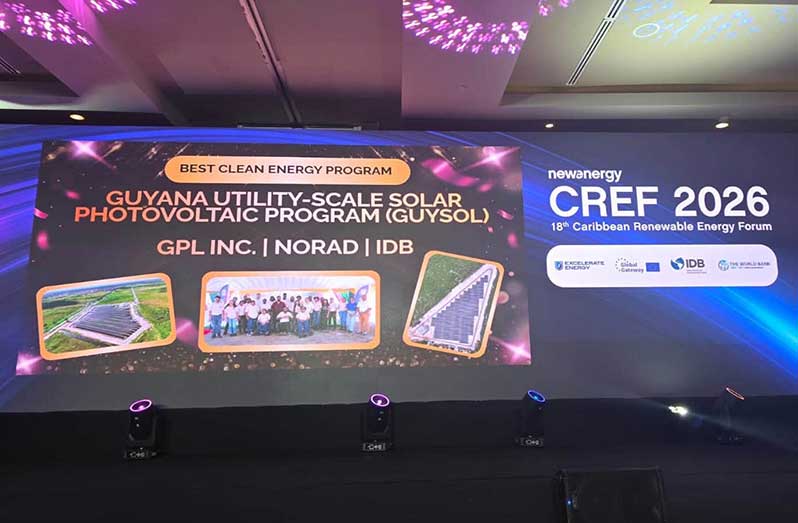
GUYANA’S drive to expand renewable energy has earned regional recognition, with the Guyana Utility Scale Solar Photovoltaic (GUYSOL) Programme winning the Best Clean Energy Programme Award at the 2026 Caribbean Renewable Energy Forum (CREF) Industry Awards in Panama.
The programme, which has already delivered five solar farms adding 18 megawatts-peak (MWp) of renewable energy capacity, is set to expand further with three additional solar facilities planned for Linden.
According to a press release from the Ministry of Public Utilities and Aviation, subject Minister Deodat Indar, and GUYSOL Programme Coordinator, Amir Dillawar, represented Guyana at the forum and received the award last week.
The achievement highlights Guyana’s ongoing efforts to diversify its energy mix and advance its clean-energy transition under the Low Carbon Development Strategy (LCDS) 2030, championed by President, Dr Irfaan Ali and Vice-president Dr Bharrat Jagdeo.
The GUYSOL Programme is executed by Guyana Power and Light Inc. (GPL) and is financed through Guyana’s forest-climate earnings under its partnership with the Government of Norway. The funding is channelled through the Guyana REDD+ Investment Fund (GRIF), administered by the Inter-American Development Bank (IDB), with support from the Norwegian Agency for Development Cooperation (Norad).
The programme builds on the Guyana–Norway climate partnership established in 2009, which helped lay the foundation for Guyana’s forest conservation and climate-financing initiatives.
The country has been pressing ahead with plans to slash electricity costs by 50 per cent nationwide through a phased programme of solar installations and other renewable energy projects.
Speaking at a recent press conference, President, Dr Irfaan Ali said the reduction was a key manifesto commitment and confirmed that some communities are already benefiting from lower tariffs.
He noted that areas such as Bartica and parts of Region One have seen initial cuts following the commissioning of solar farms and battery storage.
“One of the things that we have committed to in the manifesto is the reduction in the cost of electricity, and we are fully committed to the reduction of that cost, and that is to bring it down by 50 per cent for consumers across the country,” he had said, adding:-
“We have started, especially in areas where we had the solar installation and where we had the battery back-up system. In those areas, we have been able to already announce phased reduction in the cost of electricity. Both in Bartica when I was there on the cabinet outreach, and I think in Region One, we have addressed the issue of a phased reduction.
In Bartica, a 1.5-megawatt solar photovoltaic farm is now supplying power to the Region Seven community.
This was an investment of more than $703 million, has resulted in an output of 6,148 drums of diesel, with electricity costs now being reduced by 25 per cent.
Dr Ali said similar assessments are under way for other communities equipped with renewable systems, including solar projects in Region Two, Leguan and Wakenaam, as well as hydro‑powered Lethem.
“I’ve committed to, in other areas, for example, in Region Two, where we have the solar system, and in Laguan and Wakenam, where we have that solar system to look also at the phased reduction there,” the Head of State had told reporters.
“Lethem is also one community where we have the hydro… those analyses are being conducted so that though the initial phased reduction, the tariff can be looked at in those communities. So, we are committed to this, and the consumers will definitely benefit,” he told reporters, while assuring consumers they would “benefit tremendously” as the programme expands.
Guyana has rapidly expanded its energy infrastructure. Under its Low Carbon Development Strategy (LCDS) the country has taken a transformative approach to energy that seeks to reduce reliance on imported fossil fuels, by diversifying energy sources and ensuring affordable, reliable energy access for all Guyanese.
The aim is to integrate renewable resources such as solar, hydro, wind, biomass, and natural gas to meet growing energy demand, while keeping emissions low.
Further, the 300 MW Wales gas to energy (GTE) project, Guyana’s largest infrastructural initiative to date, aims to reduce electricity costs by 50 per cent and support domestic production of liquefied petroleum gas (LPG) for cleaner household cooking.
Beyond immediate energy benefits, the GtE project is expected to enhance industrial competitiveness and strengthen the country’s energy mix.




