






–President Ali says; calls for national conversation to build a more united Guyana
PRESIDENT Dr. Irfaan Ali, on Thursday, described national reconciliation and shared governance as unfinished business for Guyana, stating the late former People’s National Congress Reform (PNCR) leader Robert Corbin’s political journey challenged the country to reconsider how it could build a more united future.
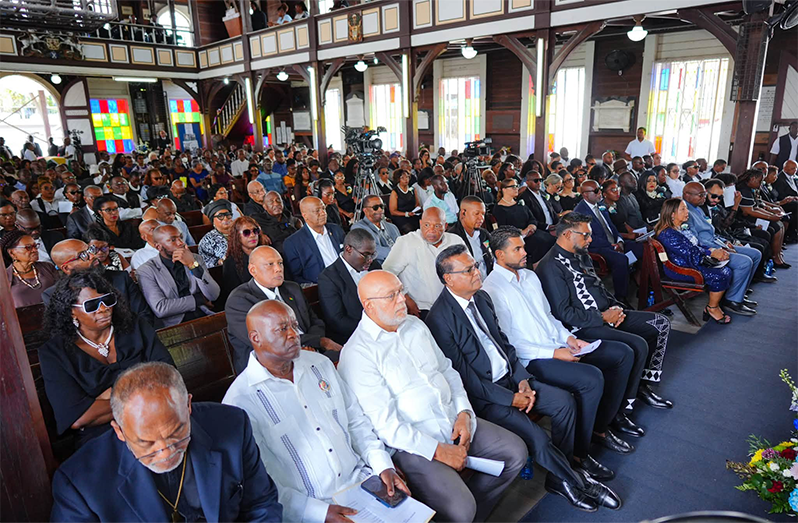
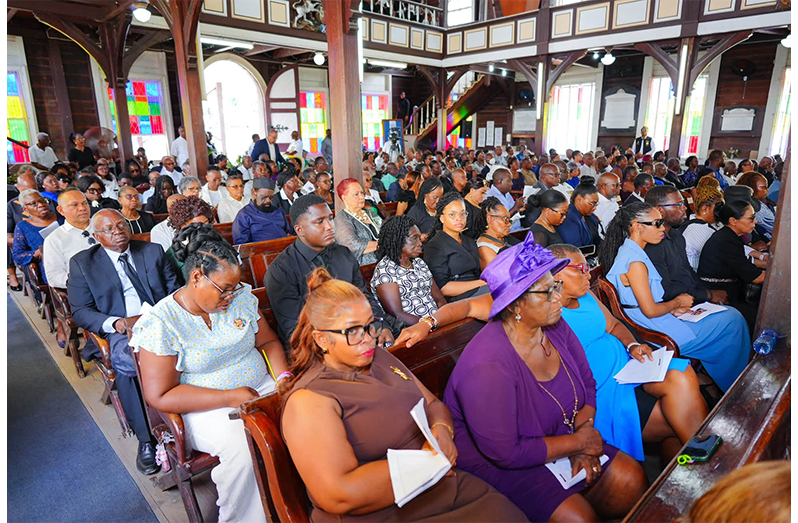
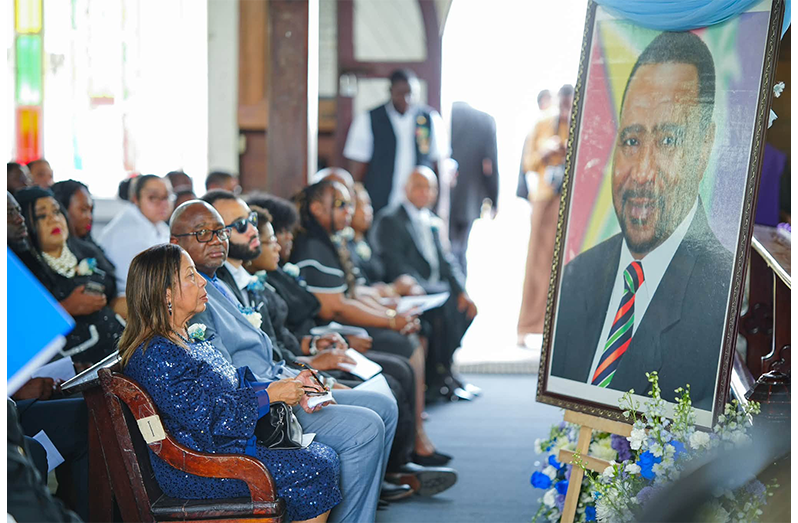
Speaking at Corbin’s funeral service at the St Andrew’s Kirk in Georgetown, Dr. Ali reflected on the veteran politician’s decades in public life, recalling him as a formidable parliamentary opponent who remained capable of extending friendship and respect across the political divide.
“The aspirations he championed remain unfinished business,” the President said, referring to Corbin’s advocacy for national reconciliation and co-operation among Guyanese of different racial, religious and cultural backgrounds.
He added, “And the challenge of translating them into a global national compact continues to confront us.”
President Ali said Corbin’s life and political journey should prompt Guyanese to examine not only the vision advanced by earlier generations but also what the country needed to do collectively to realise it.
“I believe we have arrived at a defining moment in our history. A moment when our collective effort can give shape to a national vision that finally fulfils the dream of 1950,” the President said.
“The time has come for a conversation about the course we must chart together so that we may build a nation in which we stand taller, stronger, and more united.”
The President acknowledged that the former opposition leader’s political record was not without shortcomings.
“We need not pretend that every position he took was correct, or that every political strategy he pursued achieved its intended results,” Dr. Ali said.
“For me, Corbin’s enduring significance lies in the combination of persistence and his own political convictions.”
He added that Parliament was strengthened when its members took their responsibilities seriously, while national unity demanded more than simply avoiding open conflict.
“National unity requires more than the absence of open conflict, and the tests of political leadership extend beyond the fortunes of a party.
A FORMIDABLE POLITICAL OPPONENT
The Guyanese leader recalled serving alongside Corbin in the National Assembly, where they occupied opposing sides of the political divide.
He described the former PNCR leader as a seasoned parliamentarian whose interventions were often well prepared, persistent and focused on forcing the House to address matters affecting the country.
He stated, “I remember Robert Corbin as a forceful debater. He came well prepared for his interventions in the National Assembly.”
The president recalled that Corbin was capable of presenting arguments persistently, challenging the government and insisting that important matters received parliamentary attention, regardless of whether his colleagues agreed with his position.
Among the issues associated with Corbin’s parliamentary interventions were the 2005 floods, the Lusignan massacre and the Clico crisis.
Dr. Ali said those matters differed in their circumstances and implications but reflected Corbin’s insistence that Parliament confront issues affecting the lives, security and livelihoods of Guyanese.
“He was a man with whom one could disagree profoundly and whose contribution one could nevertheless acknowledge,” the President said.
Beyond the parliamentary chamber, the president remembered Corbin as friendly and approachable, despite their political differences.
He recalled occasions when the former opposition leader reached out to greet him warmly, demonstrating that political rivalry did not necessarily have to develop into personal hostility.
“After, on the outside of the chamber, he was witty and friendly to those on the other side of the House. Holding no personal animosity, on many occasions, he reached out to shake my hands with warmth and a smile, as many of us who serve here can attest.”
The President also recalled the 2012 National Assembly sitting at which Corbin’s contribution to Parliament was formally recognised, describing the occasion as an important acknowledgement of a career spanning successive periods of Guyana’s political and economic development.
A CAREER SPANNING POLITICAL CHANGE
Corbin entered the National Assembly in 1973 and served in Parliament for more than three decades. He held several ministerial portfolios and served as Deputy Prime Minister from 1985 to 1992.
He later became leader of the PNCR and Leader of the Opposition, positions he held during a significant period in Guyana’s political development. He stepped down as party leader in 2012.
Corbin, who was also an attorney-at-law, rose through the ranks of the party’s Young Socialist Movement and the People’s National Congress before assuming senior leadership positions.
President Ali described him as a self-made politician whose rise was built through sustained party service rather than privilege or luck.
“He rose through the ranks of the Young Socialist Movement, the YSM, and the PNC by his work on behalf of the party,” the President said.
“Few could match his commitment to the party and its governments.”
Dr. Ali said Corbin’s lengthy experience in Parliament had given him an unusually broad perspective on Guyana’s evolution, from extensive state control of the economy through economic liberalisation and market-oriented reforms to the country’s democratic changes.
His years in public life, the President noted, made him one of the most experienced and politically astute parliamentarians of his generation.
President Ali placed particular emphasis on Corbin’s commitment to coalition politics and national reconciliation, recalling a Christmas message the former PNCR leader delivered on December 24, 2003.
In that message, Corbin had declared: “Ultimately, it is the people of Guyana who must determine their destiny.”
President Ali said Corbin had envisioned a Guyana where people of every race, religion and cultural background could overcome prejudice and conflict, working together in peace and
harmony for the country’s development.
The president acknowledged that Corbin had not always succeeded in translating those aspirations into political outcomes but maintained that his advocacy for reconciliation and shared governance remained an important part of his public life.
As he extended condolences to Corbin’s wife, Carol, their children, relatives, friends, political colleagues and the PNCR, the President said the former leader’s legacy should encourage continued efforts towards national harmony.
Corbin died on October 4, 2026, at the age of 78, following a period of illness.
In his closing remarks, President Ali said Corbin had devoted a substantial portion of his life to Parliament and the political organisation he served, while urging Guyanese to pursue the shared destiny to which the former leader had often given expression.
“May he rest in peace, and may Guyana continue to pursue the national harmony and shared destiny to which he so often gave expression,” the Guyanese leader said.
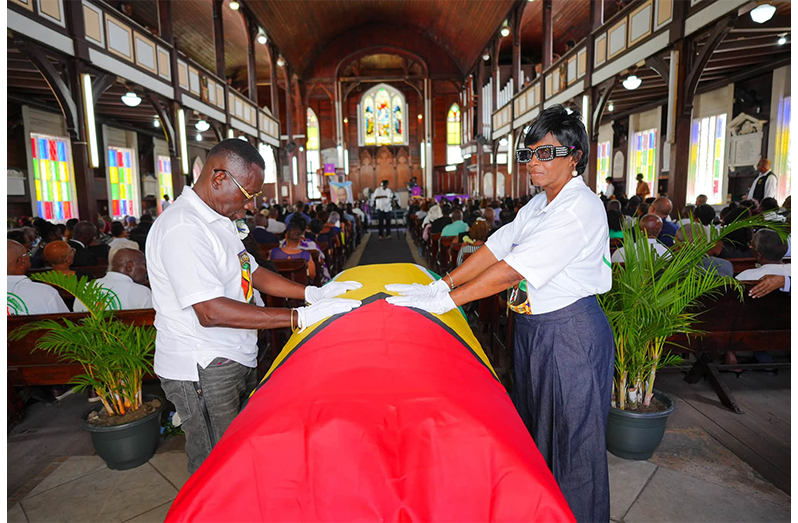
Corbin was cremated following the funeral service on Thursday.




