






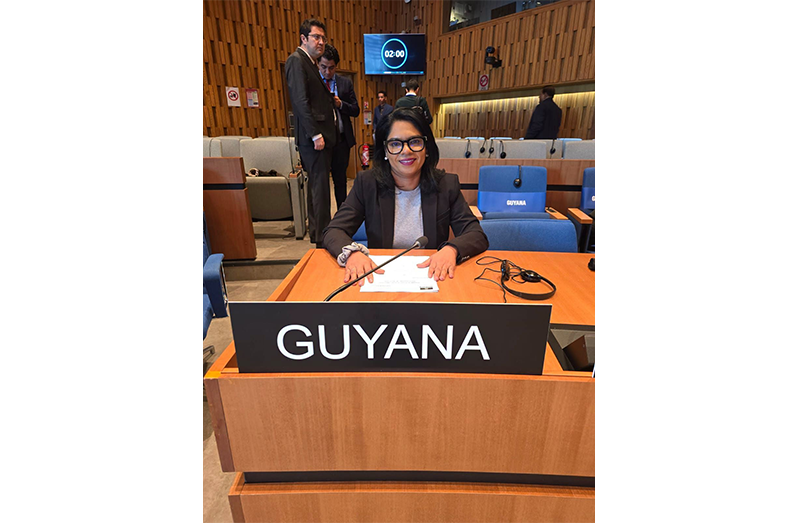
-Parag highlights teacher development, sustainable financing, inclusive digital transformation
MINISTER of Education, Sonia Parag, has called for greater equity in education delivery, sustainable financing, and stronger support for teachers as Guyana contributes to international discussions on advancing quality education for all by 2030 at the 225th Session of the UNESCO Executive Board in Paris, France.
The minister is representing Guyana at the session, which runs from October 5 to 20, 2026, at UNESCO Headquarters, where discussions are focused on advancing Sustainable Development Goal 4 (SDG 4), the United Nations’ global commitment to ensuring inclusive and equitable quality education and promoting lifelong learning opportunities for all.
As a newly elected member of UNESCO’s 58-member governing body, Guyana is participating in deliberations shaping the organisation’s future direction.
Addressing the plenary debates, Parag welcomed the Director-General’s report on UNESCO’s continued leadership in advancing SDG 4 and the Education 2030 agenda, while stressing the need for education systems to remain resilient and responsive to the needs of the most vulnerable learners.
“For Guyana, equity must remain central. Our collective progress must be measured by how effectively we reach learners facing the greatest barriers, including those in hinterland, riverine, and remote communities, Indigenous learners, and children with disabilities and special education needs,” the minister said.
She emphasised that international support for education must take account of the different geographical, cultural, and linguistic realities of countries, particularly where access to education can be affected by distance and the challenges of reaching underserved communities.
Minister Parag said efforts to improve educational outcomes must ensure that children facing the greatest barriers are not left behind, with progress assessed through improvements in access, participation, and learning.
The minister also highlighted the importance of investing in teachers through sustained professional development, adequate resources, and supportive working conditions, noting that these are essential to improving literacy, numeracy and overall learning outcomes. These measures, she noted, must be accompanied by sustainable financing that recognises the different costs associated with delivering quality education across communities.
“Funding arrangements should recognise the differing costs of delivering quality education across communities while maintaining national ownership and long-term sustainability,” Parag said. She also called for stronger education data systems, explaining that reliable and disaggregated information must guide decisions on participation, completion, learning outcomes and the allocation of resources. Such information, she noted, is important to identifying gaps and ensuring that support reaches the communities and learners who need it most.
Parag further addressed the opportunities and challenges associated with digital transformation, including the growing use of artificial intelligence (AI) in education. While acknowledging the potential of technology to support learning, she stressed that its introduction must be accompanied by adequate teacher preparation, accessible resources, and measures to address inequalities in connectivity.
Her remarks underscored the need to ensure that technological developments support inclusive education rather than deepen existing disparities among learners and communities. She also called for practical, country-level assistance from UNESCO to help countries implement their education priorities, supported by clear milestones and measurable improvements in access, equity, and learning.
Looking ahead to the development of the education agenda beyond 2030, Parag said teachers, young people and marginalised communities must have a meaningful voice in shaping the direction of global education policy.
She maintained that the next phase of the agenda should build on existing commitments while strengthening efforts to ensure that all learners can benefit from quality education. “This process should reinforce efforts to fulfil our existing commitments, and Guyana supports the proposed draft decision and encourages practical, country-level assistance, clear milestones, and measurable improvements in access, equity, and learning,” she said.
Guyana’s participation at the Executive Board session forms part of its engagement in discussions on UNESCO’s priorities and the future of international co-operation in education, with the country advocating for approaches that respond to the realities of learners and education systems across different communities.




