






— public charging stations to increase from nine to 24 by year’s end
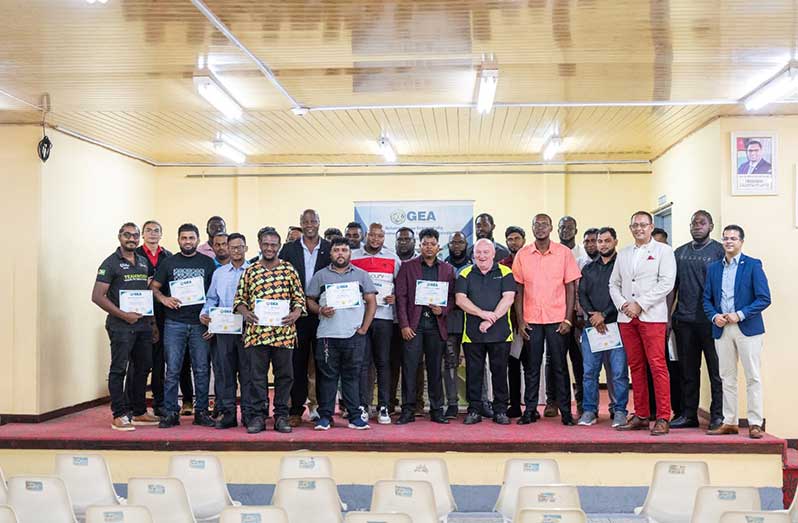
GUYANA now has 102 locally trained technicians capable of maintaining and repairing electric and hybrid vehicles, following the graduation of another 25 auto-electricians and mechanical technicians from the Guyana Energy Agency’s (GEA) specialised training programme.
The GEA, which falls under the Office of the Prime Minister (OPM), on Friday marked the completion of its fifth Electric Vehicle/Hybrid Maintenance and Repairs training programme.
The latest training was conducted from September 14 to 18 and September 21 to 24, 2026, at the Mahaicony Technical and Vocational Training Centre (MTVTC).
Permanent Secretary in the OPM Dr Alfred King, delivering the feature address, said the GEA had previously supported the training of 77 auto-electricians and mechanical technicians in the maintenance and repair of electric and hybrid vehicles.
With the addition of the latest 25 graduates, that figure has increased to 102, further strengthening the pool of local technicians capable of providing specialised services as Guyana’s electric mobility sector expands.
According to the GEA, the initiative supports the government’s broader thrust to expand opportunities in Technical and Vocational Education and Training (TVET), while equipping the local workforce with the skills required to respond to developments in electric mobility.
The programme also aligns with the Low Carbon Development Strategy (LCDS) 2030 and Guyana’s wider transition towards more sustainable energy and transportation systems.
GEA Chief Executive Officer Dr Mahender Sharma encouraged the graduates to maintain discipline as they move from the training environment into the workplace.
He urged them to remain diligent and committed while applying the knowledge and practical skills acquired during their electromobility training.
GEA Board Director Dr Vivian Lam said the new cohort represents another opportunity to support the adoption of electric and hybrid vehicles in Guyana.
He noted that the graduates now possess specialised skills in maintaining and repairing these vehicles and could become part of the country’s emerging e-mobility workforce.
Lam also pointed to increasing government investment and financing opportunities, including through institutions such as the Guyana Development Bank, and encouraged the graduates to consider entrepreneurship within the sector.
MORE CHARGING STATIONS
Meanwhile, King said the expansion of the skilled workforce is taking place alongside continued investment in the infrastructure needed to support electric vehicles.
Guyana currently has nine publicly accessible electric vehicle (EV) charging stations in Regions Three, Four, Five, Six and 10.
That network is expected to expand to 24 publicly accessible charging stations by the end of 2026.
The existing stations are located at Amazonia Mall, Providence; Giftland Mall, East Coast Demerara; S&R Parking Lot, Parika; Eugene F Correia International Airport, East Coast Demerara; the Cheddi Jagan International Airport, Timehri; Little Rock Suites, New Amsterdam; outside the GEA’s Head Office on Quamina Street, Georgetown; the Mahaicony Technical and Vocational Training Centre; and the Linden Electricity Company Inc.
The Mahaicony facility combines a 60-kilowatt EV charger with a 15-kilowatt grid-connected solar photovoltaic (PV) system incorporated into a solar carport.
The installation demonstrates how renewable energy can be integrated into transportation infrastructure, while expanding public charging facilities beyond Georgetown and the East Bank Demerara corridor.
EV CHARGING USE CLIMBS
King also pointed to increased use of Guyana’s EV charging infrastructure as an indication of growing demand.
Between January and July 2026, monthly charging sessions increased from 231 to 744.
Over the same period, the amount of electricity dispensed monthly rose from 4,186.48 kilowatt-hours (kWh) to 20,999.36 kWh.
By the end of July, 6,580 charging sessions had been recorded since the charging network was introduced, with 87,348.39 kWh of electricity dispensed.
There were also 1,540 registered accounts on the Flash Charge EV application.
“These numbers tell us something important: people are using the infrastructure and demand is increasing. They also tell us that the transition to electric mobility is not simply about purchasing vehicles,” King said.
“It requires a complete supporting ecosystem, dependable charging stations, renewable energy integration, electrical and safety standards, digital systems, trained technicians, informed consumers and institutions that can continue developing the necessary skills.”
The latest cohort underwent classroom-based and practical training covering the essential skills required to maintain and repair electric and hybrid vehicles.
Training included safely opening EV battery packs, identifying and diagnosing faulty battery cells and learning the correct procedures for repair and re-assembly.
Following successful completion of the programme, participants are to receive internationally recognised certification from the Institute of the Motor Industry (IMI) at Levels Three and Four.
The capacity-building programme forms part of efforts under the LCDS 2030 to develop the technical workforce required to support Guyana’s expanding electric mobility sector.



