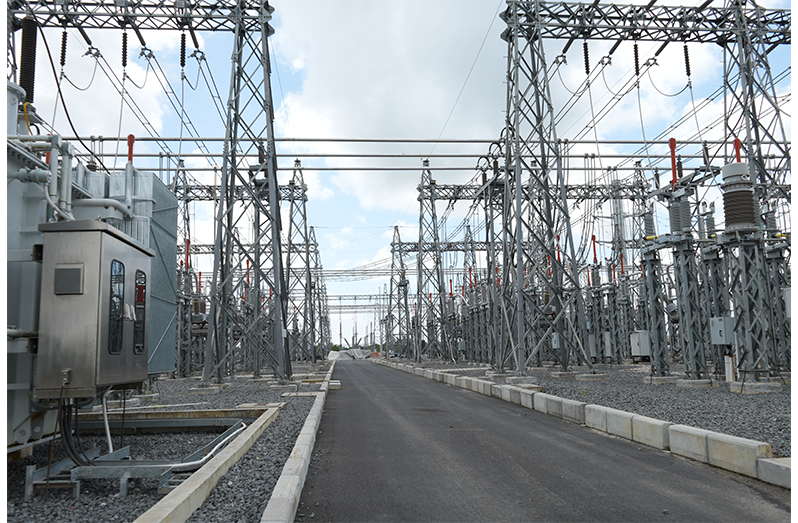
THE warning can be as brief as a flicker of the lights. Or sometimes no warning at all with the sudden silence of fans, refrigerators and air conditioners, as the power cuts out. Across Guyana, households have become accustomed to the all too familiar occurrence of ‘blackouts.’
But what is behind the interruptions and often gnawing frustrations is not simply a question of whether Guyana has enough electricity to generate, but it’s whether its ageing and heavily loaded distribution networks can safely deliver power where and when it is needed the most.
“The problem is the grid, the amount of power that goes through the transmission lines is starting to exceed the design capacity of those lines,” Minister of Public Utilities and Aviation, Deodat Indar said during a recent site visit to the country’s gas-to-energy project.
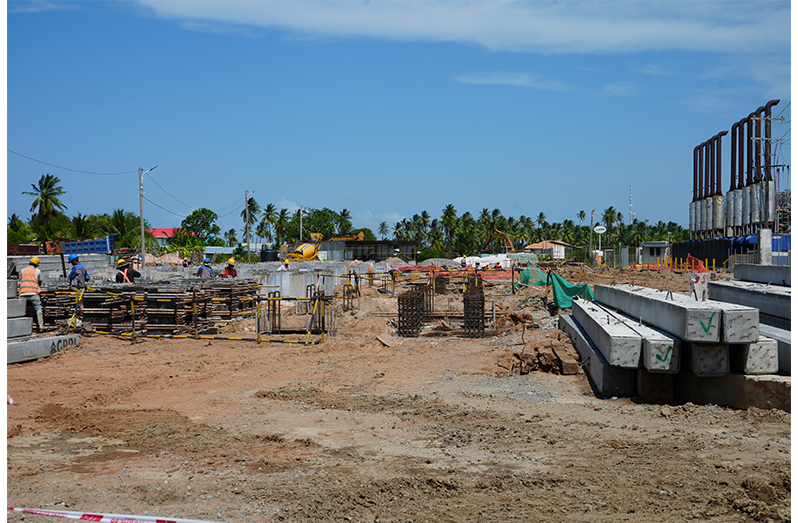
Minister Indar laid bare the pressures on the 13.8 kV distribution system, particularly along the densely populated coast. While Phase One of the gas-to-energy project is being built to deliver 300 megawatts of power to the national grid, the minister acknowledged that many of the existing lines and transformers are already running dangerously hot.
Minister Indar acknowledged that many of the existing lines and transformers are already running dangerously hot. In some communities, he explained, lines designed to carry about eight megawatts are now hauling 10.1 megawatts, as rapid housing expansion and commercial activity outpace long-planned infrastructural upgrades.
This sustained overloading has a clear technical consequence: thermal stress. When more power flows through a conductor than it is designed to carry, it heats up. Over time, that heat degrades insulators, weakens connections and places transformers under continuous strain. The result is not only reduced equipment lifespan, but a much higher likelihood of sudden failure.
Indar referenced recent incidents where four transformers caught fire in one area after being overloaded, and other cases where coastal feeders tripped out repeatedly, leaving customers in the dark for hours as crews worked to isolate the problem and restore supply.
WHAT HAPPENS BEFORE THE ‘CURRENT’ CUTS OFF?
Guyana Power and Light Inc (GPL) explained that blackouts are largely driven by an overloaded distribution network rather than a shortage of generation, with night-time peaks in residential demand placing feeders and transformers under severe strain. In some cases, GPL is forced to take feeders offline or shift loads between them, resulting in load shedding in certain communities. The situation is worsened by construction activity and heavy vehicles that damage or come too close to power lines, causing feeders to trip, as well as illegal connections and unsafe wiring that degrade voltage quality and trigger further disruptions.
While some generators are offline for planned maintenance, the company maintains that overall capacity is available; it is the stressed and vulnerable transmission and distribution system, combined with these external factors, that creates the conditions under which blackouts occur.
“We’re assessing each feeder, and we look and we’re monitoring the demand on the feeders, and we’re looking at feeders that are [in] close proximity within an existing field and see how we can transform some of the load onto the other feeder, so we can share the load. Of course, there is a limit to that,” GPL’s Deputy Chief Executive Officer with responsibility for strategic operations, Bharat Harjohn, said.
INTER ENERGY REPORT
Citing a new assessment by Inter Energy, Guyana’s President, Dr Irfaan Ali during a recent news conference said the GPL network is buckling under unprecedented demand growth and warned that the country cannot continue with an unreliable system.
Reading from the Inter Energy report, President Ali pointed out that peak demand on the Demerara–Berbice Interconnected System (DBIS) has climbed from approximately 205 megawatts in 2024 to 242.6 megawatts in August 2026 – an 18 per cent growth rate in a very short period, far outstripping the three to four per cent average growth for electricity systems elsewhere in Latin America and the Caribbean.
He underscored that, while demand has surged, the grid has not been upgraded fast enough or in a sufficiently “holistic” way, leaving the system without the flexibility to remove generating units for maintenance.
The report, which examines the performance and resilience of the national grid, projects that electricity demand will increase by approximately 138 per cent by 2029, meaning Guyana will need more than twice its current electricity supply within just five years.
It further notes that the DBIS is already under intense strain, with peak demand climbing from around 205 megawatts in 2024 to 242.6 megawatts in August 2026 – an 18 per cent growth rate that far exceeds the three–four per cent average for systems in the wider Latin America and Caribbean region.
Inter Energy’s analysis indicates that this rapid growth is being driven by new housing developments, expanding industries, hotel construction and wider economic activities, all of which are placing significant pressure on existing infrastructure.
The report highlights that GPL expects to add more than 62,000 new customers over the period, as thousands of new homes, businesses and industrial consumers connect to the grid each year.
“The leverage is not there to take any of the system out for maintenance. So, if anything goes wrong there, the entire system shuts down. And I’m being very open with the population on this matter. It is a critical issue,” the president said.
One of the key risks President Ali cited is the lack of operational “leverage” for maintenance in certain areas, such as Essequibo, where generation is already operating at or near maximum capacity.
To address these vulnerabilities, Inter Energy, the president says, calls for a “massive, holistic investment” in the power sector rather than ad hoc or piecemeal upgrades.
The report recommends the establishment of an independent grid-reliability task force to focus specifically on technical performance, outage patterns and resilience, drawing on international best practice from other rapidly growing economies.
“Those are the challenges. I acknowledge that it is unpleasant. Some of it unacceptable, but that is why the smart grid has to be predictable.”
BIG SPENDING
In response, the president disclosed that Finance Minister Dr Ashni Singh is working to secure additional funding for GPL to absorb tens of billions of dollars in increased fuel costs, preventing those higher expenses from being passed on to consumers.
“The Minister of Finance is working on finding more money for GPL just to meet the increases in the fuel costs—tens of billions of dollars—so that it’s not passed on to the consumer. This is what we do every single day to protect disposable income. This is the type of work we do every single day behind the scenes,” the president said.
Already, more than 360 kilometres of new high-voltage transmission lines are being built to strengthen the national grid and improve the movement of electricity across the Demerara-Berbice Interconnected System.
More than 10 new substations, four substations expanded, and two mobile substations. The introduction and expansion of 230 kV transmission infrastructure. The ongoing project introduced 155 kilometres of 230 kV double-circuit line. The expansion of the 69 kV transmission infrastructure, which, of course, includes the investment of a 2.5-kilometre river underground 69 kV connection between Greenfield and Kingston.
“What we can assure Guyanese people is that we are taking decisive action to make the system stronger and more reliable. It’s the largest investment in Guyana’s electricity infrastructure in its history, but it’s also the largest economic expansion in Guyana’s history and this region’s history,” the president said.