






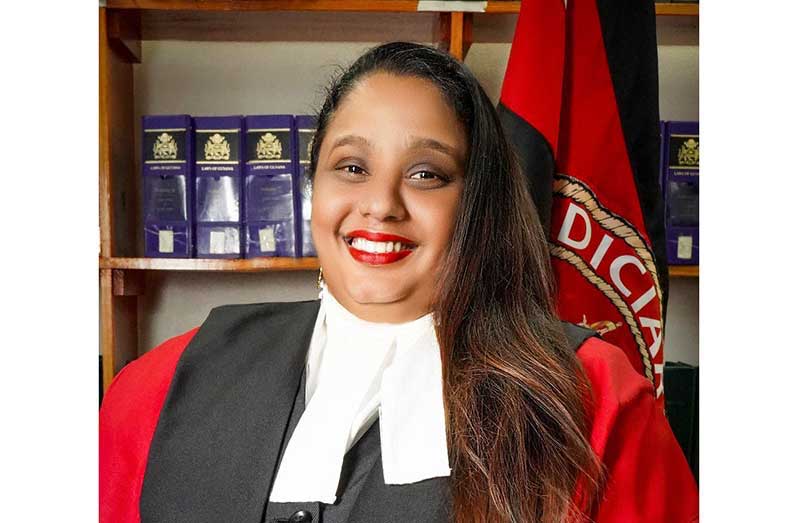
DIRECTOR of Public Prosecutions (DPP) Shalimar Ali-Hack’s bid to have Justice Priscilla Chandra-Hanif removed from the Haresh Singh murder proceedings involving three of the four accused men has been rejected.
The judge ruled that her earlier decision to sever the trials did not amount to prejudging the accused.
The three accused are Joel Gittens, called “Bolo”, of Jangotown, East Coast Demerara; Charles Scott, called “Bucko”, of Lot 29 Jarvis Street, Rosignol, Berbice; and Glaston Henry, also known as “Gladwin Henry” or “Soldierman”, of Number 3 Village, West Coast Berbice.

The three men are accused of murdering 17-year-old Singh, who was found bloodied in a rice field in the Number Two Village Backdam, West Coast Berbice, on September 9, 2020.
The case initially involved four accused, but the trial of one accused, was severed from that of Gittens, Scott and Henry.
Justice Chandra-Hanif, in a judgment delivered on Friday at the High Court in Demerara, said the prosecution’s concerns about her August 24 severance ruling did not establish apparent bias.
She stressed that the ultimate decision on the evidence and guilt remains with the jury.
“The trial judge is not the arbiter of fact and does not determine guilt,” Chandra-Hanif said.
She explained that while deciding whether the accused should be tried together, the court was required to examine the evidence and assess its potential prejudicial effect.
According to the judge, that assessment was provisional and did not mean that she had reached conclusions about the truthfulness of witnesses, the reliability of identification evidence or the guilt of any of the accused.
She ruled, “The Court therefore rejects the contention that the reasoning employed in determining the severance applications amounted to a prejudgement of the guilt or innocence of any accused.”
The recusal application was filed by the State, represented by State Counsel Praneta Seeraj and State Counsel Christopher Belfield, after the judge ruled that the trial of one of the accused should be separated from the trial of Joel Gittens, Charles Scott and Glaston Henry.
The prosecution argued that aspects of the severance ruling created a reasonable perception that matters which should properly be determined at trial had already been decided.

Among the issues raised was the judge’s description of certain evidence as being “capable of altering the jury’s assessment” and an evidential contrast as “stark.”
The prosecution also raised concerns about the judge’s treatment of a caution statement allegedly made by the other accused, the handling of case management deadlines and comments concerning the constitutional role of the DPP.
But Chandra-Hanif said the words relied upon by the State had to be considered within the context in which they were used.
“The words ‘capable of altering the jury’s assessment’ and the description of an evidential contrast as ‘stark’ must therefore be read in context,” she said.
She explained that the observations concerned “the potential prejudicial effect of materials in a joint trial” and whether safeguards could adequately protect the accused.
The judge said, “They did not purport to find that the statement was true, that the alibi witnesses were false, that identification evidence was reliable, or that any accused was guilty.”
Chandra-Hanif also rejected the suggestion that her involvement in earlier decisions meant she could no longer approach the trial with an open mind.
“If the giving of reasons on a severance application were itself sufficient to disqualify the judge from the trial, ordinary criminal case management would become unworkable,” she said.
The judge noted that a recusal application is not an appeal against a ruling with which a party disagrees.
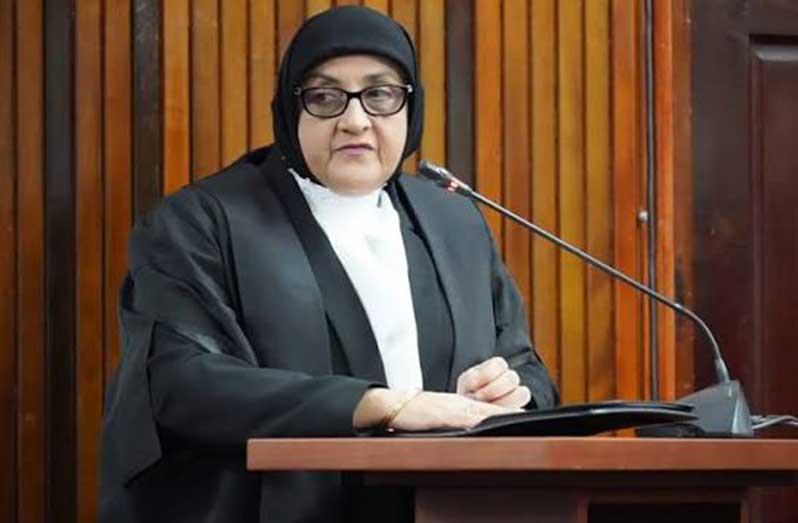
She said the legal question was whether a fair-minded and informed observer, having considered the circumstances realistically and practically, would conclude that there was a real possibility the judge would not decide the matter fairly.
The State, she noted, did not allege that she had acted in bad faith or out of personal animus. Its case was based on apparent bias and alleged prejudgement.
Chandra-Hanif also addressed the arguments surrounding the DPP’s constitutional authority and the court’s responsibility to manage criminal proceedings.
She said the recusal application did not determine those broader legal questions.
“Nothing in this ruling diminishes the constitutional independence of the Director of Public Prosecutions or the Court’s corresponding duty to ensure a fair trial and to manage proceedings according to law,” she said.
“Any disagreement as to their precise legal boundary must be resolved by legal principle and, where appropriate, appellate process, not by converting the disagreement itself into an inference of bias.” The judge ultimately dismissed the State’s application.
“The State’s application for recusal is therefore refused,” she ruled.
Justice Chandra-Hanif’s latest ruling means the recusal request has failed and the proceedings remain before her.
Gittens and Henry were represented by attorneys Nigel Hughes and Kiswana Jefford. Scott was represented by attorneys Dexter Todd, Dexter Smartt, Eden Corbin and Keona Higgins.




