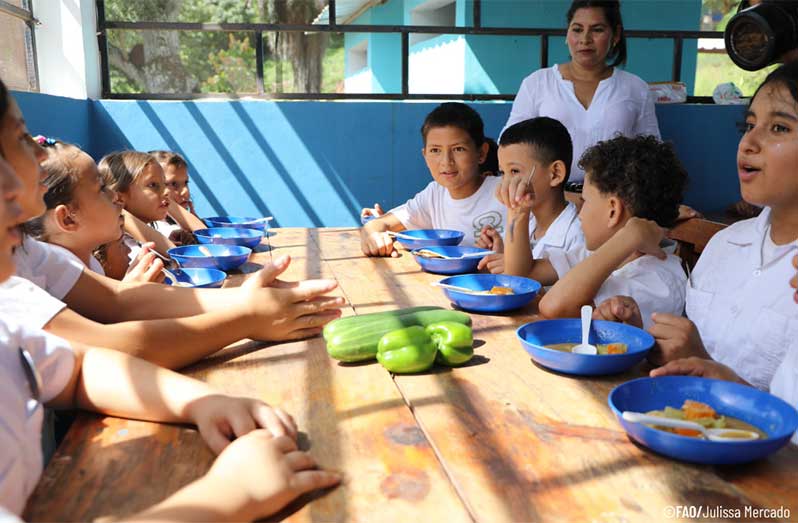
A TECHNICAL team visited school facilities and production centers in Comayagua and Santa Bárbara, Honduras, to advance the incorporation of local fish and aquaculture products into the country’s school menus.
In Latin America and the Caribbean, nearly 80 million children receive meals at school every day.
With the aim of making these meals more nutritious, locally sourced, and sustainable, the Food and Agriculture Organization of the United Nations (FAO) conducted the first technical field mission for the regional project “Incorporating aquatic foods from local fishers and aquaculture producers into school feeding programs in Latin America and the Caribbean,” which launched this year.
The mission, carried out from August 26 to 28, 2026, brought together FAO technical staff with fishers, aquaculture producers, school officials, and local communities in Comayagua and Santa Bárbara, Honduras, marking the operational start of the project in one of the three countries where it is being implemented: Belize, Bolivia, and Honduras.
The project seeks to strengthen the integration of aquatic foods-fish and aquaculture products-into school feeding programs (SFPs) through two main avenues: local public procurement mechanisms connecting fishers and aquaculture producers with schools, and food and nutrition education initiatives within communities.
“Fish has valuable properties; it greatly aids development and cognitive function. In Honduras, we have significant production volumes, and we can complement the dietary plate with this product,” stated Nasry Asfura, President of Honduras.
School feeding programmes have established themselves as key initiatives for social protection and human development in the region.
Available evidence shows that these programmes improve school attendance and retention while contributing to student nutrition and health, making it essential to incorporate aquatic products rich in high-quality protein, omega-three fatty acids, and vitamins.
“Experiences gathered thus far in the region confirm that when fish is properly incorporated, student acceptance exceeds 80 per cent. Furthermore, it contributes to local sustainable development by generating stable income for agri-food producers through public procurement,” said Daniela Godoy, FAO’s Senior Policy Officer for Food Security and Nutrition for Latin America and the Caribbean.
This project is supported by FAO’s Flexible Voluntary Contribution (FVC) mechanism and by the governments of Flanders, Norway, Qatar (Qatar Fund for Development), the Principality of Monaco, and Sweden.