






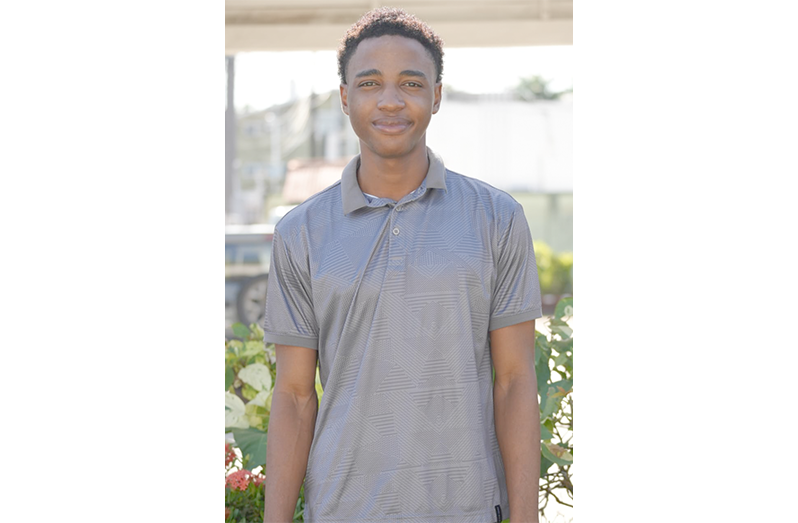
-achievements include CSEC and CAPE ‘passes,’ business diploma, national literary prize in the same year
By Andrea Hendricks
WHILE many students map their lives in neat, familiar steps, CSEC in fifth form and CAPE in sixth, Juvell Atherley has been quietly rewriting the order to suit his goals and what he wants his life to look like.
Queen’s College scholar, who is just 17, recently sat CSEC and CAPE examinations in the same year, earning 15 Grade Ones and one Grade Two at CSEC, while simultaneously completing three CAPE Level 1 subjects. On top of that, he is two months away from achieving a Diploma in Business Management through the GOAL scholarship programme.

It is, he insists, less about chasing a trophy shelf and more about choosing his own lane. “I am a dreamer, someone who takes an unconventional path from my peers,” Atherley said.
From Parfaite Harmonie on the West Bank of Demerara in Region Three, Atherley grew up as an only child with a strong support system around him. He credits the “grace of God” and a steady community—his parents, an uncle, wider family, and teachers—for helping him push past self-doubt into discipline. And in a Guyana pressing for more homegrown excellence in classrooms, business and culture, his story lands as a national reminder that talent is not confined to Georgetown, and when village support and opportunity meet, young people from places such as Region Three can set a pace that turns heads across the country.
The decision to write CAPE alongside CSEC was not a spur-of-the-moment gamble. Atherley said he approached teachers early, telling them he wanted to include their subjects in his exam preparation. Their encouragement, he recalled, helped him take on the extra load with confidence.
He points back to an earlier turning point: in fourth form: he wrote three CSEC subjects even while uncertain of himself and still excelled. The experience reshaped his mindset; if he could perform in a “season of doubt,” he reasoned, he could do it again when the stakes were higher.
Even so, he said the best part of school is not the scoreboard at the end. “The best part of school is the learning,” Atherley said, describing the value of hearing different perspectives, building relationships with peers and teachers, and learning how to manage his own personality. “You have to be teachable in life,” he added.
That outlook also explains why he describes his growth “in a vertical sense.” He said he did not want “quantity, but quality”—depth that comes with added challenge. For him, adding CAPE was not simply more subjects; it was a test of focus, maturity, and method.
Atherley’s drive is not limited to the classroom. In August 2026, he earned first place for Best Story in the Youth Category of the Guyana Prize for Literature for his short story, “Saltwater Does Not Forget”—a milestone that marked him nationally as an emerging talent in Guyanese writing.
He is the first to admit that literature was not always his comfort zone. “I wasn’t always a fan of reading and writing; it was one of the most powerful things I could have given to the world,” he said.
Writing, he explained, has become both a mirror and a bridge: a way for people to “see his personality,” interpret his thoughts, and find their own meaning in what he puts on the page. Inspiration comes from daily observation—social injustice, quiet internal conflicts and the small moments that reveal larger truths. He often keeps a notepad and pens close by, ready to capture lines and ideas as they appear.
He believes Guyana’s stories are not scarce; they are everywhere. There is, he said, “a fountain of writing material just from daily living” and the experiences of local people—evidence, in his view, that Guyanese literature still has room to grow and be celebrated.
At the award ceremony, Atherley said he felt content receiving the prize, even as he acknowledged a private tension many high achievers know well: there are moments when he feels inadequate in himself. The recognition, then, was not only public applause; it was reassurance that he was on the right track.
HUMBLE, FOCUSED AND MULTI-TALENTED
His creativity also shows up in other work. After writing an electronic subject a year earlier, he said he used what he learned and turned it into a practical craft in digital media, working as a graphic designer.
On any given week, Atherley is balancing academics with music, creative projects, faith, and family time. To stay organised, he relies on Google Calendar and a daily log—tools that, he said, keep him honest about what he planned versus what actually happened.
The system has also taught him humility. Tracking his days showed him he “has failed more than win,” because plans sometimes fall apart. But he does not treat that as defeat, he adjusts, continues logging, and uses the record to manage his time and refine his routines.
Music is another anchor. Atherley is a percussionist and leads his own band, 592Fusion, a steelpan orchestra with big ambitions and a community focus. Beyond performance, he wants the group to open doors for other young people interested in the music industry, creating space to learn, practise and grow.
The band’s sound, he said, is intended to stretch across genres—calypso, jazz, reggae, gospel, Soca, and Latin. “I want to take 592Fusion from being a band to a movement, where others can learn music and have the space to do so,” he told this publication.
His leadership extends beyond music. Atherley enjoys volunteering and giving back, and he has participated in the 12 months 2025 Young Influencer Programme, representing it in national forums and supporting campaigns such as youth dialogues hosted alongside the Rights of the Child Commission.
Those who meet him today might assume he has always been a “brainbox,” but his childhood was more ordinary—and, at times, medically complicated. He lived with a respiratory health condition monitored until the age of nine. Still, he remembers playing outside with friends and being encouraged by parents whom, he said, supported what he wanted to pursue through primary and secondary schools.
Looking ahead, Atherley plans to complete sixth form and continue to tertiary education to pursue a bachelor’s degree in Law. He also wants vocational skills training as part of his wider development goals.
For now, he is not pretending to have every step scripted. As he puts it, he does not have his life mapped out—only a commitment to do his best, give back to the underprivileged and follow where God leads.
Wherever his purpose takes him, that is where he is prepared to go, confident that “it will be better in the end from where it all started,” he told this publication.




