






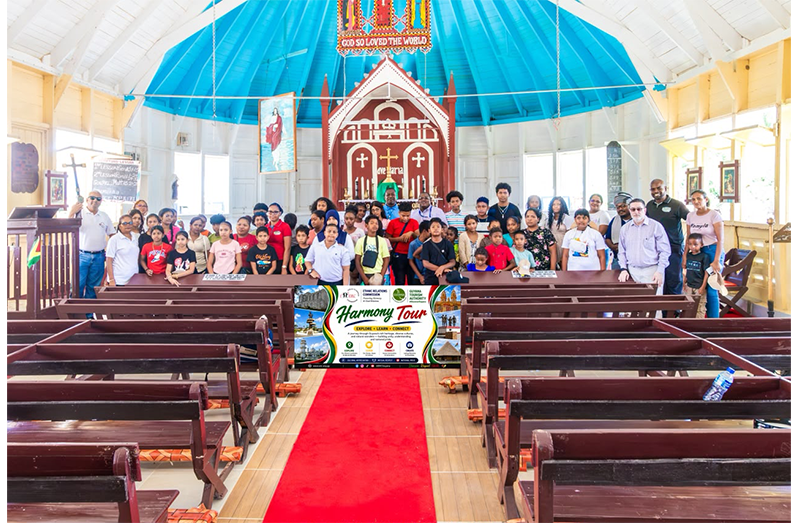
THE Ethnic Relations Commission (ERC) on August 19, 2026, concluded the Essequibo leg of its Harmony Tour, taking 51 participants, including 43 children accompanied by eight parents and guardians, to several sites of faith, heritage and national memory along the Essequibo Coast in Region Two, Pomeroon-Supenaam.
The commission was represented by its Chairman, Shaikh Moeenul Hack, together with Commissioners Reverend Rodwell Porter, Pandit Krishn Sharma, Mrs Chandrowtie Sarran and Mr Deon Dick (Ras Khafra), who joined participants throughout the day’s engagements.
The religious component formed the heart of the tour. The group tour began at Badrinaath Ashram at Spring Garden, where participants stood beneath the 50-foot murti of the Hindu God Shiva, which is recognised as the largest Shiva murti in South America. The group then travelled along the coast to the St. Bartholomew’s Anglican Church, located in the historic Queenstown village, which was purchased by emancipated Africans in 1841, before proceeding to the Anna Regina Mosque which was completed in the 1930s and currently houses the Al Madina Islamic Academy in the same compound.
At each place of worship, participants were welcomed by representatives of the respective faith communities and learned firsthand about their beliefs, practices, and customs. Before entering each site, the children were briefed on the appropriate courtesies and conduct. For several participants, it was their first experience entering a place of worship belonging to a faith other than their own.
Addressing the participants at the start of the tour, ERC Chairman Shaikh Moeenul Hack emphasised that meaningful harmony required more than simply living alongside people of different backgrounds.
“Harmony does not begin when we agree on everything; it begins when we take the time to understand one another. Today, these young people did something powerful: they crossed the boundaries of familiarity, entered places that may not have been their own, listened to people of different faiths and learned to appreciate traditions beyond their own. That is how respect is built, and that is how a more cohesive Guyana is shaped,” he posited.
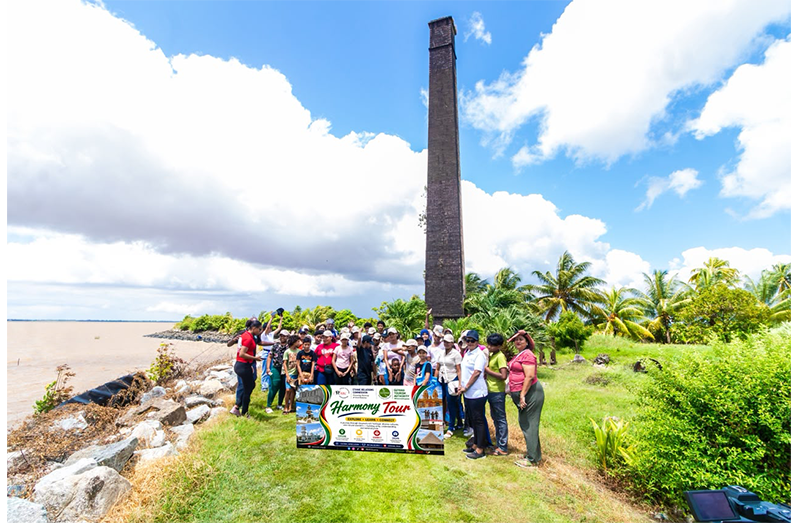
The tour also explored significant chapters in Essequibo’s history and heritage at sites such as the Aurora Chimney in Zeelandia and the Damon Monument in Anna Regina. At Mainstay/Whyaka, participants were welcomed into a titled Arawak village where they learned about the community’s Indigenous heritage and were provided with a demonstration on the production of cassareep and cassava bread, among other product varieties that were being produced and sold by the community.
Parents, guardians and children expressed appreciation for the initiative, with the guardians describing the tour as an opportunity they had not previously been able to provide for their children.
The ERC extends sincere appreciation to the Regional Democratic Council of Region Two for providing transportation and to the Guyana Police Force for its support in ensuring the safe movement of participants during the tour.
The commission also expresses gratitude to the religious leaders, tour guides and institutions that welcomed the group and generously shared their time, knowledge and traditions, with special appreciation extended to the Toshao Ms Marsha Williams and people of Mainstay/Whyaka for their warm welcome.
The Harmony Tour will conclude this week with its Berbice leg on Friday, August 21, 2026. (ERC)




