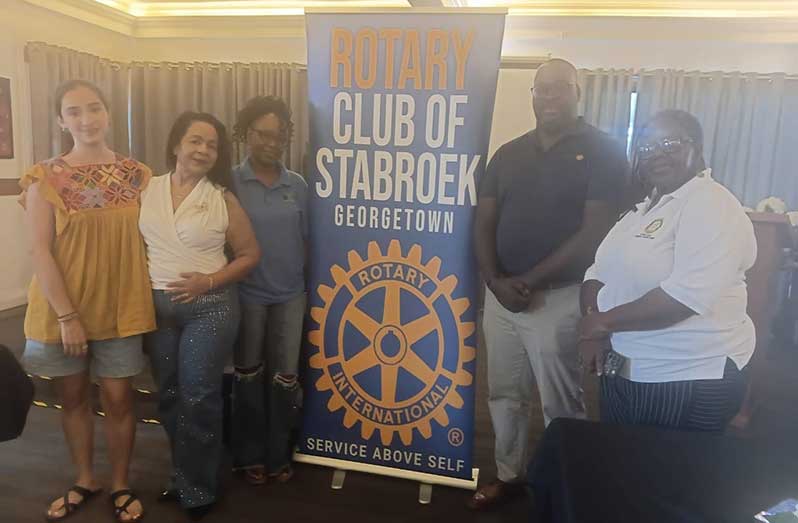
– two-day workshop helps women build path to self-reliance
FOR women rebuilding their lives, empowerment can begin with something as simple as believing that a different future is possible. This was among the messages emerging from a two-day workshop held last Saturday at the Grand Coastal Inn on the East Coast, where women transitioning from difficult circumstances were given space to reflect on their lives, explore economic opportunities and begin thinking about the future they want to create for themselves and their families.
The workshop, led by Rotarian Carlotta Boodie of the Rotary Club Stabroek focused on self-reliance and empowerment, with participants drawn mainly from the Ministry of Human Services and Social Security Help and Shelter unit.
For these women, the discussions were about more than finding employment. They centred on moving from difficult lifestyles toward greater independence, stability and personal well-being.
Rotarian Boodie said the programme recognises that some women, particularly those caring for children, are unable to leave home to take up conventional employment. The question, therefore, becomes how women can create economic opportunities within the realities of their lives.
“We need to see how they can create some microbusinesses or small businesses. We are not expecting to see huge ventures,” Boodie said. “But once either having the idea generation, having that in mind, and understanding the processes, or even taking the second step of actually making a start in terms of registering a business and so on.”
For some participants, the goal over the next six months may simply be to say, “This year I want to start,” and then take that first step. The programme is therefore measuring empowerment through small growth rather than dramatic overnight transformation.
The women will eventually be contacted again to see what progress they have made.
But before economic independence can take root, Rotarian Boodie believes women must also learn to invest in themselves.
“One of the first things is just self-awareness and well-being,” she said. “Understanding that checking in with yourself, taking care with yourself, your mental health, etc is a big piece.”
The two-day programme reflected that broader understanding of empowerment, and closed with a session on Sunday which was focused on nutrition and self-care, reinforcing the message that rebuilding one’s life also involves taking care of the body and mind.
The discussions also included sexual and reproductive health, with participants encouraged to understand their bodies, make informed decisions and recognise the relationship between reproductive health, family life and overall well-being.
“We need to understand our bodies,” the Rotarian said. “We need to talk about family, we need to talk about safe sex, because those things have a huge impact on our well-being.”
Economic empowerment was also connected to legal and social protection. Participants discussed the importance of understanding the process of registering a business and the significance of contributing to the National Insurance Scheme (NIS).
For women working from home or operating small businesses, she noted that NIS can become particularly important during periods when circumstances such as illness or childbirth affect their ability to work.
The activity message was clear in that self-reliance requires knowledge as much as income. It means that knowing how to earn, how to save, how to register a business, how to access social protection and how to care for one’s health can give a woman greater control over the direction of her life. But the workshop did not frame women’s empowerment as a battle between women and men. Instead, Rotarian Boodie placed equity and equality at the centre of the discussion.
“Well, it’s not for me putting women in the forefront, but it’s balanced. Empowerment is not about one gender becoming more important than the other. It’s equity first and then equality,” she said.
She believes men and women are both valuable to the family and that each has a role to play.
“It’s just the understanding and looking that we are both sexes and we are people who are both valuable to the family. We all have a role.”
Empowerment does not mean asking women to carry every responsibility alone. It means ensuring that women have the knowledge, opportunity and confidence to participate fully in decisions affecting their lives, while also recognising that healthy families require co-operation between both men and women.
Rotarian Boodie acknowledged that some traditional cultural and societal roles may no longer work for every family.
Her vision is therefore one of collaboration. The objective, she added, is to understand how men and women “collaborate and co-operate with each other so we can have a healthy society.”
That message gives the workshop a significance beyond the two days. It is about rebuilding confidence, developing economic independence and strengthening women’s ability to make choices, while also encouraging a family structure in which both genders are recognised as valuable contributors.
The work will continue on August 30, when participants are expected to take part in another session focused on practical financial management. The upcoming workshop will explore budgeting, the power of saving and how to balance income and expenditure, with participants encouraged to apply what they learn over a period of time. The approach is intentionally practical. Rather than simply discussing financial independence, participants will be encouraged to examine where they are financially, where they want to go and what steps they can take to get there. For some, that may mean saving more consistently. For another, it may mean developing a business idea. For another, it may mean taking the first step toward registering a micro-business. The programme’s success will ultimately be measured in those small changes.
Six months from now, the organisers hope to reconnect with the women and see what has changed. The expectation is not that every participant will emerge as a major entrepreneur. It is that each woman will have moved one step forward.
The workshop forms part of Rotary’s broader tradition of service to communities. Rotary International describes its network as people working together to create lasting change in communities and around the world, with areas of focus including maternal and child health, education, economic and community development and other humanitarian priorities. Its work on diversity, equity and inclusion also reflects the principle that people should have meaningful access to the resources, opportunities and support needed to thrive.