–says cost comparisons ignore scale of works
THE Ministry of Housing has pushed back against an attempt by Opposition Leader Azruddin Mohamed to brand the proposed Versailles to Parika Four-Lane Highway as “highway robbery,” arguing that comparisons drawing on the project’s roughly G$121 billion estimated cost against the G$13.3 billion Eccles to Great Diamond Highway in Region Four rest on an “overly simplistic” reading of the two projects’ headline figures.
In a detailed rebuttal, the ministry said the criticism fails to account for fundamental differences in scale, engineering requirements and scope between the two road developments, and that comparing the projects on cost alone, without factoring in what each price tag actually covers, gives the public a misleading picture.
The ministry noted that the two figures being compared are not even measuring the same thing: the G$13.3 billion for the Region Four highway reflects the final contract value of a completed project, while the Region Three figure is a pre-award estimate.
Construction costs have also risen in the years between the two projects, the ministry said, arguing that a 2022 contract value cannot be fairly measured against a 2026 estimate without accounting for changes in the price of labour, fuel, sand, cement, steel and other inputs.
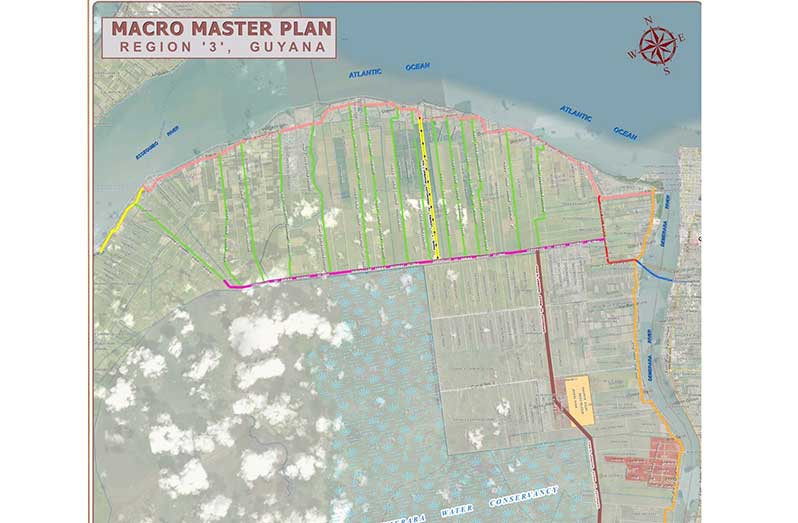
According to the ministry, the Versailles to Parika project spans approximately 20.74 km of four-lane highway, compared with 8.6 km for the completed Region Four road, making the Region Three project roughly 2.4 times longer. But the ministry argued that length tells only part of the story.
Officials pointed to the width of the highway’s preparation base, which is the area requiring ground preparation and sand-filling before paving begins, which they said measures roughly 53.15 metres for the Region Three project, more than double the 25.99 metres used in Region Four.
The ministry said the total preparation footprint for the Versailles to Parika highway is nearly five times larger than that of the Eccles to Great Diamond project, with significant knock-on implications for sand-filling, earthworks and compaction requirements.
The ministry also cited a substantially larger scope of ancillary infrastructure attached to the Region Three project, including:
• Access roads: approximately 68.02 km of access-road construction and upgrades, compared to 0.8 km under the Region Four project — a difference the Ministry described as roughly 85 times greater.
• Bridges: 62 prestressed concrete bridges for Region Three versus 40 for Region Four, with the Ministry noting the Region Three bridges amount to about 2.7 times the total structural length, including 18 bridges of 120 feet compared to two under the earlier project.
• Culverts: although Region Four had more individual culverts (26 versus 16), the Ministry said the Region Three culverts represent a slightly greater total linear length.
• Revetment works: approximately 3.82 km of revetment construction for erosion protection and embankment stabilisation, which the ministry said has no equivalent in the Region Four scope.
• Ground improvement: more than 31,100 linear metres of Prefabricated Vertical Drains (PVDs), installed to depths of 10 to 18 metres to stabilise the highway across weak, compressible coastal soils — a component the ministry said was absent from the Region Four project entirely.
The ministry did acknowledge one difference that cuts the other way: the Region Four highway was built using reinforced-concrete pavement, generally more costly upfront than the asphaltic-concrete pavement proposed for the Region Three project, and included concrete medians and drains not mirrored in the newer project’s scope. They do not, however, negate the vastly larger quantities of highway formation, sand filling, access roads, bridge structures, revetment and ground-improvement works contained within the Region No. 3 programme.
A simplistic calculation based only on the length of the principal four-lane carriageway would produce approximately GY$1.55 billion per kilometre for Eccles to Great Diamond and approximately GY$5.21 billion per kilometre for Versailles to Parika.
“However, this comparison is inherently misleading because the approximately GY$108 billion for Region Three does not purchase only 20.74 km of asphaltic-concrete highway. It finances an integrated infrastructure programme encompassing a main highway with a preparation and sand-filling footprint approximately 4.9 times that of the Region Four highway, approximately 68.02 km of access-road construction and upgrading, 62 bridges, substantial culvert works, 3.82 km of revetment, extensive PVD ground improvement, and other associated highway infrastructure,” the ministry said.
Allocating the entire programme cost solely against the 20.74 km length of the main carriageway therefore artificially inflates the apparent “cost per kilometre.”
There is also a significant temporal issue with the comparison. The Eccles to Great Diamond project was initiated in 2022 and completed in 2023, whereas the Versailles to Parika project is being implemented several years later. Construction prices should therefore be compared using contemporaneous rates for labour, fuel, sand, aggregates, cement, steel, bitumen, transportation, equipment and other construction inputs rather than treating a 2022 contract value as though it were directly equivalent to a 2026 project estimate.
Consequently, the claim that the Versailles to Parika Highway is “overpriced” cannot reasonably be established merely by comparing its approximately GY$108 billion estimated programme value with the GY$13.3 billion cost of the Eccles to Great Diamond Highway. The projects are neither equivalent in length, physical scale nor engineering scope.
“The Region Three project comprises approximately 2.4 times the main highway length; a preparation base more than twice as wide; approximately 4.9 times the main highway preparation and sand-filling footprint; approximately 85 times the stated length of access-road works; 55 per cent more individual bridges, and approximately 2.7 times the nominal bridge structural length, in addition to substantial revetment and major PVD ground-improvement works not identified under the Region Four project.
“A comparison based principally on the headline values of two projects undertaken several years apart, while disregarding these substantial differences in physical quantities and engineering requirements, does not provide a technically sound basis for characterising the Versailles to Parika Highway as “Highway Robbery””, the Housing Ministry said.