






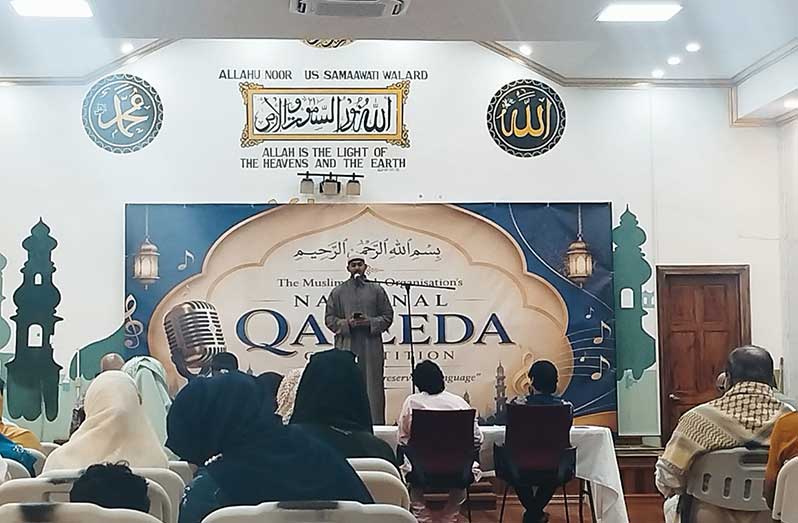
— 24 contestants compete in junior, senior preliminary rounds
THE Muslim Youth Organisation (MYO) hosted the male preliminary rounds of the National Qaseeda Competition 2026 on Saturday, bringing members of the Muslim community together in an effort to preserve a longstanding religious and cultural tradition that has been passed down through generations.
Held at the MYO Complex on Woolford Avenue, the competition featured five contestants in the junior category and 19 in the senior category, with successful participants advancing to the national finals on September 12.
More than a showcase of voices, the event celebrated a tradition, language and heritage that organisers say must be preserved as familiarity with qaseeda and the Urdu language declines among younger generations.
Qaseeda, also commonly spelt qasida, is a form of classical poetry traditionally composed in a single metre and rhyme. Over centuries, the tradition spread beyond the Arab world and developed into different cultural and religious forms across North Africa and Asia.
Delivering brief remarks, Director of Education and Dawah at the Central Islamic Organisation of Guyana (CIOG), Shaikh Moeen ul-Hack, described qaseeda as part of a legacy inherited from previous generations.
He explained that poetry occupied an important place in Arab culture and eventually became intertwined with vocal expression.
According to ul-Hack, travellers journeying for days or even months across the desert would recite poetry and sing during their travels, helping to lift their spirits and make difficult journeys more bearable.
“One person would recite or sing, and the other members of the caravan would make the journey with this. And they felt that this changed the mood and sometimes made the journey less burdensome for them and their families,” he explained.
He said that although the tradition originated in the Arab world, it eventually spread to parts of North Africa, including Egypt, Tunisia and Morocco, as well as parts of Asia, including India and Pakistan.
During the programme, it was also noted that qaseeda became an important part of the religious and cultural practices of Muslims who arrived in Guyana during the period of Indian indentureship.
Prominent broadcaster Neaz Subhan, who chaired the programme, said qaseeda has occupied a special place in the cultural and religious traditions of Guyana’s Muslim community for generations.
“It has a long and cherished history among the Muslim community here, but has declined over the years. Through beautiful Urdu poetry and melody, our foreparents expressed their love and reverence to the Holy Prophet Muhammad, peace be upon him,” Subhan said.
“Over time, however, both qaseeda singing and familiarity with the Urdu language have diminished.”
He said the National Qaseeda Competition represents an effort to reverse that decline by preserving the tradition, refining participants’ skills and maintaining familiarity with the language among future generations.
Saturday’s preliminary round attracted 24 male contestants, comprising five juniors and 19 seniors.
Those who qualify will advance to the male finals, scheduled for September 12, 2026, at the MYO Complex. The female finals are scheduled for September 5 at the same venue.




