






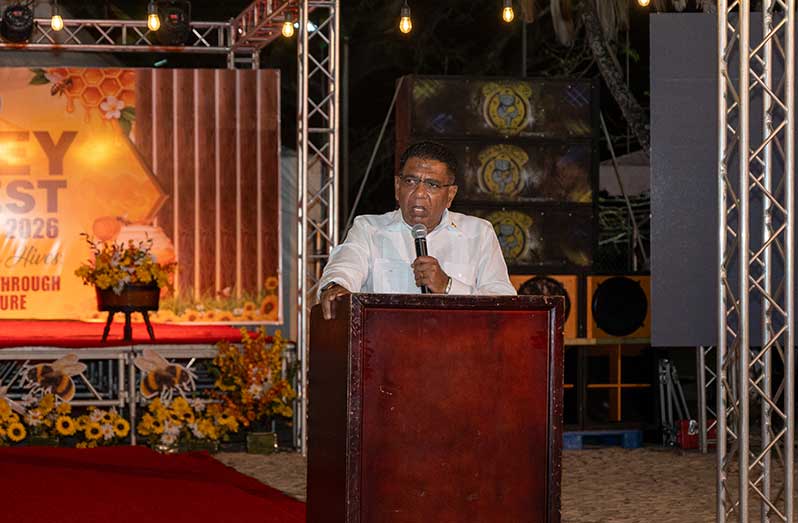
GUYANA is rapidly approaching the 50,000-gallon mark in honey production, moving from 3,745 gallons in 2022 to 40,000 gallons in 2025.
According to the Minister of Agriculture, Zulfikar Mustapha, the 2025 figure represents a 54 per cent increase compared to 2024.
Delivering the feature address at Honey Fest 2026, Minister Mustapha said Guyana’s honey industry is no longer a “small story,” it is becoming a national story of rural development, economic opportunities, and sustainability.
Through the Guyana Livestock Development Authority (GLDA), there is a deliberate strategy in place to strengthen each aspect of the honey value chain.
The vision is clear: To increase the number of active beekeepers and productive hives, while also improving honey yields through a modern colony management, strengthened quality assurance system, expanded value-added production, bee population and habitat protection, and positioning Guyana as a competitive supplier of premium honey products to regional and international markets.
He continued to state that the goal is for Guyana to become the premier food producer for the Caribbean region. Guyana is uniquely positioned to achieve this, with our tropical climate, vast forested areas, and mangrove ecosystem providing conditions for safe, sustainable beekeeping all year.
The agriculture leader explained that while many countries struggle with environmental challenges that affects pollinators, Guyana possesses a “natural advantage,” that can make us a leader in green apiculture.
This is important, because for those who are producing honey the room is there for expansion in honey production.
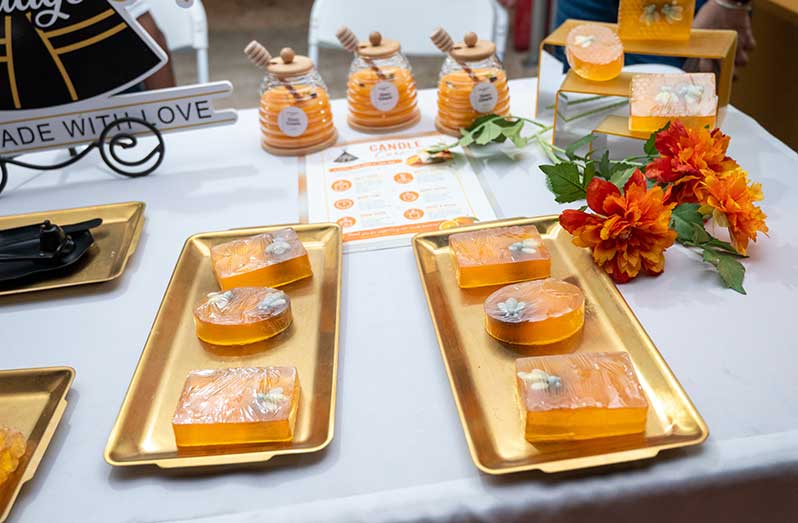
He told the beekeepers that Guyana needs them to be successful, adding that if we are to reduce the food import bill of the Caribbean Community (CARICOM) by 25 per cent, Guyana needs to be successful.
According to the minister, “We have two main commodities, valuable arable land, and abundant fresh water. Two major ingredients for us to make us a strong food producer. So, if Guyana has to be successful, for Guyana to be successful, you (beekeepers) will have to produce, and I want you here this evening to recommit yourself, because when you look at the global honey market, it’s expected to grow from US$9.9 billion in 2025 to around approximately US$18.3 billion by 2034.”
Minister Mustapha expressed that this will be a “very lucrative market,” and as producers, they have the unique opportunity to position themselves within an expanding international industry.
He continued to say that if we are aiming to increase honey production, we have to ensure that we do so massively.
“The government has been increasing budgetary allocation. We have been making boxes available. We are working to develop hives. We are helping apiculturists to get PPE protection, and other facilities to build capacity. We have specialists who are working with apiculturists to train them, and we want Guyana to have a strong export system where we can export our honey,” he said.
Minister Mustapha mentioned that when we look at the region, we are importing honey at a high cost. Guyana, he underscored, can be the main supplier of honey in CARICOM.
The minister related that the government, through the agriculture ministry, has invested heavily in the development of the honey industry, recognising that with the correct support, it has the potential to grow. The government has supported this growth through large financial investments in protective gears, production input, training, technical support, and some 3,700 ice boxes.
From 2020 to 2026, they have distributed a total of 3,320 ice boxes, 52,204 frames, 2,552 extruders, 57,140 wax sheets, and 3,053 hive stands.
“5,705 items such as PPE, tools, and equipment, and 2,500- honey samples were tested at GLDA lab. Investment and government support are expanding honey production while creating opportunities for women, as I mentioned and youth, and also for indigenous communities to participate in attracting agricultural enterprise,” Minister Mustapha revealed.
“As I said, today, Guyana has approximately 280 beekeepers, an increase over the previous years, while the number of active hives has expanded from 1,145 to 1,983. These are not merely statistics; they represent individuals and families whose livelihoods are being improved through sustainable agriculture,” he added.
He noted that equally important is government’s commitment to building the infrastructure that will support the industry’s long-term growth.
The minister spoke of the recent establishment of Guyana’s first queen-rearing facility at Kairuni which will strengthen bee programmes and improve colony performance. This facility is expected to be commissioned later this year.
Additionally, government’s efforts to establish a modern honey testing and grading laboratory will ensure Guyana’s honey meets international standards and assure of product quality.
Committing to continued investments in training, research, quality assurance, modern equipment, market development, and infrastructure necessary to support the growth in the apiculture industry, the Minister told beekeepers that the government will continue to create opportunities for youth and women to become leaders in this industry and will continue to work with its partners to unlock new markets for Guyana’s honey product.




