





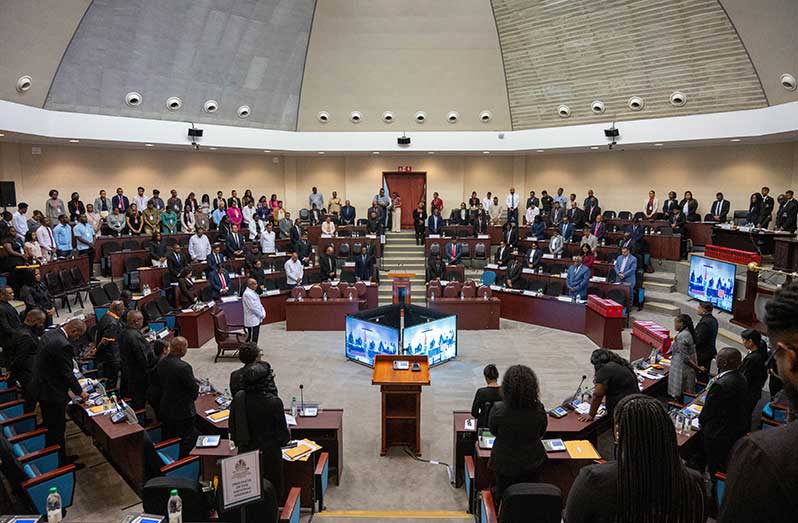
PRESIDENT Dr. Irfaan Ali, through Attorney General Anil Nandlall, SC, amidst disruptive attempts by the opposition, delivered a solemn message to the National Assembly on Monday, offering the nation’s deepest condolences over the sinking of the Motor Vessel Barima while pledging the government’s support for survivors and bereaved families will not end when the search for the missing does.
Invoking his constitutional prerogative under Article 67(2) to address Parliament directly, the President described a tragedy that “has shaken our Republic to its very foundations,” recounting how the vessel, en route from Georgetown to Port Kaituma, is believed to have capsized on the night of Saturday, July 18, going down so quickly that crew and passengers had little chance to respond.
The President detailed what he called the largest search, rescue and recovery operation in Guyana’s maritime history, aircraft, boats from government agencies and private citizens alike, and rescue teams working through darkness and rough seas without pause.
To date, 76 people have been rescued and 73 bodies recovered, though some passengers remain unaccounted for.
He thanked a long list of responders, from the Guyana Defence Force Coast Guard, Police Force, Fire Service and medical personnel to fisherfolk who went out into perilous waters as first responders, alongside international partners including French Guiana, Trinidad and Tobago, and Brazil, whose personnel and equipment supported the recovery effort.
Much of the President’s message centered on the government’s ongoing commitment to those affected.
He told survivors directly that “you are not alone” and that the country stands beside them, while assuring families still awaiting word on missing loved ones that the government would not rest “until every possible effort has been exhausted” to account for every passenger aboard.
That commitment, he stressed, extends well beyond the immediate crisis. The government’s responsibility to affected families, he said, “does not end with the recovery operation” and “will continue for as long as necessary.”
To back that pledge, President Ali reiterated the announcement of the HEART Initiative, a programme providing material, moral and emotional support to survivors and bereaved families, including psychosocial support, trauma counselling, social services and spiritual guidance.
He has also invited Caribbean jurist Eamon Harrison Courtenay, former Attorney General and Minister of Investment and Foreign Trade of Belize, to help design a framework for financial assistance to those affected; this was assistance the President was careful to note should not be viewed as compensation.
Turning to accountability, the President was unequivocal: “The people of Guyana deserve answers. Families deserve answers. History demands answers.”
He committed the government to leaving no stone unturned in establishing the full circumstances behind the disaster, both to address the questions weighing on the nation and to prevent any recurrence.
To that end, he updated the Parliament on the establishment of an independent Commission of Inquiry composed of internationally recognised experts in maritime safety, accident investigation and disaster management.
The Commission will be chaired by Justice Godfrey Phillip Smith of Belize, CARICOM High-Level Representative for Law and Criminal Justice and an Ad Hoc Justice of the Eastern Caribbean Court of Appeal.
He will be joined by Dr. Andrzej Jasionowski of Poland, a naval architect and marine engineer; Captain Hamada Fouda, Senior Maritime Surveyor and Compliance Auditor with the Maritime Authority of Jamaica; Ms. Nyree Dawn Alfonso of Trinidad and Tobago, an attorney specialising in admiralty and maritime law; and Rear Admiral (Ret’d) Hayden Pritchard, also of Trinidad and Tobago, a veteran of maritime operations and security.
The Commission’s mandate is sweeping, covering the vessel’s loading, boarding procedures and seaworthiness; the adequacy of the rescue response; compliance with maritime laws and regulations; the competence and conduct of the crew; and possible overcrowding or safety-equipment failures.
It will also be empowered to recommend legislative and regulatory reforms and to identify accountability wherever negligence or wrongdoing is found.
“The truth must be established,” the President said, adding: “The lessons must be learned. The reforms must be implemented. And where failures, negligence or wrongdoing are identified, accountability must follow.”
The President closed by urging Guyanese not to let the tragedy become a source of division, framing the nation’s response as a test of collective character rather than only of its institutions.
“Today, Guyana grieves,” he said, noting: “Tomorrow, Guyana will heal. And together, united in faith, compassion and resolve, Guyana will rise.”





