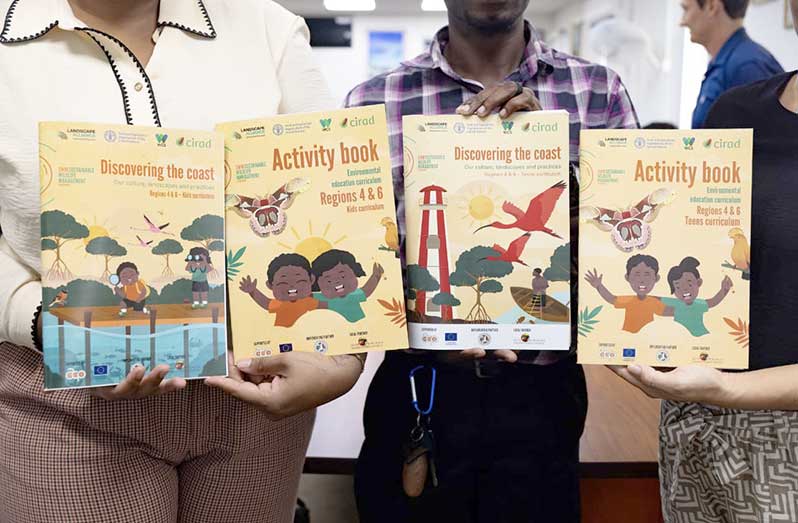
THE Environmental Education Curriculum (EEC) for Regions Four and Six, which was launched on Tuesday at the Umana Yana in Kingston, Georgetown, is expected to equip teachers across coastal Guyana with a new tool to nurture environmental awareness, curiosity and leadership among school-aged children.
Additionally, a complete guidebook on how to create the curriculum was also launched, allowing development of EEC to continue across Guyana and beyond.
The curriculum is designed as a practical and engaging guide, structured for delivery over a full academic year. It comprises of an activity book, a teacher’s handbook, and supporting appendices.
Over the course of three terms, children will learn about native plants, wildlife, and their habitats, waterways, farming, fishing, and coastal folklore and traditions.
The activity was hosted by the Sustainable Wildlife Management (SWM) Programme and the Guyana Wildlife Conservation and Management Commission (GWCMC) and funded by the European Union (EU).
The launch was attended by Ms. Omwaittie Ramdin, Director of National Center of Educational Resources Development (NCERD), who represented the Minister of Education.
In her remarks she spent some time highlighting the importance of the curriculum.
“Today is about an investment; it is about equipping our children with the knowledge, values, skills, and a sense of responsibility. They will need to protect one of the greatest treasures we possess, our natural environment. The decisions our children make in the future, will depend greatly on what we teach them,” she said.
The model for the EEC was originally developed by the South Rupununi Conservation Society (SRCS) for Region Nine, where it was successfully implemented for over seven years, with support from the SWM Programme.
Building on this success, the SWM Programme, the GWCMC, and SRCS have spent the past year adjusting the Region Nine curriculum for Regions Four and Six.
Ms. Alona Sankar, Commissioner of the Guyana Wildlife Conservation and Management Commission (GWCMC), highlighted the importance of the initiative, while Mr. Daniele de Bernardi, Focal Point for the SWM Programme in Guyana and a member of the Delegation of the European Union in Guyana, Suriname and CARICOM, expressed his vision for the curriculum.
He stated: “Today’s launch is more than the introduction of new educational materials. It is an investment in young people, in environmental stewardship, and in the future resilience of Guyana’s communities. It shows how education can help connect biodiversity conservation, cultural knowledge, sustainable livelihoods and community responsibility.”
The SWM Programme in Guyana is led by Landscape Alliance (formerly called the Center for International Forestry Research and World Agroforestry (CIFOR-ICRAF)).
The SWM Programme extended its sincere gratitude to all stakeholders who contributed to the development of the curriculum from its initial stages through to design and review. Teachers and students of the schools that will be the first to experience the curriculum were also thanked.
Special thanks went out to the European Union for its generous funding which helped to make the initiative possible, the Guyana Wildlife Conservation and Management Commission (GWCMC) for its keen interest and partnership, the Ministry of Education for its support of this important project, and the South Rupununi Conservation Society, without whom the development of the curriculum would not have been possible.