— reminds APNU+AFC scrapped programme for ‘inferior’ initiative
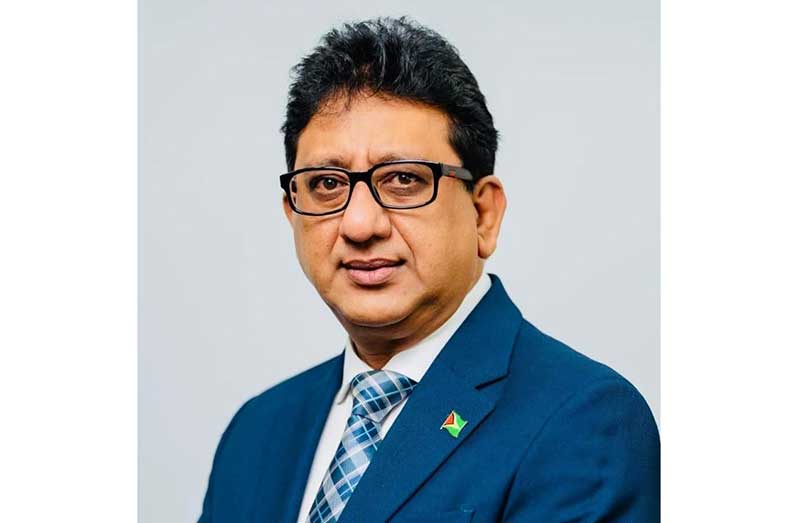
ATTORNEY General and Minister of Legal Affairs Anil Nandlall, SC, has defended the government’s nationwide schools cash-grant programme, arguing that it provides direct financial support to every eligible child and is unmatched elsewhere in the English-speaking Caribbean.
Speaking during his weekly programme Issues in the News, Nandlall accused the former A Partnership for National Unity and the Alliance For Change (APNU+AFC) administration of misleading the public about the initiative, while replacing it during its 2015-2020 term with what he described as a far less effective programme.
According to Nandlall, the previous administration discontinued the cash grant and introduced its “Three Bs” initiative, which provided buses, boats and bicycles to students.
He contended that the replacement programme reached only a limited number of children, unlike the cash grant, which he said places money directly into the hands of parents of school-aged children across Guyana.
Nandlall said, “They abolished a comprehensive national programme that put money in the hands of every single parent of this country and replaced it with a programme of a couple boats, a couple bicycles and a couple buses.”
The Attorney General also claimed that while travelling across the country during the previous administration’s tenure, he received numerous complaints from residents about how the transportation programme was implemented.
Recalling visits to communities in Berbice, he alleged that some school buses bypassed certain villages while collecting students from others, prompting accusations of unequal treatment.
“I had calls from parents complaining that buses were passing villages and collecting students from selected communities,” he said, adding that the concerns were raised during a live call-in programme.
In contrast, Nandlall maintained that the People’s Progressive Party/Civic (PPP/C) government’s cash-grant programme benefits every eligible child attending both public and private schools, irrespective of ethnicity or geographic location.
He argued that the programme’s universal approach is what distinguishes it from previous education initiatives, noting that every eligible student receives the benefit regardless of where they live or their ethnic background. According to Nandlall, the government deliberately designed the initiative to ensure that financial assistance reaches families directly, allowing parents to offset back-to-school expenses.
The Attorney General further contended that criticism of the programme by the opposition has failed to resonate with the public because thousands of parents have personally benefitted from the initiative. He argued that when citizens experience the impact of a government programme firsthand, they are able to determine for themselves whether claims made against it are accurate.
Nandlall said this, in his view, has contributed to the opposition’s declining credibility on the issue, arguing that attempts to discredit a programme that provides direct assistance to families have been unsuccessful. He maintained that the cash grant remains one of the government’s flagship education initiatives and continues to provide meaningful support to households with school-aged children.
“Every single Guyanese of every single ethnicity is benefitting from this programme once you are in a school, public or private,” he stated.
Nandlall further argued that the initiative is unique within the English-speaking Caribbean and challenged critics to identify another programme of similar scope anywhere in the region.
“As I said, it is a programme that has no similarity in the English-speaking Caribbean, or go further [sic] afield if you wish and find a programme that is similar to this,” he said.
He also encouraged parents and guardians who have not yet collected the grant to do so, stressing that the funds are intended to assist families with the cost of educating their children.
He urged, “So, please ensure that you uplift your cash grant wherever you are residing.”
During his remarks, Nandlall also criticised the opposition’s attacks on the programme, stating repeated criticism of a policy that directly benefits families had damaged its credibility with the public. He argued that voters were able to judge the programme based on their own experiences as beneficiaries.
Under this year’s programme, each eligible child is receiving a $60,000 “Because We Care” cash grant, a $5,000 school-uniform grant and the newly introduced $20,000 transportation grant, bringing the total assistance to $85,000 per child.
The government announced during the presentation of the 2026 National Budget that approximately 206,000 children enrolled in public and private schools are expected to benefit from the increased allocation. The initiative is projected to inject an additional $2 billion into households, bringing the total value of transfers under the programme to an estimated $12.4 billion.
The “Because We Care” initiative was reintroduced by the PPP/C administration in 2020 and has been expanded annually through successive increases in the cash grant and the introduction of additional education-support measures.
The programme is intended to assist parents and guardians with back-to-school expenses, while improving access to education by helping families meet the cost of uniforms, transportation, stationery and other school-related necessities.
Distribution of the grants began on Monday, June 29, and is continuing at schools nationwide in accordance with schedules established by the Ministry of Education.