A woman was crying.
IT was a dark night in a small, dusty village deep in the countryside, bordered by sugar-cane fields, a village untouched by the changing times, where a merciless, age-old tradition still reigned. In the silence of the nights, a woman’s cries could always be heard as a man, a gladiator with steel muscles and an aggressive mind, stamped his dominance and control. At dawn, the silence as she performed her daily tasks was like an oppressive veil.
Tonight, that veil, which through the times had covered the blood, tears and suffering, was thrown off as one woman stood in defiance. The shock, as the villagers watched the smouldering embers of the fire, hushed even those who followed the oppressive rules, like the soundless roar of an angry sea, the screaming winds. The woman, crying softly, her lips quivering with a deep passion, blood trickling from her wounds, looked at her husband’s charred, lifeless body lying on the dusty street. Her three young children huddled close to her, too often in the embrace of violence to be shocked, but still scared.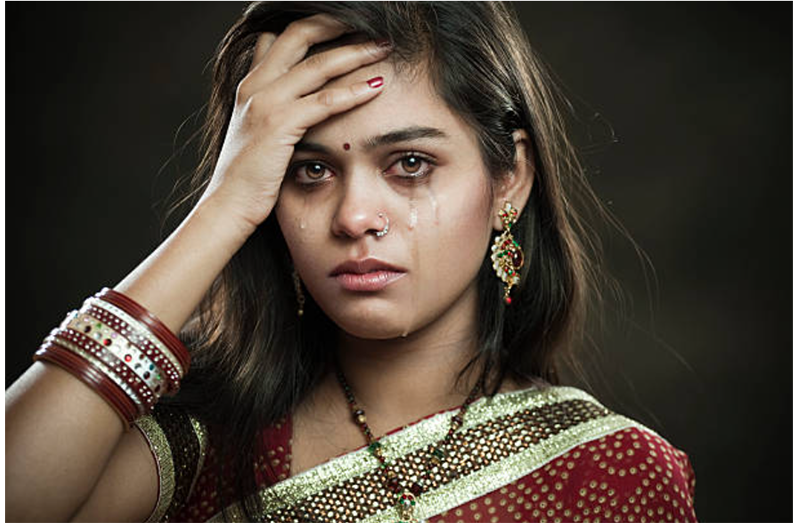
Tragedy, a messenger of fate, always came calling in that little village where minds and bodies are torn and bled, and most often the woman was the victim.
Tonight, one woman changed it all; her name is Sharda.
At the young age of fifteen, when her life, like a rose petal, was just starting to bloom, her father, a man of old-fashioned ideals and principles, decided she should get married. She had wanted so much to be given a chance to study at a high school, to broaden her horizons, so she could break the shackles that imprisoned the women of her generation, but her father wouldn’t listen to her pleas. She had lost, and a life she wasn’t ready for was forced upon her, a flower not allowed to bloom, plucked from a garden, withering in uncaring hands. Her husband, much older and educated, used that as a tool to dominate her life, not to love or share, for to him marriage was only a convenience. He was a habitual drinker and, so often, he would be in a bad mood. His insults that denounced her womanhood and his cruel fists made life a nightmare she couldn’t awake from. Yet, in her culture, she must honour him as her God, love him, pray for him, and cry for him.
How can he be my God if he cannot love me?
“A new day will dawn,” she kept reassuring herself. “A new day must dawn.”
He was demoted from his job just after her second son was born because his drinking habit had worsened, and life became a greater struggle. She had begun working her father’s small farmland to sustain their needs so her children wouldn’t go hungry. In the quiet as she tilled the land, she often wondered, “Why, as a woman, am I treated in such an inhuman way? How much better is he as a man than I am?”
From within a woman comes life, purity and richness, that the Gods know, and she would ask of the heavens as she sat to rest under a jamoon tree, “Questions I ask of you, Dear Lord, can you answer me?”
No answers came as time moved on, and she opined:
“Maybe there’s no answer because maybe a woman’s tears have to fill the rivers and her blood must fertilise the earth.”
She had watched the women of the village suffer as she did, with no one really willing to go to the depths and lengths to understand the problem, to stand in the shoes of an abused woman and feel her suffering. Many sleepless nights, she would sit looking at her sleeping children, deeply worried that her sons would most likely grow up to be abusers and her daughter a victim, as the cycle of oppression continued. Something must be done, but what and how?
On the day of Raksha Bandhan, when a sister ties a sacred thread on her brother’s wrist for care and protection, an answer she had long awaited called at her humble home.
It was her ‘Rakhi brother’, whom she hadn’t seen for over fifteen years.
He had left when she was just eight years old, and now he was back. He had to see her. A worried look crossed his face.
“What has become of you, Sharda?”
She smiled wryly. “Nothing, I’m okay.”
“No, you’re not. You can talk to me. I’m like a brother to you.”
She had been so happy to see him after all those years, not wanting to burden him with her problems, and, as they talked, her husband came home. She introduced her ‘Rakhi brother’ to him, the grandson of an old Pandit from the next village. All was well until her husband came back home later that night, drunk. The suspicious look he gave her rang warning bells in her ears, and she knew she had to hide herself to escape his cruelty.
“You look happy today, woman,” he said, “when you look at that man.”
“He’s my brother and I haven’t seen him in years. I tied rakhi on his hand.”
He grabbed her around the neck, his eyes wild with anger.
“I don’t believe it. Something is going on.”
She struggled and managed to pull away from him, gasping for breath.
“A man in my house is the worst thing you can do!” he swore loudly, knocking over the kitchen table. The children awoke, her little daughter crying, and she ran to grab them and move, but it was too late. He blocked their escape, a cutlass in his hand, dark rage on his face. She was trapped in the room with the children, fear welling in her heart, almost suffocating her.
“Is this how it ends for me, hacked to pieces as my children watch?”
As he advanced on her, her eldest son shouted and threw his cricket bat.
“Use this, Mommy!”
She grabbed the bat, warding off the cutlass, not too successfully, for he possessed the strength and fear had weakened her. She felt a burning in her arm and shoulder, knowing she was bleeding, but she steadied her mind, refusing to go down. The boys kept grabbing him around the waist to slow him, giving her a chance to escape from the room. She screamed for the children to run out of the house and, as he swung the cutlass, she grabbed the lighted lamp from the table and threw it at him. The last thing she saw as she ran out the door was his shirt on fire. She closed the door, putting all her strength against it, knowing one thing: if he exited that door, she was dead, if not tonight, then another night or day.
As he shouted and kicked the door, she screamed to the dark sky, “I’ve had enough; you will give me strength, you will give me strength!”
Even the earth seemed to shudder at her anguished screams, a woman whose pain and suffering were close to breaking point.
The door did not budge.
Now, as she looked down at his burnt remains, she felt no sorrow, but deep regret that it had to end this way. The veil of oppression had burnt with him. A new day would now dawn for her.