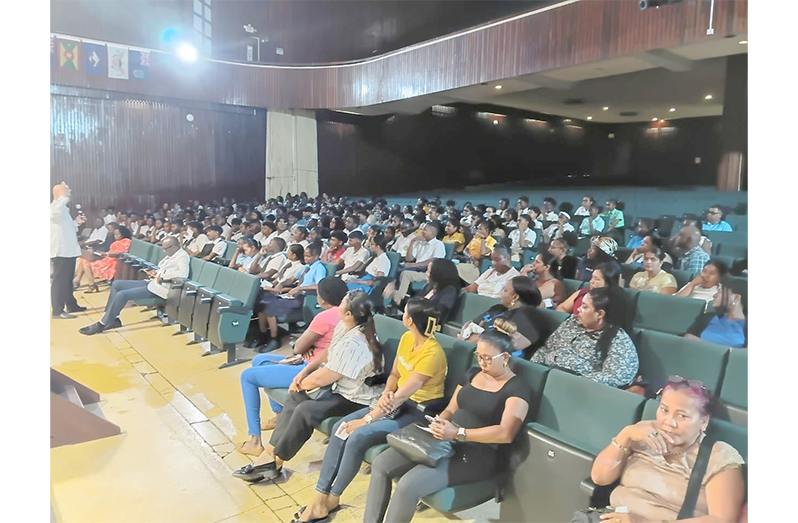
MORE than 300 students across Region Four are preparing to step beyond the classroom and into professional workplaces as part of the Department of Education’s annual work-study programme, an initiative designed to bridge the gap between education and employment.
Held under the theme, “From Classroom to Career – Shaping Future Professionals,” the orientation programme brought together students ahead of their five-week attachment period, providing guidance on workplace expectations, professional conduct, and the responsibilities that come with representing their schools and communities.
According to Education Officer II, Mr. Loren Parks, the orientation serves as a critical link between what students learn in school and the realities they will encounter in the workplace.
“The orientation is really about giving the children a glimpse of what the expectations are when they are out on the work-study programme. This is the bridge between what we teach them in school, what they learn from their parents, and what they learn to this stage. It is a bridge to the world of work.”
This year, the Department of Education expects approximately 300 students in Region Four, and possibly more, to participate in the programme. Students will be attached to various government and private-sector agencies, including the Department of Education, the Regional Democratic Council (RDC), and a number of private businesses and organisations.
For many participants, the attachment will provide their first experience in a professional working environment.
Parks noted that the programme offers students an opportunity to explore career paths before making long-term educational and professional decisions.
“Some of them may enjoy the environment we put them in, while others may discover that it is not the environment they want at all,” he said. “It gives them an opportunity to redirect their higher education in one way or another. We can give them experience and life skills so they are in a better position to make these permanent decisions.”
While students are exposed to workplace concepts through the Caribbean Vocational Qualification (CVQ) programme offered in secondary schools, Parks explained that the orientation brings together many of the practical lessons students will need to succeed during their attachments.
The sessions focused on workplace etiquette, professionalism, communication, punctuality, accountability, and the importance of maintaining appropriate behaviour in a professional setting.
“We do not want our students to turn up on Monday and be ill-prepared. We do not want them to turn up and we have to get complaints about their behaviour because they are still behaving like they are in the classroom rather than in a professional working environment.”
He emphasised that students participating in the programme carry responsibilities beyond themselves.
“When they are out there, they are not just representing themselves. They are representing their schools, their families, their communities, the Department of Education, and so on.”
The orientation therefore serves as an important preparation exercise, helping students understand both the opportunities and expectations that accompany their placements.
“We would like them to make the most out of it. This is preparation prior to them being in the workplace.”
The work-study programme forms part of the Department of Education’s broader efforts to equip students with practical skills and career awareness before they leave the secondary education system.
Increasingly, educators recognise that academic achievement alone is not enough to prepare young people for success in today’s workforce. Employers are also seeking communication skills, professionalism, adaptability, teamwork, problem-solving abilities, and workplace experience.
Through work-study attachments, students gain firsthand exposure to professional environments while developing these essential employability skills.
The programme also provides opportunities for networking, mentorship, and career exploration, allowing students to better understand the expectations and realities of different professions.
According to Parks, the Department of Education would ideally like every student to benefit from some form of apprenticeship or workplace attachment. However, he acknowledged that achieving that goal presents several challenges.
While enthusiasm for the programme continues to grow, practical limitations affect the number of students who can be accommodated each year.
Among the most significant challenges are budgetary constraints, available placement opportunities, and restrictions imposed by workplace regulations. Parks explained that some organisations are unable to accept younger students because of legal requirements.
“For example, we would have asked Banks DIH and DDL to take on some of our students, but the Factory Act does not allow them to take students below eighteen years,” he noted.
Competition for available placements also presents challenges. Secondary school students are not the only group seeking workplace attachments. Technical and vocational institutions such as the Government Technical Institute (GTI), the Carnegie School of Home Economics, and other training institutions also rely on industry partnerships to provide practical experience for their students. As a result, agencies often have limited capacity to accommodate every request.
“While the desire may be for us to expose all our students, it is not always practical, but as many as we can accommodate, budget-wise and space-wise from the agencies, we will accommodate.”
Despite these challenges, the Department remains committed to expanding opportunities whenever possible. As students prepare to begin their five-week placements, education officials remain optimistic about the programme’s long-term impact.
The work-study initiative continues to play an important role in helping young people make informed career decisions, develop confidence, and acquire practical workplace skills that cannot always be taught in a traditional classroom setting.
By connecting education with real-world experience, the programme helps students move beyond theory and begin envisioning their future careers.
For many participants, the attachment may reinforce existing career ambitions. For others, it may open doors to possibilities they had never previously considered.
Either way, Parks believes the experience will provide valuable lessons that extend far beyond the five-week programme.
As the Department of Education continues to strengthen the relationship between schools and workplaces, initiatives such as these remain essential in preparing students to become competent, responsible, and career-ready citizens. Under the theme “From Classroom to Career – Shaping Future Professionals,” the programme represents more than just a temporary placement. It is an investment in the next generation of workers, leaders, and professionals who will one day contribute to the development of Guyana.