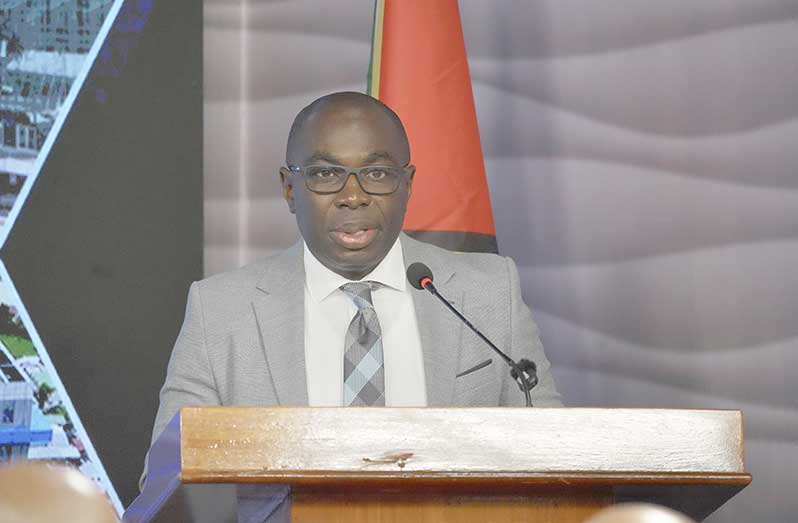
GUYANA is set to welcome media leaders, broadcasters, journalists, policymakers, academics and digital innovators from across the region when it hosts the 57th Annual General Assembly (AGA) of the Caribbean Broadcasting Union (CBU) and the 37th CBU Media Awards from August 17–19 in Georgetown.
Speaking at the official launch on Tuesday, Minister within the Office of the Prime Minister with responsibility for Public Affairs and Information, Kwame McCoy, said the event comes at a defining moment for the Caribbean as artificial intelligence continues to reshape industries, information systems and societies, while highlighting Guyana’s ongoing investments in media development, education, digitisation and national transformation.
CBU President Anthony Green said the assembly will provide a platform for regional stakeholders to examine both the opportunities and risks posed by AI, with discussions focused on ethics, authenticity, trust and innovation.
Meanwhile, CBU Secretary General Sonia Gill announced a record-breaking awards competition and revealed that the host nation, Guyana, achieved its highest-ever performance, securing 37 nominations across three media organisations.
With participating nations already anticipating this year’s assembly and media awards, Minister McCoy emphasised that Guyana is honoured to host the Caribbean media family at the historic event.
Noting the importance of the event, Minister McCoy said this year’s gathering comes at a uniquely consequential moment for the region as AI continues to reshape sectors, with journalism being among the most impacted.
“Artificial intelligence is reshaping industries, transforming how information is created and consumed, redefining labour markets and challenging long-held assumptions about truth, trust, and accountability,” he said.

Moreover, Minister McCoy noted that geopolitical realities are shifting, adding, “Global economic norms are evolving, new centres of influence are emerging, and societies everywhere are grappling with how to remain competitive, resilient, and united in an increasingly uncertain and technologically driven world.”
For small states, including those of the Caribbean, this massive shift could present both extraordinary opportunities and challenges, Minister McCoy said.
The Caribbean region and the international journalism landscape are grappling with sustaining innovation while protecting the integrity of information and ensuring that Caribbean values remain visible and influential.
This is why Guyana has taken steps to enhance the Guyanese journalism network, as Minister McCoy explained, “We are investing heavily in strengthening the professional ecosystem for the Guyanese media fraternity, including through robust, cost-free upskilling opportunities for practitioners and newcomers alike. Our National Media and Communications Academy continues to equip cohort after cohort with industry-based knowledge and hands-on practical skills.”
He said this while pointing to investments in other areas, such as free tertiary education at the University of Guyana and wide-ranging international online scholarship opportunities through the Guyana Online Academy of Learning.
Citing Guyana’s development in a number of other areas, Minister McCoy noted that regional dialogue remains a pillar of sustainable development.
He noted that there are challenges surrounding the use of AI in journalism, with difficult questions about regulation, ethics, media sustainability, misinformation, technological adaptation, and the evolving role of journalists and broadcasters being among the biggest areas of discussion at this year’s assembly.
Minister McCoy added, “I am confident that Caribbean media practitioners have never shied away from the difficult conversations that must be had among us in the Caribbean. Indeed, the history of Caribbean media is one of resilience, creativity, and adaptation. Our media institutions have weathered political changes, technological revolutions, economic upheavals, and natural disasters.”
Minister McCoy noted that AI will challenge the region’s media landscape to build skills, rethink old models and create opportunities to expand access to information, strengthen public engagement, improve efficiency, and amplify Caribbean voices in new ways.
Also delivering an address was the President of the Caribbean Broadcasting Union, Anthony Green, who shared similar sentiments on the urgency of the conversation surrounding AI and journalism, stating, “Artificial intelligence is no longer on the horizon. It is already reshaping how content is produced, distributed, translated, monetised, archived, and consumed. For Caribbean media, the question is not whether artificial intelligence will affect us. It already has.”
The next step moving forward will require a collective look at how the Caribbean will respond in a way that protects people, strengthens institutions and preserves culture, Green added.
This year’s assembly, he said, will be the space for media leaders, broadcasters, journalists, technical professionals, policymakers, academics, development partners, and content creators to examine the opportunities and risks of artificial intelligence in a Caribbean context.
As he added, “We will explore innovation while examining the ethics, authenticity, trust, safety, and inclusion required of media practitioners in small developing societies, where information can quickly shape public confidence and national conversation.”
Green also outlined several highlights planned for the three-day gathering, noting that the opening ceremony will feature an address by President Dr. Irfaan Ali, while UNESCO Caribbean representative Eric Falt will help frame discussions on the ethical, safe and inclusive deployment of artificial intelligence.
The conference programme will also include a keynote address from Minister McCoy, alongside presentations from regional and international experts in technology, communications and media development.
Technology will be a major focus of the assembly, with a dedicated workshop for senior broadcast engineers and technical officers examining ways to expand reach, strengthen resilience, support emergency communications and create new opportunities for connectivity.
The assembly will also honour two distinguished Caribbean media figures through induction into the CBU Media Hall of Fame, recognising their contributions to journalism, media education and public service across the region.
Meanwhile, Secretary General of the Caribbean Broadcasting Union, Sonia Gill, announced that the 2026 CBU Media Awards attracted a record 683 entries across 63 categories from 41 organisations and individuals representing 16 countries and territories, reflecting significant growth in participation over the previous year.
She noted that Jamaica led all participating jurisdictions with 105 nominations, followed closely by Trinidad and Tobago with 102, while Belize and Barbados each secured 95 nominations. Host nation Guyana achieved its strongest performance ever, recording a national record of 37 nominations from three media organisations.
Other territories also made strong showings, including the French-speaking Caribbean with 32 nominations, the Cayman Islands with 32, Saint Vincent and the Grenadines with eight, Colombia and Cuba with seven each, Saint Lucia with six, Antigua and Barbuda with five, The Bahamas with two and the British Virgin Islands with one.
Gill also highlighted the introduction of photography categories and new student-focused awards aimed at encouraging the next generation of Caribbean media practitioners.