






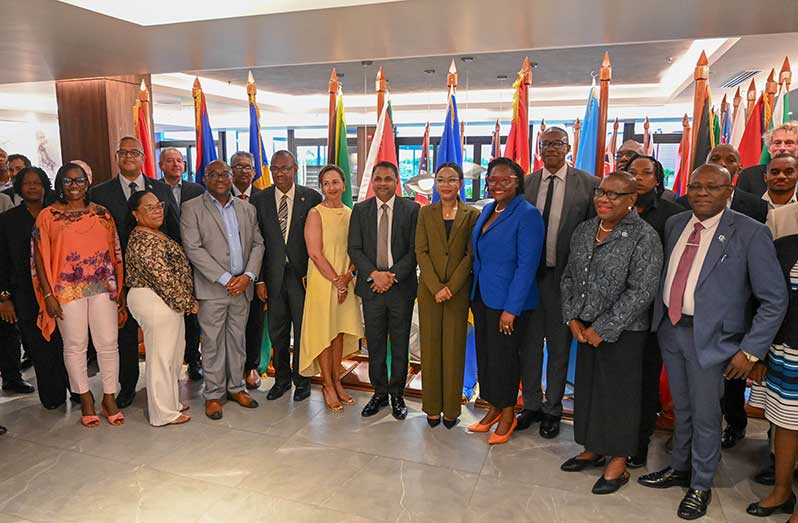
—Safety, security and sustainable shipping among key focus areas at 31st CMOU meeting
GUYANA on Tuesday reinforced its commitment to strengthening maritime governance and advancing regional cooperation as the 31st Annual Meeting of the Caribbean Memorandum of Understanding (CMOU) on Port State Control gets underway.
The regional conference, which brings together delegates from more than 30 countries, addresses critical issues facing the maritime sector.
According to Minister of Public Utilities and Aviation, Deodat Indar, who delivered the feature address, the conference represents more than a gathering of regional maritime professionals, noting that it reflects the Caribbean’s shared commitment to building an efficient and internationally competitive maritime sector.
“Gathering today and for the next few days represents more than the coming together of nations and professionals across the region. It demonstrates a strong partnership and collective ambition shared by Caribbean states and its peoples,” Indar said.
The minister noted that the meeting is taking place at a significant time as the region marks the 30th anniversary of the CMOU, which was established to improve maritime safety and ensure compliance with international shipping standards across member states.
Indar highlighted Guyana’s expanding maritime sector, pointing to substantial growth in vessel traffic and imports in recent years as economic activity accelerates.
“For Guyana, these developments are especially relevant as we advance efforts to modernise our ports and maritime infrastructure,” he said.
He disclosed that vessel traffic has increased by approximately 42 per cent since 2020, while imports have risen significantly over the same period.
“But this growth represents opportunity. It places greater responsibility on us to maintain high standards of maritime governance, environmental stewardship and operational excellence,” he stated.
Against this backdrop, the minister spoke to the growing global focus on environmental sustainability and decarbonisation within the maritime industry, noting that international ambitions for net-zero emissions by 2050 will require countries to adapt.
“Decarbonisation now is at the centre of global maritime policy,” Indar said, while adding that Guyana has already begun taking steps through renewable energy initiatives outlined under the country’s Low Carbon Development Strategy.
He also urged regional partners to examine challenges affecting maritime trade, including increasing shipping costs, global supply disruptions and illegal activities at sea.
Minister of Home Affairs, Oneidge Walrond, also underscored the wider significance of port state control, noting that maritime regulation goes beyond administration and is closely linked to national and regional security.
“Port state control must not only be seen as a maritime administration function, but as part of a wider national security ecosystem,” Walrond said.
She noted that regional cooperation and intelligence sharing remain essential in combatting transnational crimes such as narcotics trafficking, weapons smuggling, human trafficking and illegal migration.
“Criminal networks do not respect national borders, and the vessels they exploit often move across multiple jurisdictions,” the Home Affairs Minister said.
Walrond indicated that agencies under the Ministry of Home Affairs, including the Guyana Police Force, immigration authorities and the Customs Anti-Narcotic Unit (CANU), continue to play critical roles in safeguarding Guyana’s ports and borders.
Meanwhile, President of the Shipping Association of Guyana, Dr. Komal Singh, said the conference comes at a transformative period for Guyana as the country positions itself as an emerging regional logistics and maritime hub.
“We are witnessing the expansion of port facilities, improvements in transportation corridors, enhanced connectivity with our neighbours and increased international interest in Guyana as a destination for logistics,” Singh said.
Against this backdrop, Singh cautioned that expanding maritime activity must be supported by stronger standards and environmental responsibility.
“Economic growth and maritime development must be accompanied by robust standards that protect our people, our marine environment and the integrity of international trade,” he added.
Chairman of the CMOU, Michel Amafo, meanwhile, reflected on the organisation’s progress over the last three decades while highlighting the need for continued adaptation.
“The maritime industry continues to evolve rapidly. New technologies, increasing environmental expectations and emerging risks require us to remain adaptable and forward-looking,” Amafo said.
Over the coming days, delegates of the conference are expected to discuss inspection standards, maritime safety measures and engage in information sharing and discuss issues affecting the regional maritime industry.



