






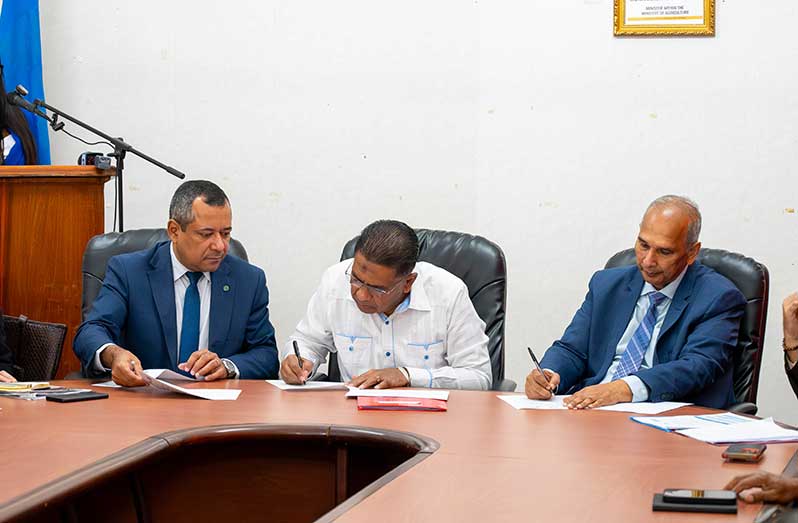
—Letter of Intent signed to establish EMBRAPA Science, Technologies, and Innovation Hub, with operations expected to begin within a year.
GUYANA will soon become home to the EMBRAPA Science, Technologies and Innovation Hub, a landmark initiative expected to transform agriculture across the Caribbean through greater access to research, technology and scientific expertise.
The project was formally launched on Tuesday with the signing of a Letter of Intent between Guyana and Brazil, paving the way for Guyana to benefit from the expertise of Brazil’s globally renowned agricultural research institution, EMBRAPA, while strengthening regional efforts to improve food security and climate resilience.
Minister of Agriculture Zulfikar Mustapha described the initiative as a “game changer” for Guyana and the wider Caribbean, noting that it represents a shared commitment to advancing agricultural innovation and scientific cooperation.
The hub will support the development and deployment of technologies tailored to tropical agriculture, facilitate knowledge transfer, strengthen research networks and help reduce the region’s dependence on imported food. It also aligns with CARICOM’s food security agenda and Guyana’s growing role as a regional leader in agricultural development and innovation.
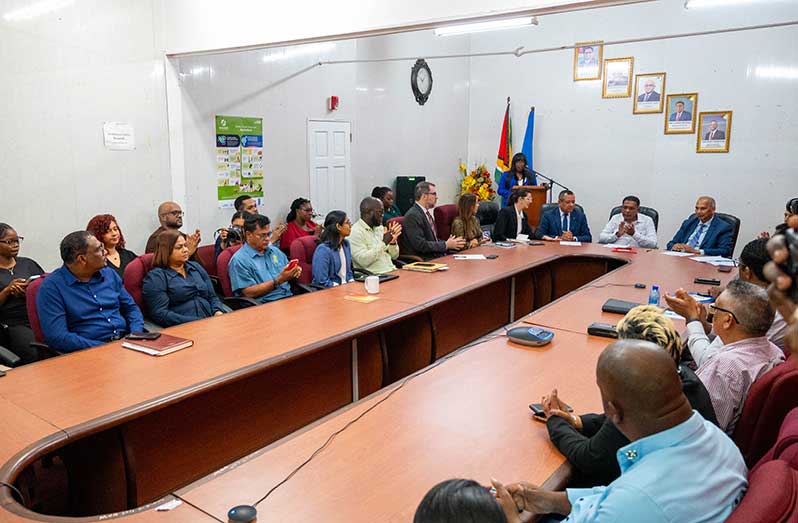
Speaking at the launch event hosted in the Ministry of Agriculture’s boardroom, Minister Mustapha said the initiative stemmed from engagements between President Dr. Irfaan Ali and Brazilian President Luiz Inácio Lula da Silva.
The partnership, he said, reflects the two countries’ shared commitment to advancing agricultural innovation, strengthening scientific cooperation and building a more resilient and food-secure Caribbean.
For decades, Guyana and Brazil have maintained a strong relationship rooted in practical cooperation.
“Our previous collaboration has strengthened our technical capacity in areas such as coconut development, livestock disease surveillance, laboratory strengthening, GIS capability and the joint monitoring of the Carambola fruit fly,” Mustapha said.
With Guyana and Brazil uniquely positioned to create a corridor of production, processing and logistics between the State of Roraima and the Caribbean, the minister said the collaboration will further deepen bilateral relations.
He also highlighted the role of the Inter-American Institute for Cooperation on Agriculture (IICA), describing it as a steadfast development partner supporting science, technology, innovation, agricultural health, climate resilience and regional integration.
According to Mustapha, the hub is expected to become operational within the next year.
Following the IICA Executive Committee meeting on July 21 and 22, Guyana and Brazil will begin negotiations to recruit a full-time liaison officer who will be based in Guyana. Thereafter, Guyana, Brazil and IICA will develop a work plan by August in close coordination with CARICOM.
All parties are aiming to officially commence operations between September and October.
REGIONAL CENTRE OF EXCELLENCE
With technical expertise being provided by EMBRAPA, widely recognised as one of the world’s leading agricultural research institutions, and IICA, Mustapha said Guyana will soon establish a regional situation room and expand its tissue culture programme.
“We will have a centre of excellence, a cooperation between IICA and Guyana. In another month from now we will have a situation room with full data, not only for Guyana but for the entire Caribbean,” Mustapha said. “In another three months we will have, and we already have, a tissue culture lab that will produce millions of planting materials for our farmers in Guyana.”
He added that Guyana’s expanding network of soil laboratories, research facilities and innovation centres is positioning the country as a major driver of regional agricultural development.
“We have a number of soil laboratories, and all those science and innovation centres will make up the agricultural sector in Guyana. Imagine what Guyana will be: a powerhouse in the Caribbean driving agriculture and food security,” the minister said.
STRENGTHENING FOOD SECURITY
Addressing challenges facing the sector, Mustapha pointed to supply chain disruptions and rising global food prices as major concerns affecting Guyana and the wider region.
To tackle these issues, he said science-based, data-driven and regionally coordinated solutions are essential.
He noted that many CARICOM countries are now building agricultural capacity, making the EMBRAPA hub a critical component of the region’s food security agenda.
“The establishment of the EMBRAPA Science, Technologies and Innovation Hub in Guyana aligns perfectly with our national priorities and supports CARICOM’s vision, 25 by 2025 Plus Five, which calls for deeper integration, accelerated technology adoption and adaptation, and a resilient regional agri-food system,” Mustapha said.
“This hub will strengthen our collective capacity to reduce the region’s food import bill, expand intra-regional trade and build true food security.”
Work on establishing the hub is expected to begin in the coming months, with technical teams from the Ministry of Agriculture of Guyana, the Ministry of Agriculture and Livestock of Brazil, EMBRAPA and IICA finalising the institutional, operational and financial arrangements required to commence operations during the second half of this year.
Executive Secretary of Brazil’s Ministry of Agriculture and Livestock, Cleber Soares, said the hub has the potential to transform agriculture across the Caribbean and Central America.
Delivering remarks during the signing ceremony, Soares reflected on Brazil’s agricultural transformation over the past five decades, noting that the country moved from importing 85 per cent of its food to becoming one of the world’s leading agricultural producers and exporters.
“Why did this happen? Because we invested heavily in science, technology and innovation to bring food security. It is a pleasure and an honour for the Brazilian agricultural system to support one in every eight plates of food in the world. But we need to create food security around the world,” Soares said.
He expressed confidence that through collaboration and leadership, Guyana will play a central role in advancing regional and global food security efforts.




