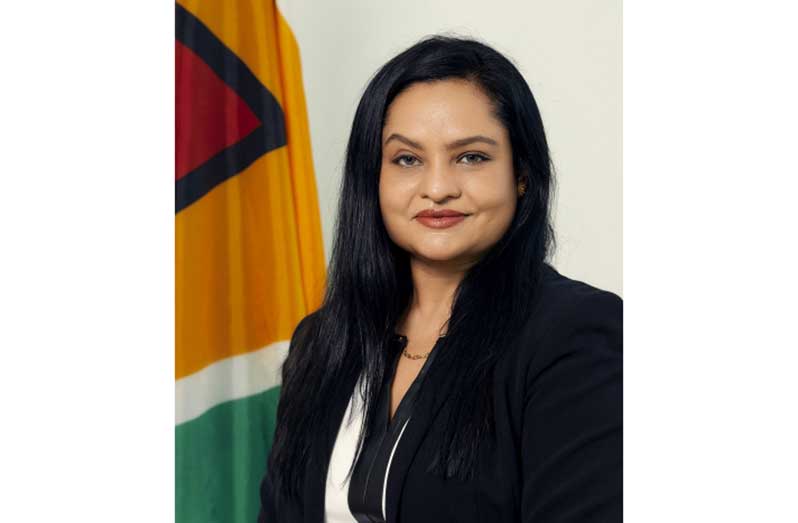
—Nationwide community engagements planned to address issues
Minister of Human Services and Social Security Dr. Vindhya Persaud is encouraging parents and families facing challenges to make use of the Ministry’s support services, warning that unresolved trauma, emotional abuse and harmful parenting practices are contributing to cycles of violence and dysfunction across society.
In a candid public discussion on family relationships and child welfare, the minister stressed that many of the issues affecting homes and communities today stem from deeper, unaddressed emotional wounds.
“We often hear the phrase, ‘hurt people hurt people,’ but if we’re being completely honest, it goes much deeper than that. In fact, I think untreated pain passes down,” Persaud stated.
According to the minister, the country is witnessing troubling patterns of abuse, aggression and emotional harm that affect both children and adults. She noted that while physical violence often attracts public attention, emotional and verbal abuse can be equally damaging and leave lasting scars.
She asserted, “We are seeing children fighting children, bullying each other. We are seeing parents and children going at it. I am seeing parents supposedly disciplining children, but to my mind, it looks totally like abuse. It is abuse.”
Persaud argued that society often overlooks harmful behaviours within families, particularly when there are no visible signs of physical violence.
“We ignore the quiet, subtle emotional neglect in families because at least there’s food on the table, right? That’s what we say. And no one is getting hit. But is that enough?” she questioned.
The minister highlighted concerns about parents who routinely belittle or humiliate their children, explaining that such treatment can have lifelong consequences.
“There is also this subtle and quiet thing sometimes called emotional abuse and verbal abuse, where children will tell me that their own parents call them terrible names,” she explained.
Recalling interactions with children during workshops, Persaud shared examples of young people who reported being called degrading names by their parents.
As part of efforts to address these issues, Persaud urged parents and guardians who feel overwhelmed to seek assistance through the Ministry’s various programmes and services.
“We have parenting programmes. We have parenting classes. And I want to encourage parents to reach out to us if they feel overwhelmed,” the minister said.
She outlined several initiatives currently available, including the Family Enhancement Service, the Child Protection Agency and the probation programme, all of which work with children, young people and families experiencing difficulties.
“We have the Family Enhancement Service, where we work with young people and their families. We have the Child Protection Agency, where we do the same. We have the probation programme, where we do the same,” she explained.
While noting that the Ministry stands ready to assist, Persaud emphasised that lasting change will require broader societal involvement.
“The point is, we have these services. But I still believe that while we have these services and we are 100 per cent ready to support. We need to really, really face what’s happening there and ask the hard questions,” she said.
The minister also reiterated her opposition to physical punishment and public humiliation as disciplinary methods.
“I do not support embarrassing children and young people in front of their peers, or in front of the public, or in front of anybody. These things have such deep-seated scars,” she remarked.
Persaud indicated that the discussion will continue through a series of community engagements across the country, beginning with visits to Region Two (Pomeroon-Supenaam), where she plans to meet directly with residents and hear their concerns.
The minister stated, “This is not a one-man solution or a one-woman solution. This is a solution that our country has to find, because it deals with people. It deals with homes. It deals with families.”
She urged citizens to participate in the conversation, seek help when needed and work collectively to create healthier homes and stronger communities for future generations.