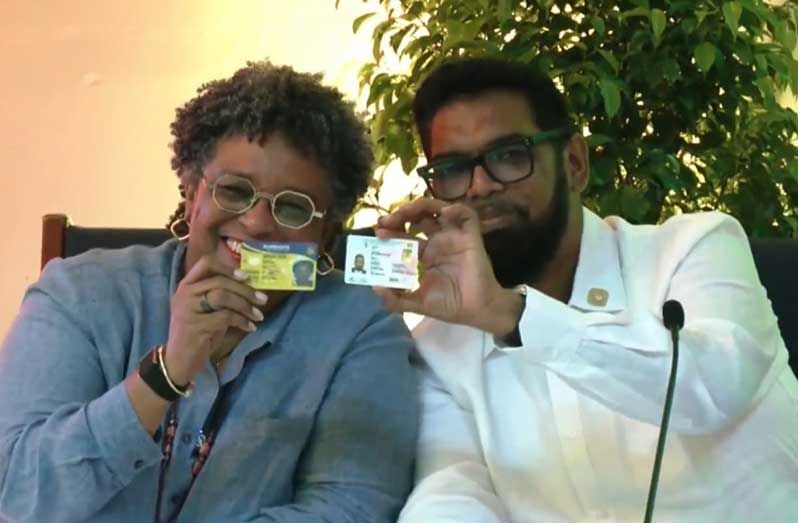
GUYANA and Barbados are moving to establish a new regional investment fund aimed at allowing ordinary citizens to invest in major development projects, as both countries prepare to officially roll out digital ID card travel from July 1.
The announcement was made on Tuesday during a press conference at the National Stadium, Providence, where President Dr. Irfaan Ali and Barbados Prime Minister Mia Mottley outlined a broader vision for deeper regional integration through digital systems, investment, and freer movement.
On Monday, Prime Minister Mottley became the first Barbadian to travel to Guyana using a digital identification card instead of a passport, under a new arrangement being implemented by both countries to allow citizens to travel without passports.
Under the new arrangement, citizens of both countries will be able to travel between Guyana and Barbados, using only their digital ID cards instead of passports.
“From July the first, you can forget your passport at home and travel with your digital ID card to Barbados and from Barbados to Guyana,” President Ali announced.
Prime Minister Mottley said the initiative is intended to directly benefit ordinary citizens, and make regional travel easier and more accessible.
“Even if a person does not have a passport but has a digital ID card, they can now travel between the two countries, and we say simply to you, we’ve only just begun,” she said.
Beyond travel, both leaders revealed that discussions are advancing on a major cross-border investment mechanism known as the “Trident Arrow Investment Fund”.
According to Prime Minister Mottley, the proposed fund is being designed to allow ordinary Barbadians and Guyanese to collectively invest in medium-and-long-term infrastructure and development projects.
“The second one we want to work on is the Trident Arrow Investment Fund, an investment fund that we want to be able to create that will be open to ordinary Bajans and ordinary Guyanese to invest in critical infrastructure and long-term, medium-to-long-term investment projects,” Mottley said.
She explained that the initiative could support investments in sectors such as utilities, technology, and agro-processing while giving citizens greater ownership in regional economic development.
“It allows ordinary people who could not do it on their own, but who, as part and parcel of a collective group, can make it happen,” the Barbadian leader stated.
President Ali said Guyana and Barbados are also advancing talks on stronger digital financial integration to create wider commercial and investment opportunities for citizens of both countries.
“We are now advancing talks on how we would digitally connect our financial systems in a stronger way, creating financial opportunities, business opportunities, commerce opportunities for both citizens of Barbados and Guyana,” President Ali disclosed.
The President noted that the digital ID initiative also forms part of a wider regional modernisation strategy and could eventually support integrated healthcare systems, allowing medical professionals in either country to securely access patient records when needed.
Both leaders described the developments as a major step towards modernising CARICOM integration through technology, easier movement and expanded economic participation for Caribbean citizens.