—more than 95% of population already has access to potable water as new treatment plants, wells advance nationwide
MINISTER of Public Utilities and Aviation Deodat Indar has outlined plans for Guyana to achieve 100 per cent treated-water coverage within the next two years, building on major investments that have already expanded potable-water access to more than 95 per cent of the population.
Speaking recently on the Guyana Dialogue, Indar explained that while access to potable drinking water already exceeds 95 per cent nationwide, treated water coverage, particularly along the coastline, currently stands at approximately 80 per cent.
“The potable drinking water, we have about 95 per cent, but treated water on the coastline is about 80 per cent. And in the next two years, we expect to bring that to 100 per cent,” the minister disclosed.
According to Indar, the government has already undertaken extensive infrastructural upgrades over the last five years to improve water access and quality, including the construction of seven new water-treatment plants and rehabilitation works at several others.
He noted that treatment plants have been established in communities, including Caledonia on the East Bank corridor, Onderneeming in Region Two (Pomeroon-Supenaam) and Parika and Wales in Region Three (Essequibo Islands-West Demerara), while additional facilities are planned in growing communities experiencing rising housing demand.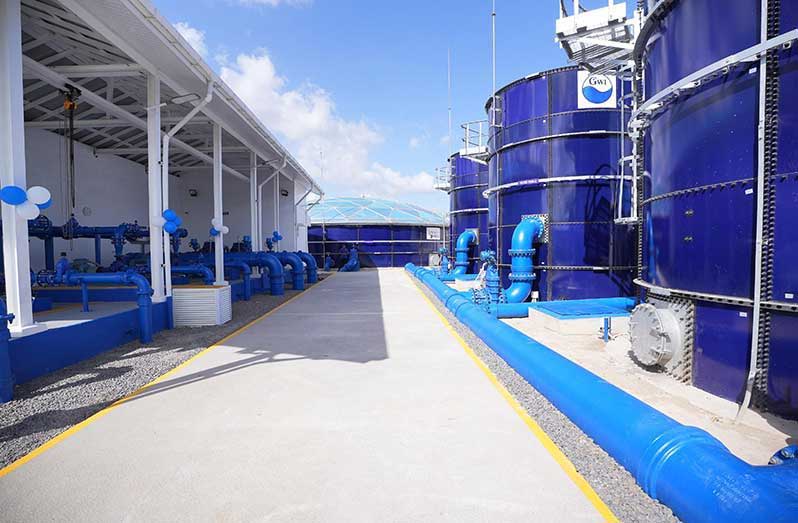
The minister explained that major population growth on the coastland has created increased demand for water production, particularly in expanding housing areas.
He pointed to planned treatment plants at Stewartville in Region Three and at La Bonne Intention (LBI) on the East Coast of Demerara (ECD), explaining that those areas have seen rapid housing expansion and require greater production capacity.
He said, “Across the entire coastline where there are more houses, more schemes going in, we have to have more production of water and the water has to be treated.”
The minister also highlighted advances in water-treatment technology, pointing to improvements made in communities such as Bartica, where surface water is now being treated to international standards for the first time.
According to Indar, authorities constructed a $607M treatment facility at Four Miles in Bartica using stream water, allowing residents to receive safer and more reliable supplies.
The minister explained, “Look in Bartica, we took for the first time, we took the stream that was running at the back there at Four Miles and we treated the water from the stream, the surface water and we put in a treatment plant there, and the water is treated.”
He noted that the treated water produced at the facility meets and exceeds standards established by the World Health Organization (WHO), with similar treatment systems expected to be replicated in additional communities as demand grows.
Indar further disclosed that the government has allocated approximately $22 billion in the 2026 capital budget for the Guyana Water Incorporated (GWI) to address water production and delivery challenges across the country.
Indar also highlighted progress in hinterland communities, where water access has now reached close to 100 per cent, with additional wells currently being drilled in remote villages.
He added, “In the last five years, we have done a number of wells in the hinterland, in areas that some Guyanese people don’t even know the names of the communities…”
The minister explained that delivering water services to remote communities remains challenging because settlements are often spread far apart, requiring additional pressure and production to maintain supply.
He also noted that Guyana’s water system faces challenges with iron content, particularly along the coastline, making treatment necessary to remove discolouration and impurities before the water reaches consumers.
Despite those challenges, Indar maintained that the government remains committed to ensuring every household and community gain access to safe and reliable water.
“We are working with an across-the-country approach to make sure that every household and every community has [sic] access,” the minister stated.
Minister Indar also pointed to challenges associated with water wastage and leakages, revealing that losses in the water system remain high. According to the minister, the loss factor for water production is close to 60 per cent, often due to broken transmission pipes, unattended leaks and consumer wastage.
“The same thing troubles GWI with leakages and wastage too, because their loss factor on water production is much higher [than that of the Guyana Power and Light]; it’s close to 60 per cent,” he stated.
The government has allocated $21.6 billion in the 2026 budget for improvements across the water sector, including $1.5 billion to expand access to potable water for more than 37,000 hinterland residents through new wells and water-distribution systems in communities such as Port Kaituma, Mabaruma, Mahdia, Batavia, Kumu and Shea.
An additional $8.2 billion has been earmarked to increase treated-water coverage nationwide, including advancing a 24 million litres per day surface-water treatment plant at Hope to serve more than 35,000 residents along the Cane Grove to Cove and John corridor, and the construction of a second 26 million litres per day treatment plant at Diamond to benefit over 36,000 residents on the East Bank Demerara corridor.
Improvements are also planned for the shelterbelt to expand water-treatment capacity for residents in Greater Georgetown.