






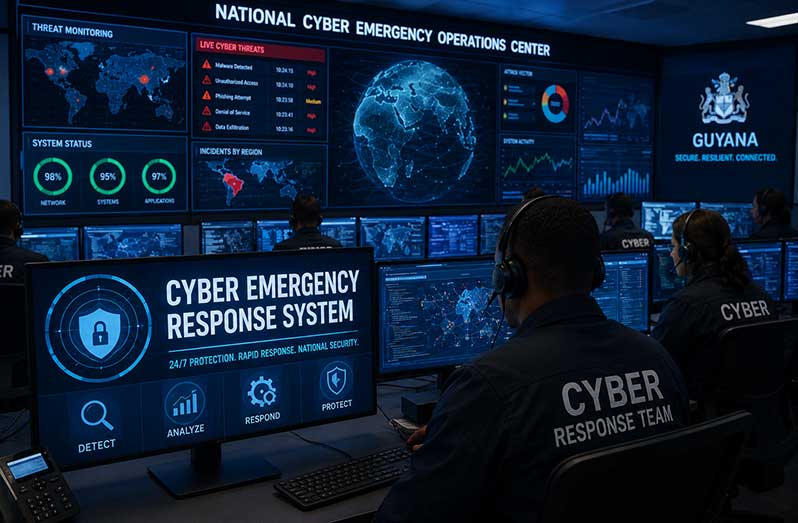
—Energy, banking and national infrastructure among key areas targeted for digital protection
TO protect the country’s rapidly expanding digital and economic infrastructure, President Irfaan Ali, on Friday, announced that Guyana is developing a round-the-clock cyber emergency response system as part of a wider national cyber security and digital resilience strategy.
Speaking during a press conference at the Office of the President, President Ali said cyber security has become a core pillar of Guyana’s national security architecture as the country accelerates digitisation across government services, finance, border management and the energy sector.
The Head of State explained that major investments are being made to ensure that Guyana’s digital systems and critical infrastructure are protected from cyber threats as the country transitions towards a more technology-driven economy.
“Cyber security is treated as a core national pillar,” President Ali said while outlining the government’s plans for a comprehensive cyber defence framework.
According to the President, one of the key components of the strategy is the establishment of a cyber emergency response team capable of operating 24 hours a day to detect and respond to threats in real time.
“We have to build a team with global standards, the best as a cyber emergency response team, a team that is available 24/7 to respond efficiently and effectively to cyber threats and challenges,” he said.
President Ali noted that the expansion of Guyana’s digital infrastructure, including the national payment system and electronic transactions, makes cyber resilience increasingly important.
He disclosed that by the end of this year the government expects to have the national payment system fully implemented, allowing persons to conduct transactions using QR codes and mobile devices.
“You can go and just scan a QR code and pay for anything,” the President said, adding that some local banks are already facilitating advanced mobile transactions and international payments.
The President stressed that the growing dependence on digital systems also requires stronger safeguards for critical sectors such as oil and gas, energy, telecommunications and financial services.
He revealed that the government is developing a dedicated energy sector cyber defence strategy to secure Guyana’s expanding oil and gas infrastructure, including the Wales Development Zone, petrochemical facilities and offshore assets.
“We will now have infrastructure in the petrochemical field, fertiliser plant, for example, the building out of the Wales Development Zone, our oil assets, our gas assets,” President Ali said.
He added that protecting energy-related data and infrastructure has become a national priority as Guyana moves toward greater “data sovereignty.”
“As we move towards owning more of our data and having data sovereignty, we have to ensure that the backbone is there to protect that data, so that it’s not stolen,” the President said.
President Ali also indicated that the government is reviewing and updating legislation to align with evolving international cyber security standards and norms.




