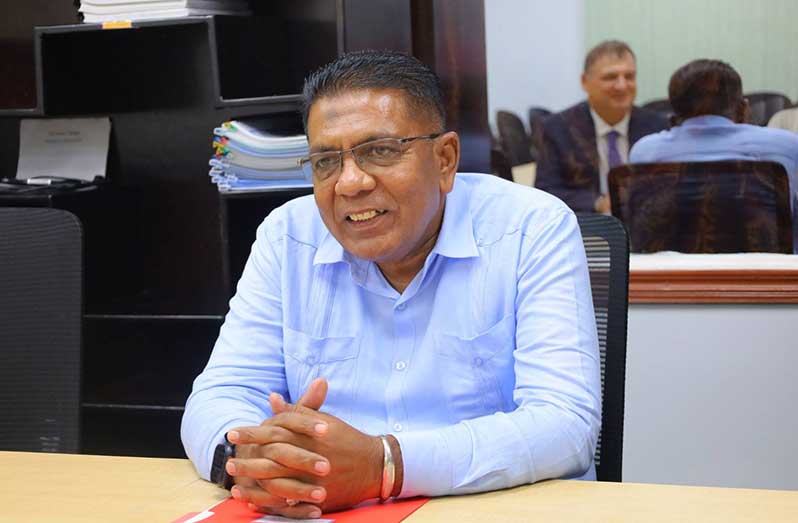
—Minister Mustapha highlights regional investments, climate-smart farming and agro-processing gains ahead of CWA 2026.
MINISTER of Agriculture and Chair of the Ministerial Task Force on Food Production and Food Security, Zulfikar Mustapha, delivered a sweeping assessment of the Caribbean’s agricultural landscape at the virtual launch of the 20th Caribbean Week of Agriculture (CWA).
Speaking on Thursday, the minister outlined a region-wide push toward food sovereignty, climate resilience, and export competitiveness, reaffirming Guyana’s position at the forefront of that charge.
Speaking ahead of the landmark event, which will be hosted in Jamaica from September 28 to October 2, 2026, Minister Mustapha highlighted record national investment, celebrated progress across member states, and called on the region to embrace the transformation signalled by this year’s theme: “The New Face of the Caribbean Food System.”
Recent years have seen the Caribbean Week of Agriculture evolve into one of the region’s most important platforms for dialogue, collaboration, innovation, and action in advancing sustainable agricultural development and regional food security.
As the minister stated, the forum aims to bring together governments, farmers, private sector stakeholders, development partners, youth, and researchers with the common purpose of building a strong and more resilient Caribbean food system.
Calling this year’s theme both timely and visionary, he noted that it reflects the region’s goal of securing the future of agriculture and strengthening collective resilience.
Speaking on the importance of collective development, Minister Mustapha stated, “Agriculture remains deeply connected to the economic and social fabric of our region. It sustains livelihoods, supports rural communities, contributes to economic growth, and plays a critical role in reducing poverty and improving nutrition and health outcomes.”
Highlighting the challenges, he added, “However, we also recognise that the sector continues to face significant challenges. Climate variability, rising production costs, global supply chain disruptions, natural disasters, and market instability continue to affect food production and food availability across Caribbean.”
Despite these challenges, the region has made notable progress in strengthening food production systems and advancing the regional food security agenda. As the minister explained, this progress has been driven by deliberate investments, innovative policies, and strategic partnerships across member states.
Countries across the Caribbean are implementing transformative initiatives tailored to national priorities while contributing to the broader regional agenda. As he shared, the Bahamas has developed climate-smart agriculture initiatives supported by the Inter-American Development Bank, which are promoting hydroponics, farming, and renewable energy solutions.
Similarly, Belize continues to support small farmers through financial assistance and reforestation initiatives while expanding production in key commodities through World Bank-supported projects.
Jamaica, the minister noted, is also strengthening post-harvest infrastructure through the expansion of cold storage facilities while investing in climate adaptation measures to improve water management and crop resilience.
Suriname is modernising plant and animal health services and implementing climate-resilient agricultural projects focused on sustainable land and water management.
Haiti’s agricultural recovery efforts continue through FAO-supported seed distribution programmes and watershed restoration initiatives aimed at building livelihoods and reducing disaster risk.
Meanwhile, on the meaningful advances of other member states, he added, “Antigua and Barbuda is expanding greenhouse farming systems. Barbados is positioning breadfruit as an export-orientated superfood while engaging youth in agriculture. Dominica is investing in agro-processing resilience and employment creation.”
He continued, “Grenada continues to strengthen fisheries management and land regulation. St. Lucia is improving fisheries resilience and revitalising the banana industry. St. Vincent and the Grenadines is enhancing partnership for sustainable crop marketing. St. Kitts and Nevis is advancing sustainable land management programmes. Montserrat is focussing on reducing food import dependence through targeted local production. Trinidad and Tobago is investing heavily in agro-processing and protected agriculture systems.”
Bringing the conversation back home, Minister Mustapha noted that Guyana continues to prioritise agriculture as a major driver of economic diversification and regional food security.
Noting this year’s robust budgetary allocation, he said, “This year alone, over $113 billion Guyana dollars has been allocated to the agriculture sector as we continue expanding drainage and irrigation infrastructure, increasing production, and investing in value-added opportunities across multiple subsectors.”
He further cited these developments across the region as encouraging signs that CARICOM is steadily moving in the right direction, adding, “We are witnessing increased primary production, greater investment in agro-processing, wider adoption of climate-smart and protected agriculture technologies, and stronger linkages among farmers, processors, markets, and exporters.”
On the policy front, Minister Mustapha noted that CARICOM has identified several priority sectors critical to transforming the region’s agri-food system. As the minister further explained, investments are being made in livestock production to modernise slaughtering facilities, improve feed systems, strengthen food chain logistics, and expand inter-regional trade.
In cereals such as corn and soya, the region is scaling up commercial production, expanding storage, milling, and feed processing capacity to improve feed security and reduce production costs.
In the area of fruits and vegetables, member states are investing in orchard development, greenhouses, and shade house systems. The dairy industry is also receiving renewed attention through investments in modern dairy farms, pasteurisation facilities, and cold chain infrastructure.
On niche industries, Minister Mustapha added, “Niche industries such as honey and spices are being strengthened to improve certification systems, quality assurance mechanisms, and export promotion initiatives that position Caribbean products in the international market.”
The continued collective push for sustainable development in agriculture represents a coordinated regional strategy that combines production, processing, logistics, trade, and export competitiveness as the region works toward its 2030 food security target.
Moving forward, Minister Mustapha emphasised that the Ministerial Task Force will remain committed to working closely with member states and regional institutions to remove barriers to inter-regional trade, harmonise standards, improve transportation, increase production in priority commodities, and expand value-added and export opportunities for Caribbean producers.
As the minister stated, “Our collective success will depend on continued collaboration, innovation, and sustained investment in the agriculture sector. I am confident that the discussion and engagement during CWA 2026 will help shape a more resilient, sustainable, and competitive agricultural future for our region.”