— rules anti-money laundering agency has legal standing to institute court proceedings and dismiss Moura Gago appeal bid
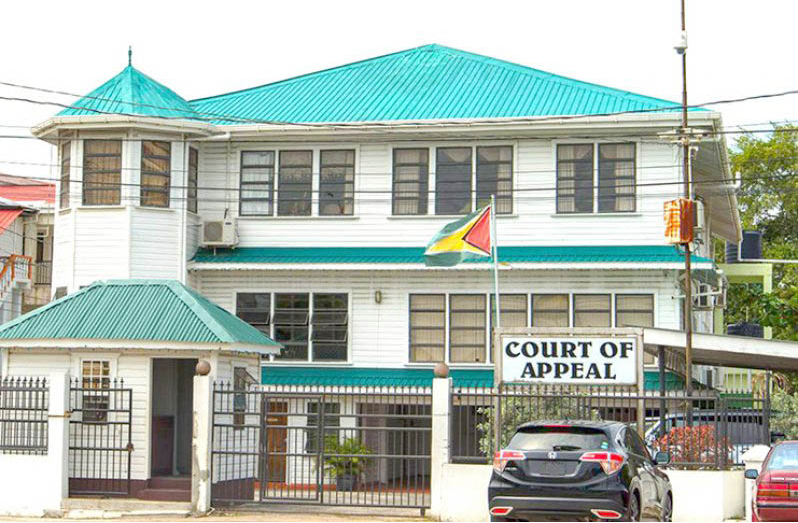
The Court of Appeal on Monday dismissed an application by Brazilian gold dealer and his company seeking leave to appeal a Full Court ruling which affirmed that the Special Organised Crime Unit (SOCU) has the legal authority to institute proceedings under the Anti-Money Laundering and Countering the Financing of Terrorism (AML/CFT) Act.

In a unanimous decision delivered by Justices of Appeal Dawn Gregory, Jo-Ann Barlow and Rafiq T. Khan, S.C., the court ruled that the Sebastiao De Oliveira and Moura Gago Gold Inc. failed to show that their proposed appeal had “a realistic prospect of success.”
The matter stemmed from an earlier Full Court ruling which overturned a High Court finding that SOCU lacked legal personality to bring proceedings for the detention of property under the AML/CFT Act.
The Full Court had instead found that SOCU was expressly empowered under the legislation to initiate such actions as a “relevant Competent Authority.”
Attorneys for the applicants argued that amendments to the AML/CFT Act in 2022 and 2023 did not grant SOCU legal personality or the capacity to sue.
They contended that SOCU would need to be a “body corporate” or otherwise clothed with legal personality before it could institute court proceedings.
However, attorneys for SOCU maintained that amendments to the legislation, particularly Sections 39 and 109A, specifically identify SOCU as a competent authority and provide the statutory basis for it to engage the courts in matters prescribed under the Act.
In examining the matter, the Court of Appeal upheld the reasoning of the Full Court, which found that the AML/CFT Act explicitly assigns functions to SOCU that “cannot be discharged without recourse to the courts.”
The Full Court had stated in its ruling, “It would be illogical to conclude that Parliament intended SOCU to restrain or detain property yet denied it the procedural means to do so.”
The judges further noted, “Formal incorporation is not required. Parliament has, by necessary implication arising from its statutory function conferred the requisite legal standing.”
The Court of Appeal said the Full Court conducted a “careful examination” of the relevant provisions of the AML/CFT Act, including Sections 2(1), 38, 39 and 109A, all of which identify SOCU as a competent authority with powers relating to forfeiture and other related matters.
According to the ruling, the Full Court correctly interpreted Parliament’s intention as granting SOCU the legal authority necessary to carry out its responsibilities, including initiating legal proceedings under the Act.
As a result, the Notice of Motion seeking leave to appeal was dismissed, with the court making no order as to costs.
Shortly thereafter, SOCU filed five criminal charges against Moura for alleged money laundering under the AML/CFT Act. Despite an interim return of the assets to the respondents in November 2025, SOCU re-seized the properties, arguing they were at risk of dissipation and necessary for evidentiary purposes.