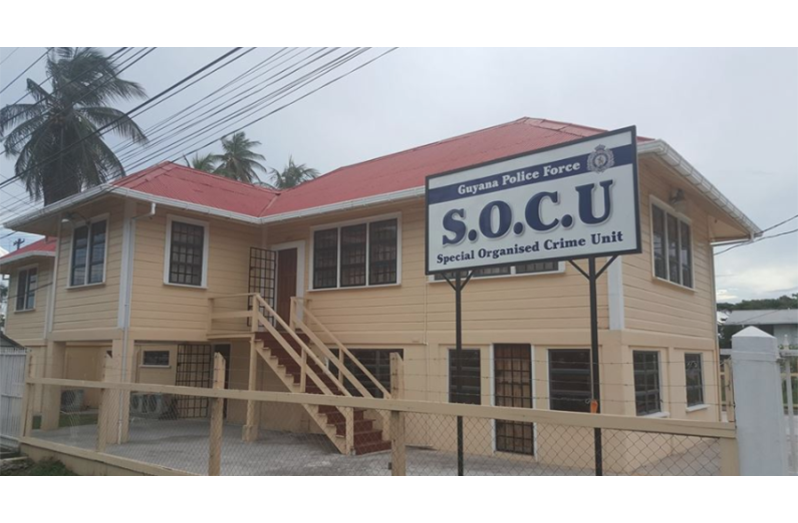
THE Full Court, on Thursday, unanimously ruled that the Special Organised Crime Unit (SOCU) has the legal capacity to institute and maintain court proceedings in its own name under the Anti-Money Laundering and Countering the Financing of Terrorism Act (AMLCFT Act), setting aside a High Court decision that had significantly limited the agency’s powers.
In a reasoned judgement delivered on December 18, 2025, Justices Nigel Niles and Zamilla Ally-Seepaul held that SOCU’s authority to initiate legal action flows directly from the AMLCFT Act, which assigns the unit functions that necessarily require access to the courts.
The ruling restores SOCU’s ability to pursue civil restraint and confiscation proceedings involving property suspected to be the proceeds of crime.
The decision arose from an appeal filed by SOCU on June 17, 2025, challenging a ruling by High Court Judge Peter Hugh delivered on May 27, 2025.
In that decision, Justice Hugh struck out an application by SOCU seeking detention and restraint orders over large quantities of gold and foreign and local currency allegedly linked to money laundering. The assets are associated with Sebastiao Moura, a Brazilian national with gold mining operations in Guyana, and Gago Gold Inc.
Moura is charged with five counts of money laundering under section 3(1)(c) of the AMLCFT Act. Those charges, which remain before the Georgetown Magistrates’ Court, are directly connected to the properties SOCU sought to restrain.
Justice Hugh had ruled that SOCU lacked legal capacity to institute or maintain proceedings because it is not a body corporate within the meaning of the Companies Act and because the AMLCFT Act did not expressly confer corporate status on the unit. That finding, if upheld, would have prevented SOCU from carrying out key aspects of its statutory mandate.
Appearing before the Full Court, Attorney General and Minister of Legal Affairs Mohabir Anil Nandlall, SC, argued that the issue was one of substantial public importance. He submitted that the High Court ruling had effectively disabled SOCU from performing critical functions expressly assigned to it by Parliament, including the restraint and confiscation of assets linked to money laundering and other financial crimes.
The Attorney General contended that the question of corporate legal personality under the Companies Act was irrelevant to SOCU, and pointed to several provisions of the AMLCFT Act that, he argued, clearly empower the unit to bring proceedings in its own name. He warned that allowing the earlier ruling to stand would cripple SOCU’s operations and undermine the effectiveness of the country’s anti-money laundering framework.
In agreeing with those submissions, the Full Court held that SOCU’s legal standing is a matter of public importance with direct implications for the administration of the AMLCFT regime. The judges noted that the issue involves statutory interpretation and SOCU’s institutional competence, and that if left unresolved, it could recur and adversely affect future cases brought under the Act.
After examining sections 2, 38, 39 and 109A of the AMLCFT Act, along with relevant case law, the Court found that the legislation “assigns to SOCU in explicit terms, functions that cannot be discharged without recourse to the courts, particularly the restraining, seizing, detaining and forfeiting of tainted property.” The judges further observed that sections 38 and 109A “directly integrate SOCU into the framework of civil restraint and confiscation proceedings,” making it illogical to suggest that Parliament intended to grant those powers without also providing the procedural means to exercise them.
The Full Court concluded that SOCU does possess sufficient legal capacity under the AMLCFT Act to institute proceedings for civil restraint and confiscation, and that there is no requirement for the unit to have corporate personality to do so. Parliament, the Court held, has expressly conferred on SOCU the necessary legal authority as a competent agency to bring and maintain such actions.
SOCU was represented in the appeal by Attorney General Nandlall, along with Shoshanna V. Lall, David Brathwaite, Thalia Thompson and Mohanie Sudama. The respondents were represented by Latchmie Rahamat and Naresh Poonai.
The ruling is expected to have significant implications for the enforcement of Guyana’s anti-money laundering laws, reaffirming SOCU’s role as a central actor in efforts to restrain and recover assets suspected to be derived from criminal activity.