






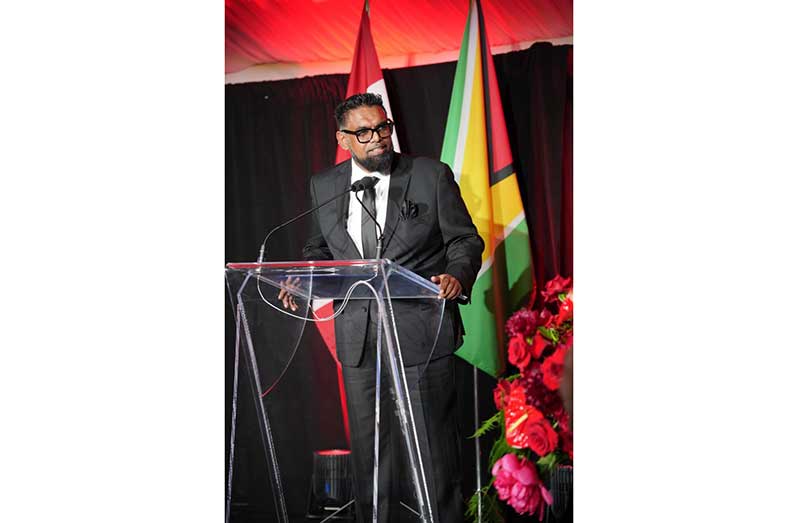
PRESIDENT Dr. Irfaan Ali has called on Canada to join Guyana’s Global Biodiversity Alliance (GBA), arguing that a country positioning itself as a leader in climate and environmental issues should play an active role in shaping the future of biodiversity protection and financing.
The GBA, conceptualised by President Ali, is a Guyana-led international initiative launched in July 2025 to bring together countries, experts and key stakeholders to advance biodiversity conservation, unlock the value of ecosystem services through carbon markets, and support the global goal of protecting 30 per cent of nature by 2030.
Headquartered in Georgetown, Guyana, the alliance is focused on developing, promoting and implementing innovative financing mechanisms, including biodiversity credits, to support conservation efforts and sustainable environmental management.
Speaking recently at the Guyana-Canada Business Forum at the Aga Khan Museum in Toronto, Canada, President Ali said Canada’s participation in the alliance was critical, especially as the global economy increasingly shifts toward climate and biodiversity-based solutions.
He stressed that Guyana has already launched the initiative and attracted participation from advanced economies and leading institutions worldwide.
Over a dozen countries had joined as founding members. Members/partners include Guyana, the United Kingdom (UK), which formally joined in January 2026, and the World Bank through its International Development Association (IDA) as a formal partner in April 2026.
Guyana aims to expand membership to at least 140 countries and organisations.
“We launched the Global Biodiversity Alliance. Some of the most advanced economies and the best institutions in the world are joining that alliance,” Ali said. However, he noted that “Canada has not joined as yet”.
The Guyanese Head of State made a direct appeal for Canadian involvement, asserting that the country’s environmental credentials should naturally align with the alliance’s objectives.
“I believe that it is important for Canada to be part of the Global Biodiversity Alliance, because if Canada projects itself as a leader on environment, climate, and biodiversity, how can they not be part of the Global Biodiversity Alliance?” he questioned.
The Guyanese leader framed the alliance not only as an environmental initiative but as a major economic opportunity for countries capable of participating in emerging climate markets.
He explained that the alliance could help unlock new pathways for sophisticated climate economies, such as Canada’s, especially through the development of biodiversity credits.
“We have to be able to make the case, because the Global Biodiversity Alliance unlocks opportunity for a sophisticated climate economy like Canada,” Ali stated.
The President said Guyana sees tremendous potential in establishing “a market-based mechanism for the sale of biodiversity credit,” noting that biodiversity loss globally presents both an environmental challenge and an opportunity for countries that have preserved their natural resources.
He said, “If we’re able to come together and build a market-based mechanism for the sale of biodiversity credit, the power of that in the future, when the world has lost more than 60 per cent of its biodiversity in the last 50 years, just imagine a country like Guyana that has kept our biodiversity intact.”
Dr. Ali cautioned that global industrial expansion and increased mineral extraction are placing additional strain on ecosystems worldwide, making biodiversity preservation even more urgent.
“Just imagine the potential of this market,” he said, while referencing a world “pursuing minerals at a speed and scale, never imagined in the history of humanity,” which could continue to place pressure on the Earth’s natural systems.
The President also linked government policy directly to private sector participation, warning that Canadian businesses may be less likely to pursue biodiversity-related opportunities in Guyana unless there is policy-level support from Ottawa.
“But again, if at a policy level Canada is not there, then the private sector will not follow, because the private sector follows government lead,” Ali said. “Canadian investors would follow policy.”
According to Dr. Ali, diplomacy and government cooperation remain essential to unlocking broader investment opportunities between Guyana and Canada, especially as Guyana rapidly advances its development agenda.
He added, “That is why diplomacy and government goes hand in hand. If at a government level we don’t create the lead for the private sector to follow, then it becomes difficult for the private sector to understand at a national frame where we’re heading and where those opportunities are.”
President Ali’s remarks formed part of a wider address to Canadian investors and officials in which he outlined opportunities in agriculture, tourism, manufacturing, healthcare, education and energy, while encouraging a deeper reset in Guyana-Canada relations to reflect Guyana’s evolving economy.




