

THREE generations have chosen service over self. Now, Kella and Pamela Ramsaroop are ensuring that the Dharm Shala’s pledge — ‘Home of Benevolence for All Races’ — endures.
The Dharm Shala, Guyana’s oldest charity, marked 106 years this year. Its legacy endures because the Ramsaroop family gave up careers abroad to continue what began as one man’s vision in Albouystown.
Founded in 1921 by Pandit Ramsaroop Maraj at 128 James and King Streets, Georgetown, the charity was born from his travels as a gold dealer.
Moved by the poverty he witnessed across Guyana, the deeply spiritual 32-year-old abandoned his lucrative trade to serve others.
He began with alms and a soup kitchen, then built five wooden structures with his own funds and community donations.
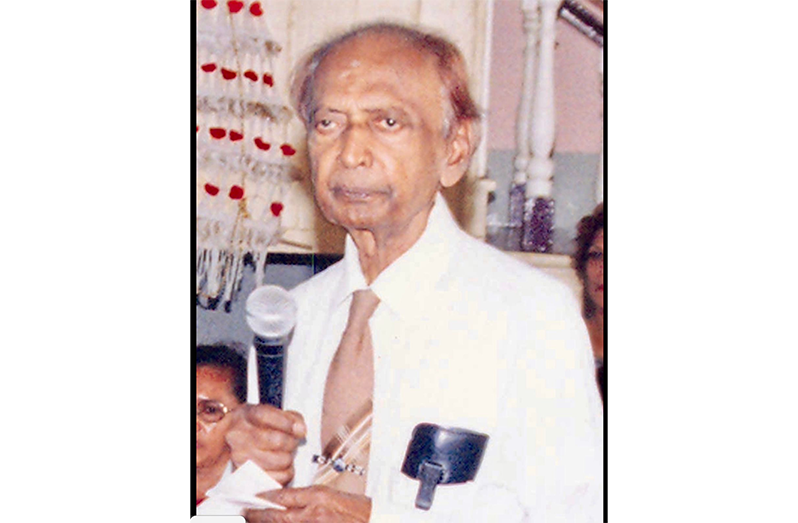
The Dharm Shala’s aims remain unchanged: To shelter, feed, clothe, and attend to the medical and spiritual needs of residents — entirely free of charge.
That mission is now upheld by Maraj’s granddaughters.
Kella Ramsaroop, a former banker in Guyana and municipal worker in the U.S., serves as the Managing Head. Pamela Ramsaroop, a retired UK barrister-at-law, is President. Both women returned to Guyana to continue the charity after their father, Harry Ramsaroop, died in 2013.
Their father had made the same sacrifice decades earlier.
In his 30s, with four young daughters, Harry left a senior government post and a promising cricket career to lead the Dharm Shala after Pandit Maraj’s death in 1950, days before his 60th birthday.
HANDS-ON LEADERSHIP
“We have a hands-on approach to all matters,” Kella says. She visits the Georgetown Home daily, checking residents’ health, needs, and the facility’s upkeep.
The charity operates 11 buildings — six in Georgetown and five in Canje, Berbice. Twenty-four residents are housed in Georgetown, while the Canje location is home to fifty persons.
Under the sisters, structures have been modernised with improved sanitation, updated rules, and renovated living quarters.
Funding comes from a $2million annual government subvention, public donations, and the sisters’ inheritance.
President Irfaan Ali donated $1M during his traditional Christmas Day visit in 2024 and pledged continued support.
FROM JEWELLER TO SERVANT OF HUMANITY
Pandit Maraj, born November 3, 1889, at Friendship, Wakenaam, relocated to Georgetown and founded the Hindu Religious Society.
The first Dharm Shala building opened in 1929 at King Edward and Sussex Streets. A feeding space served 200 people daily.
Realising many needed shelter not just meals, he built a wooden dormitory, which would be the first Dharm Shala.
In 1939, he added a Christian chapel and a priest’s quarters next to his colonial-style home on James Street and opposite the Dharm Shala.
Below the house stands a Shiva mandir. The chapel was re-dedicated to St. Francis in 1957 by Archbishop Alan John Knight.
Expansion to Berbice followed in 1941, with colonial government support. There, Maraj built another Shiva mandir, an Anglican chapel, and an L-shaped structure for residents, plus a school.
Maraj’s service made history. In 1934, he became the first Indian in the West Indies to be honoured twice by King George VI with the Silver Jubilee Medal. He was later appointed a Member of the Order of the British Empire (MBE).
Harry Ramsaroop also received an MBE for charitable work, along with Guyana’s Medal of Service and Cacique Crown of Honour (CCH).
The Dharm Shala welcomed Princess Mary, the Princess Royal, on January 30, 1960, during her tour of British Guiana. Prince Charles, now King Charles III, visited in February 2000.
When Harry assumed leadership, contractors warned that repairing three aging colonial buildings would be costly.
He heeded their advice: The structures were dismantled and replaced with two ferro-concrete buildings, with separate male and female sections.
In 1963, a medical dispensary was added to serve residents and the Albouystown community. In Berbice, he replaced the L-shaped building with two separate dormitories for men and women.
A FAMILY COMMITMENT
Kella recalls her grandfather’s daily visits to discuss the Dharm Shala with her father as she did homework. “That made a great impact… This is noble work. We don’t take money from there. God has blessed us with what we have.”
Their mother, Anna Callie Bansgopal of Corentyne’s prominent Hanuman family, also supported the charity. Two other sisters, Ula and Pauline, volunteer when able.
At Harry’s request, his death was not announced until after a simple cremation. Wreaths sent afterward were distributed to the Dharm Shala’s temples and churches.
At his funeral, an Anglican priest said, “You don’t need a recommendation to where you are going” — a tribute, Kella notes, “for someone who spent a lifetime serving humanity.”
The sisters recount one notable episode: A government official once asked Harry to temporarily house Indian immigrants awaiting the MV Resurgent — the final ship to repatriate indentured labourers to India.
It left Guyana on September 4, 1955, arriving October 12, ending the indenture system.
As documented in their book ‘A Labour of Love,’ the Dharm Shala’s humanitarian journey continues without pause.
“We pray God blesses and sustains those who support the charity and its beneficiaries,” the sisters say, “as we continue to serve and keep the charity alive.”