






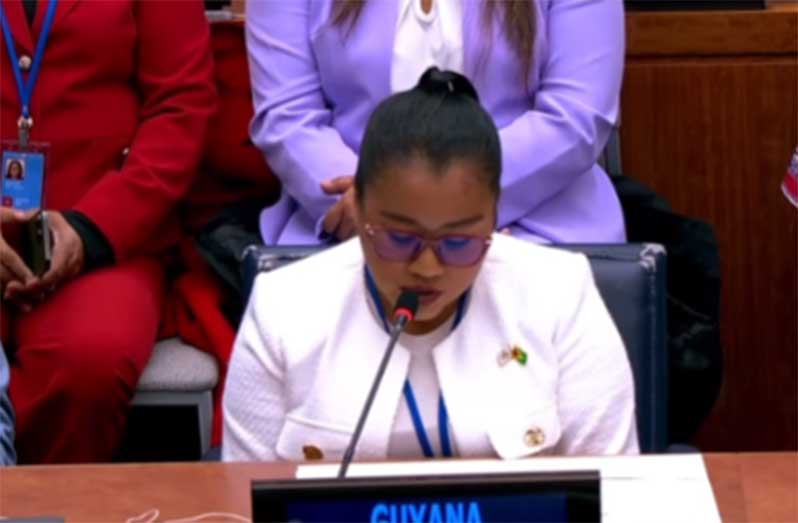
GUYANA has used a prominent platform at the United Nations (UN) to highlight its model of ongoing government-supported Indigenous participation, and to urge the international community to change how multilateral institutions fund Indigenous Peoples’ work and representation.
Director General of the Ministry of Amerindian Affairs, Toshao of Bethany Village, and Vice-Chairperson of the National Toshaos Council (NTC), Sonia Latchman, presented the statement at the 25th session of the UN Permanent Forum on Indigenous Issues (UNPFII).
This event is taking place at UN Headquarters in New York from April 20 to May 1, 2026. She spoke during a thematic dialogue focused on the financing of Indigenous Peoples’ participation within multilateral and regional systems.
As both an Arawak leader and a senior government official, Latchman emphasised a fundamental belief that meaningful Indigenous participation at the global level cannot happen without first securing support at the national level.
“We cannot expect the full and effective participation of Indigenous Peoples at the regional and multilateral levels if they are ignored at the national level,” she told the Forum.
Latchman noted that Guyana differs from many nations because its government actively funds the participation of Indigenous leaders in international discussions.
Guyana’s delegations to groups like the UNPFII, the UN Climate Change Conference (COP), and the Amazon Cooperation Treaty Organization (ACTO) include representatives from the National Toshaos Council. The NTC serves as the statutory body representing elected Indigenous leaders from over 200 Amerindian communities in Guyana.
This formal inclusion is strengthened by an annual state grant provided directly to the NTC for its operations.
Latchman described this measure as a sign of a real and ongoing partnership between the government and Indigenous Peoples, rather than a one-time or symbolic gesture.
A key point of Latchman’s address was Guyana’s approach to sending funds directly to Indigenous villages, avoiding bureaucratic middlemen that often slow down or dilute development financing.
She explained that, in addition to the national budget for education, health, food security, economic projects, and support for women and youth, funds are deposited straight into the bank accounts of every Indigenous village through Guyana’s Low Carbon Development Strategy (LCDS) and the Ministry of Amerindian Affairs.
This model, based on the LCDS 2030 framework, has already produced significant outcomes. Carbon credit revenues from Guyana’s vast rainforest have provided GY$14.4 billion (about US$69 million) directly to Indigenous communities over three years.
Between 15 and 26 percent of annual carbon credit revenues have been transferred directly from the government to these communities, with those funds going into Village Sustainability Plans made and approved by the villages themselves.
In the past two years alone, $9.5 billion in climate revenues has been distributed to over 242 villages, funding roughly 1,700 economic and social projects.
While celebrating Guyana’s achievements, Latchman also offered a critical perspective on the international system.
MULTILATERAL LEVEL
She acknowledged that at the multilateral level, funding for Indigenous Peoples is still fragmented, hard to access, and often flows through intermediary systems that limit speed, scale, and the direct control that communities need to drive their own development.
On behalf of Guyana, she urged the international community to establish dedicated and reliable funding for Indigenous Peoples, provide direct access to climate and biodiversity finance, and formally recognise Indigenous governance systems as legitimate and effective channels for managing and delivering development outcomes.
These requests support a broader discussion at UNPFII 25, where member states and Indigenous representatives have been looking at how structural barriers in multilateral financing continue to marginalize Indigenous Peoples.
Latchman concluded her statement with a powerful realisation drawn from experience, which also challenged multilateral institutions that are still hesitant to grant direct financial ownership to Indigenous communities.
“Guyana’s experience has shown that when Indigenous Peoples are trusted with resources, we deliver,” she said.




