






-Agriculture Minister says
ON Friday, Minister of Agriculture Zulfikar Mustapha said that the private sector’s role remains critical, as greater investment is needed in processing, innovation, and market development in the agriculture and manufacturing sectors.
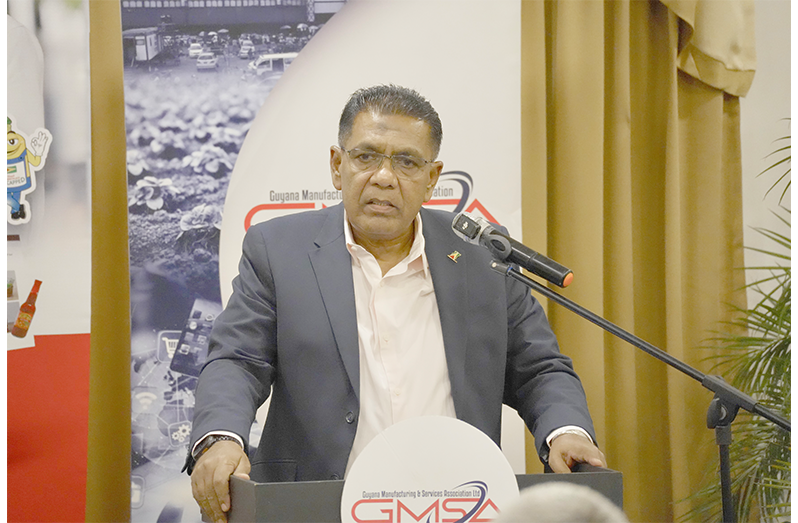
At the time, the minister was delivering remarks at the Guyana Manufacturers and Services Association (GMSA) Annual General Meeting, which was held under the theme, ‘Positioning for Progress: Advancing Industries Together’.
Minister Mustapha had said that the agriculture, and manufacturing and services sectors are no longer operating in silos, but instead are increasingly interdependent on each other, forming integrated value chains which drive economic growth, job creation and national resilience.
He commended the GMSA for consistently providing a platform where key stakeholders can enjoy meaningful activities, reflect on the progress and chart a strategic path forward for these sectors locally.
The minister posited that Guyana’s economy remains robust, with a projected overall growth of 16.2 per cent, and non-oil economic growth of 10.8 per cent in 2026. This non-oil growth is expected to be driven by construction, which is set to contribute 25.4 per cent, manufacturing 12.9 per cent, agriculture 7.9 per cent and services 6.8 per cent.
The agriculture head stated that much of this growth in the manufacturing sector is driven by agriculture. As the agriculture sector continues to contribute tremendously to Guyana’s development, Minister Mustapha highlighted current initiatives that are taking shape in this sector to boost offerings and opportunities around Guyana and the wider Caribbean community. These include the food hub at Yarrowkabra that is being built by Blumberg Grain at a sum of US$12million plus.
“In 2026, $745 million has been allocated to advance agro-processing initiatives. This will be complemented by a suite of progressive fiscal incentives, including zero per cent tariff on agro-processing inputs, special incentives, and a graduated corporate tax regime for agro-processors, expanding financing and co-investment opportunities,” the minister added.
He explained that these measures are designed to reduce production costs, as well as stimulate private investment, and position Guyana as a leader in value-added agri-business within the region.
The minister affirmed that as we expand into the regional and international markets, maintaining high standards of quality, safety and competitiveness will be essential for us.
“While the government continues to invest in infrastructure and production, the role of the private sector remains critical. Greater investment is needed in processing, innovation, and market development,” he said.
The minister assured his audience that over the next five years, the agriculture sectors will undergo significant modernisation, supported by investments in drainage and irrigation systems, farm-to-market roads, research and extension services, infrastructure, and input support for farmers across Guyana.
He disclosed that digital transformation is also underway, with platforms such as the Agriculture Information System and the Farmers Connect app improving access to data and extension services, while the upcoming digital seafood market is set to connect fish folks directly with buyers.
“As we look ahead, inclusive development must remain a priority. Economic growth must benefit not only large enterprises, but also farmers, small and medium-sized businesses, and communities across the country,” the minister noted.
He urged the GMSA to look at ways it can improve its services, and how it could have a consistent education for members. He called on the Association to encourage its members to take up the opportunities that will come their way.
“Let us continue to work together to build a resilient, inclusive, and forward-looking economy, one in which agriculture, manufacturing, and services are fully integrated and mutually reinforcing,” he said.




