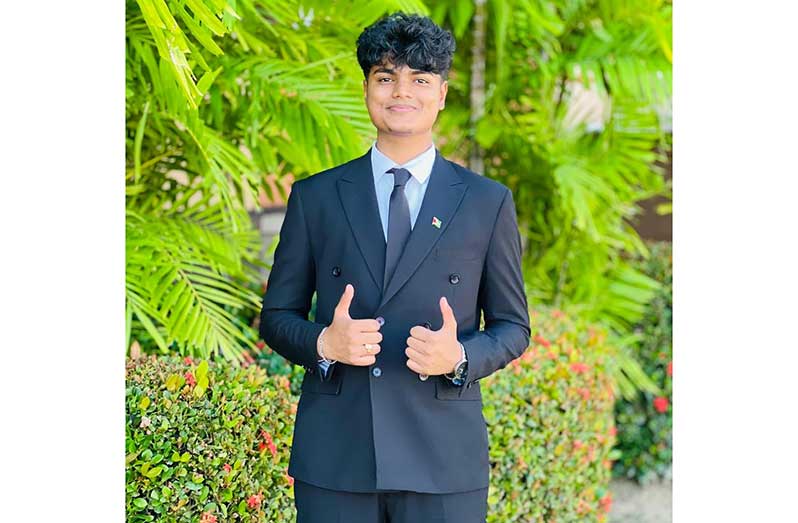
A SON of Wakenaam, Essequibo River, has challenged Caribbean graduates to use their education not merely as a pathway to personal success, but also as a responsibility to serve their communities, transform their societies and help shape a brighter future for the region.
Delivering the 2026 valedictorian address for the Faculty of Social Sciences during the morning graduation session at The University of the West Indies (UWI), Naresh Jagnanan called on his fellow graduates to rise with purpose, courage and a commitment to meaningful development.
Speaking under the graduation theme, “Built to Adapt, Ready to Lead,” Jagnanan reflected on the challenges facing the Caribbean, including economic uncertainty, climate change, technological advancement and persistent inequality, while emphasising the region’s resilience and capacity to overcome adversity.
Drawing on his personal journey from Wakenaam, a small island in the Essequibo River, Jagnanan said his experience reflected the hopes and uncertainties shared by many students who leave their communities in pursuit of higher education and greater opportunities.
He noted that the name Wakenaam, a Dutch word meaning “waiting for a name,” held a special significance for him as he embarked on his own journey of self-discovery at UWI.
“When I left home for UWI, I too was waiting — waiting to discover what was possible, waiting to discover who I could become,” he told the graduating class.
Jagnanan said the university experience extended beyond academic learning, allowing students from different Caribbean territories to appreciate their shared identity, culture and history.
Referencing the Mighty Sparrow’s celebrated message, “All Ah We Is One Family,” he highlighted how friendships, cultural exchanges and shared experiences brought students together, demonstrating regional integration in practice.
He also acknowledged the personal sacrifices made by graduates along the way, including balancing employment and studies, managing family responsibilities and overcoming disappointments that often remained unseen by others.
According to Jagnanan, their presence at graduation was proof that a person’s circumstances or beginnings should never determine the limits of their achievements.
“Because every graduate sitting here today is evidence that our beginnings do not have to dictate our endings,” he declared.
Turning his attention to the future, Jagnanan said the graduating class was entering a rapidly changing world in which artificial intelligence is reshaping the workplace, climate change is affecting communities and economic pressures are testing the resilience of nations.
However, he maintained that the Caribbean’s history of adapting to challenges provided a strong foundation for the next generation of leaders.
He urged graduates to recognise that their degrees came with an obligation to use their knowledge and skills in the service of others.
“A UWI degree asks something more of us than professional competence. It asks us to serve,” he said.
Jagnanan encouraged graduates from the various social science disciplines to look beyond statistics, policies and academic theories and remain mindful of the people and communities affected by their work.
He further challenged them to redefine Caribbean development, arguing that progress should not be measured solely by economic growth and prosperity, but also by the opportunities created for ordinary people.
“Our generation must have the courage to shape that story — to define development not simply as more wealth, but as more opportunity; not simply as more prosperity, but as prosperity that reaches people,” he said.
As he concluded his address, Jagnanan reminded the graduating class that they were part of a region with a rich history of resilience, creativity and possibility, and that their ambitions should not be limited by the size of their islands or the challenges facing their countries.
Invoking UWI’s motto, “Light Rising from the West,” he described the graduates themselves as the light that must continue to shine beyond the university gates.
“Take it with you. Take it into your professions. Take it into your communities. Take it into the decisions you make, the lives you touch, and the future that you build,” he urged.
He closed with a powerful call for graduates to rise with purpose and courage, carrying the promise of a generation determined to make a meaningful difference across the Caribbean.