






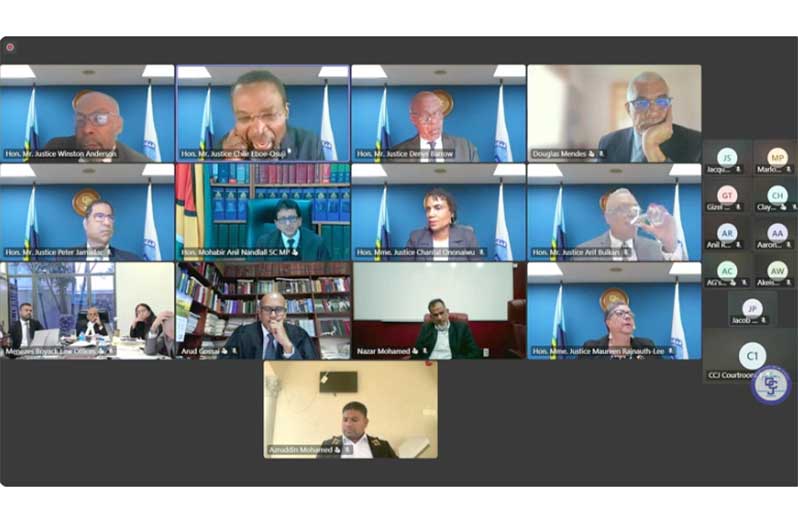
–during Mohameds’ extradition appeal at CCJ
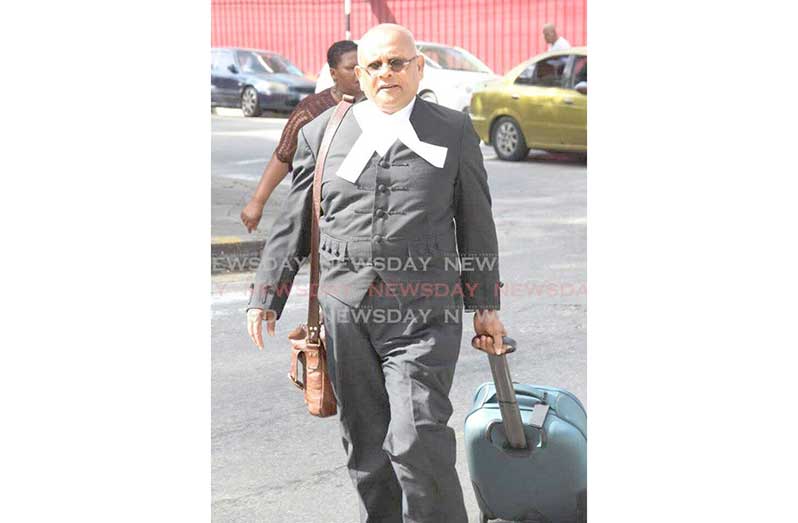
TRINIDAD and Tobago Senior Counsel Douglas Mendes, on Tuesday, advanced two central arguments before the Caribbean Court of Justice (CCJ) in the extradition challenge brought by Opposition Leader Azruddin Mohamed and his father Nazar Mohamed.
He contended that any claim of bias against the Minister of Home Affairs, Oneidge Walrond, had been waived through prior engagement, and that, in any event, the minister was legally required to act under the doctrine of necessity.
The case arises from a United States request dated October 30, 2025, seeking the extradition of the Mohameds to face an 11-count indictment including conspiracy, fraud, and money laundering.
Following that request, Minister Walrond issued an Authority to Proceed (ATP) under the Fugitive Offenders (Amendment) Act, triggering arrest warrants and committal proceedings.
Both the High Court and the Court of Appeal have dismissed the Mohameds’ judicial review applications challenging the validity of the ATP, with the CCJ now considering their final appeal.
Appearing for Minister Walrond, Mendes first addressed the issue of alleged bias, arguing that the Mohameds’ own conduct amounted to a waiver of any such claim.
He relied on correspondence exchanged before the extradition decision, specifically two letters dated 6 and 13 October 2025, which predated the ATP.
Mendes told the court that the applicants had directly engaged the minister in her official capacity.
He said, “those letters indicate that the applicants [Mohameds] were engaging the minister as the minister responsible for the exercise of extradition functions.”
According to Mendes, the correspondence demonstrated that the Mohameds were not only aware of her role but actively sought her intervention.
He said the applicants sought to “use her good offices” to facilitate a peaceful surrender and also raised issues about whether Guyana was the proper forum for the allegations.
On that basis, Mendes argued that it was inconsistent for the applicants to later assert that the minister was biased.
He submitted: “Having engaged the minister in her capacity as the extradition minister, they waive their right later on to say… you are infected by bias.”
He further stressed that legal objections based on bias must be raised at the earliest opportunity.
“If you have a problem with a decisionmaker on the grounds of bias, then you have to take the point… if you don’t… you cannot raise it later on,” Mendes said.
He maintained that the applicants were fully aware of the factual basis of their bias allegations at the time of their engagement with the minister, noting that these same issues were later set out in their affidavits.
In his submission, Mendes noted that their prior conduct undermined any later attempt to disqualify the minister from acting.
DOCTRINE OF NECESSITY
Alongside the waiver argument, the Senior Counsel advanced a second line of defence grounded in the doctrine of necessity.
He argued that even if bias was assumed, the minister was nonetheless required to proceed with the extradition process due to the absence of any practical alternative decision-maker and Guyana’s binding international obligations.
Mendes told the court that “The necessity point… would be a complete answer to the claim,” emphasising that there was no dispute as to the legal test, only its application.
He characterised extradition as fundamentally an executive responsibility and described it as “a quintessential executive function” linked directly to the State’s obligations under international agreements.
Mendes further explained that extradition decisions require the government to ensure treaty partners act in good faith while Guyana fulfils its own obligations.
“There is a high political element involved in acceding to a request,” he argued.
Addressing concerns raised about involvement by Attorney General Anil Nandlall, SC, Mendes said the evidence showed only limited administrative assistance, including providing legal authority on third-country extradition and helping complete a standard form.
The Senior Counsel submitted that such involvement “could not possibly… be sufficient to taint the minister’s decision.”
He also rejected the suggestion that any alleged bias could be attributed to the minister based on statements made by other government officials, arguing that such claims were insufficient to invalidate her decision-making role.
DEFENCE CONCEDES NO SPECIFIC UNLAWFUL ACT BY MINISTER
Trinidadian Senior Counsel Fyard Hosein led submissions for the Mohameds, alongside Senior Counsel Roysdale Forde and attorneys Siand Dhurjon and Damien DaSilva.
They argued that procedural fairness must apply from the earliest stage of the extradition process, including the minister’s decision to issue the ATP.
He maintained that bias at that preliminary stage undermines the entire process, contending that sufficient grounds exist for the court to quash the ATP. Citing a series of cases, Hosein maintained that “ATPs are challengeable.”
However, CCJ President, Justice Winston Anderson pressed counsel on whether the alleged issues, including procedural fairness and bias, could instead be addressed at later stages, such as during judicial proceedings or through a habeas corpus application.
In reply, Senior Counsel Hosein said that persons are entitled, under Section 12 of the Act, to bring challenges at the preliminary stage so that the issue can be determined at the outset.
He submitted: “The fact that there are other reliefs down the line that may or may not be triggered does not mean to say that you should not have that facility open to you. Because it could very well be that the minister cannot issue the ATP because of some requirement not being satisfied, and you would not have to go through the hardship, the expense…”
Justice Denys Barrow questioned whether the defence could identify any specific failure by Minister Walrond beyond the general allegation of bias.
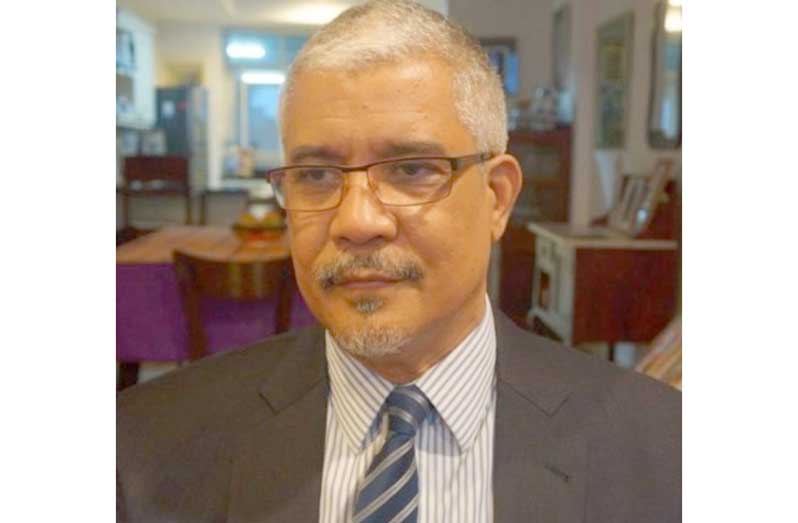
In retort, Hosein conceded that he was “not in a position” to point to any such act, noting: “This is not a case of proportionality. It is not a case of rationality. It is a case about standard… bias goes to the heart and the soul of the decision-making process.”
Building on Justice Barrow’s question, Justice Anderson asked Hosein to identify “any boxes the minister did not tick” or any conditions precedent that were not satisfied before the ATP was issued.
Pressed for a “precise response,” the Senior Counsel replied, “I don’t know, because we don’t have access to what the minister took into consideration, and we say that, because of bias, she might not have taken into consideration other matters…”
Justice Anderson put it to Hosein: “So, you’re saying that the answer is no, you can’t point to anything specific which the minister did unlawfully aside from the bias argument.”
“Yes, my Lord,” Hosein replied.
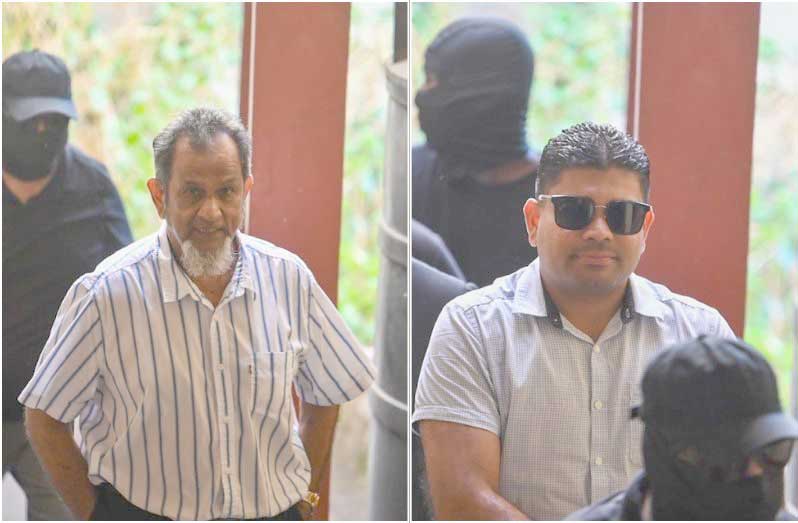
On the morning of October 31, 2025, the businessmen were taken into custody in Georgetown following an extradition request from the United States, which had been transmitted the previous day. The father, 72, and son, 39, are the subject of an 11-count indictment filed in the United States District Court for the Southern District of Florida.
They are jointly charged on 10 of those counts, while Azruddin Mohamed faces an additional charge relating to the importation of a 2020 Lamborghini Roadster SVJ into Guyana.
Court filings allege that the two conspired to commit wire fraud, mail fraud, money laundering, and customs-related offences, including conspiracy, aiding and abetting. The allegations are linked to what investigators describe as a US$50 million gold export and tax evasion scheme.
The indictment was handed down by a grand jury in October 2025.
According to the documents, Nazar Mohamed holds a 90 per cent stake in Mohamed’s Enterprise, while his son owns the remaining 10 per cent. The most serious charge carries a potential maximum sentence of 20 years in prison.
In June 2024, both men and their associated companies were sanctioned by the Office of Foreign Assets Control (OFAC), a division of the United States Department of the Treasury, over allegations of gold smuggling and large-scale corruption. The sanctions announcement also referenced claims that more than US$50 million in taxes owed to the Guyanese state had been evaded.
United States authorities are believed to have begun investigating the Mohameds as far back as the mid-2010s. The probe reportedly involved intelligence sharing and law-enforcement cooperation between Guyana and the United States.
Several American agencies were involved in the investigation, including the Drug Enforcement Administration, the Federal Bureau of Investigation, and the Department of Homeland Security.
Prosecutors allege that between 2017 and 2024 the two businessmen participated in a scheme to export large quantities of gold from Guyana to the United States using falsified customs declarations and reused government export seals.
Investigators claim the operation enabled the shipment of more than 10,000 kilogrammes of gold while avoiding the payment of taxes and royalties owed to the Guyanese state.
United States authorities further contend that the alleged scheme resulted in approximately US$50 million in losses to taxes and duties and involved acts of wire and mail fraud, money laundering and conspiracy.
The indictment also references a shipment of gold valued at approximately US$5.3 million that was seized at Miami International Airport during the course of the investigation.
Following the indictment, the United States formally sought the surrender of the two men under the extradition arrangements between the two countries, giving rise to the ongoing committal proceedings before the Georgetown Magistrates’ Courts.
They each remain on $150,000 bail as the hearing continues, with conditions requiring them to surrender their passports and report to the Ruimveldt Police Station every Friday.




