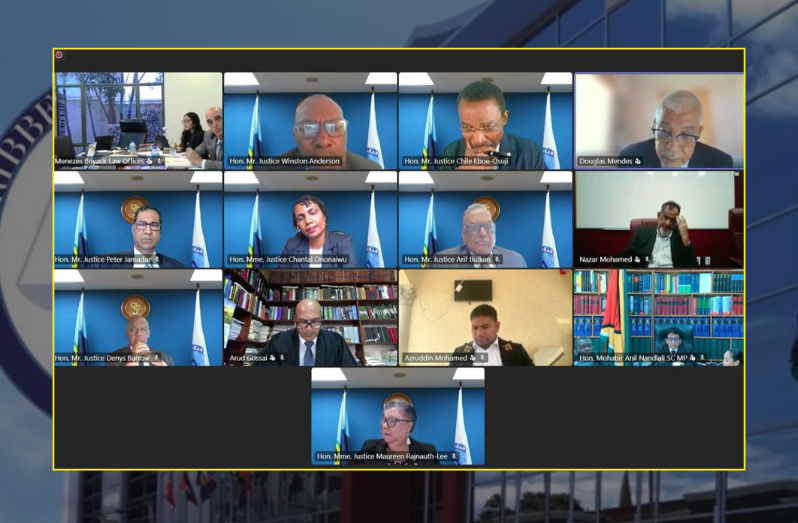
–Senior Counsel Mendes argues Minister Walrond had no choice but to act
–argues extradition duty tied to Guyana’s international obligations
Douglas Mendes, a Trinidad and Tobago Senior Counsel, on Tuesday urged the Caribbean Court of Justice (CCJ) to uphold the extradition process involving United States-sanctioned businessmen Azruddin Mohamed and his father Nazar Mohamed.

He argued that Minister of Home Affairs Oneidge Walrond was required to act in issuing the Authority to Proceed, invoking the doctrine of necessity.
Representing the minister, Douglas Mendes submitted that even if bias were assumed, the law allows a decision-maker to proceed where no practical alternative exists.
“The necessity point… would be a complete answer to the claim,” he told the court, adding that there was no dispute over the legal test, only its application.
The extradition request, submitted by the United States on October 30, 2025, led to the issuance of an Authority to Proceed and the commencement of extradition proceedings against the men the following day.
The Mohameds later launched judicial review proceedings challenging the minister’s decision, but those were dismissed by both the High Court and the Court of Appeal.
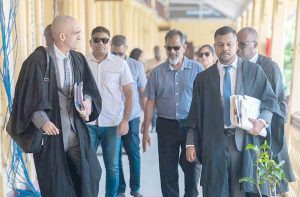
Before the CCJ, Mendes rejected arguments that another official could have taken the decision, stressing the constitutional and practical realities of extradition.
He described the function as “a quintessential executive function” tied directly to Guyana’s international obligations.
He explained that extradition decisions involve ensuring treaty partners act in good faith and that Guyana meets its own obligations under international agreements.
“There is a high political element involved in acceding to a request,” Mendes argued.
Addressing concerns about the Attorney General Anil Nandlall’s involvement, Mendes said the evidence showed only limited assistance—providing legal authority on third-country extradition and helping to complete a standard form.
He maintained that such involvement “could not possibly… be sufficient to taint the minister’s decision.”
He also argued that the allegations of bias against Minister Walrond were not based on her own actions, but rather on statements made by other government figures. That, he said, was insufficient to invalidate her role.
The CCJ is currently hearing the Mohameds’ application for special leave to appeal, which has been treated as the substantive matter.
Extradition proceedings remain on hold following an interim stay granted by the regional court in March 2026.