





–says strong offshore safety record backed by legislation, emergency-response systems as production scales up rapidly
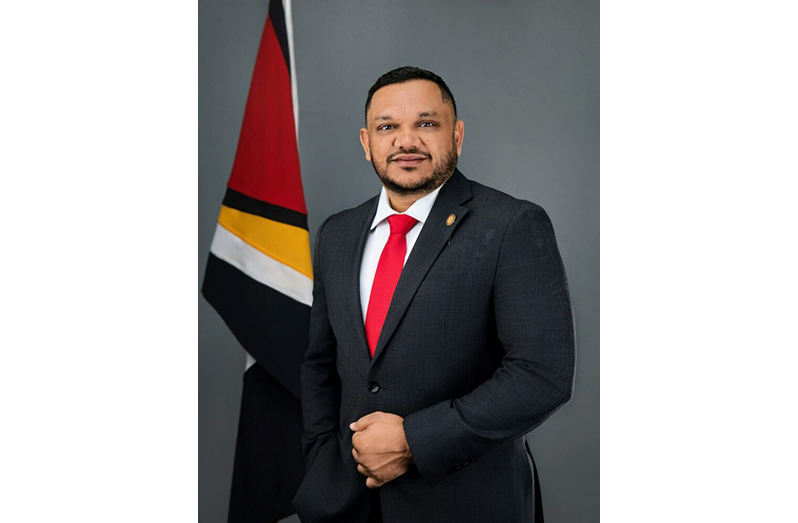
GUYANA’S rapid rise in the oil and gas sector over the past five years has been described as “unprecedented,” even as the country maintains a strong safety record, with no major offshore incidents to date, according to Minister of Natural Resources Vickram Bharrat.
“What has happened in Guyana, in the oil and gas sector in Guyana over the last five years is unprecedented,” the minister said on Wednesday’s episode of The Guyana Dialogue. He noted that the scale and pace of development “has never happened in any part of the world before.”
He pointed to the country’s exceptional exploration success, particularly in deepwater operations, explaining that “ExxonMobil is doing exploration in over 5,000 feet of deep water, and to accomplish a success rate at discovery wells of almost 85 per cent, that has never been heard of in the industry.”
The minister also underscored the sector’s strong safety performance, emphasising that “we have never really encountered any major incident offshore.”
He said the government remains “happy about that and thankful about that,” while maintaining preparedness for any potential risks.
Despite Guyana’s relatively short time as an oil-producing nation, the country has already put in place significant safeguards. Minister Bharrat noted that “as a small country, we are still prepared for any eventuality,” referencing the passage of oil-spill legislation that places clear responsibility on operators.
“You would recall some time back we passed the oil-spill bill in Parliament, which gives direct responsibility to the operator as they clean up the restoration of marine life, compensation—all of that is included in the oil-spill bill,” he explained.
The legislation is formally titled the Oil Pollution, Prevention, Preparedness, Response and Responsibility Act of 2025.
In a major boost to emergency-response capacity, Guyana is now home to one of only 13 capping stacks globally—critical equipment used to seal wells in the event of a blowout.
A capping stack is a large subsea emergency device used to seal a leaking oil or gas well if the blowout preventer (BOP) fails. It functions as a temporary cap, installing valves on the wellhead to halt or control the flow of hydrocarbons while relief wells are drilled to permanently secure the well.
“There are 13 capping stacks in the world, that are available in the world, and one is in Guyana. Imagine that, a small oil-producing country, only five years into oil and gas production, but we have one out of the 13 capping stacks in Guyana,” the minister said.
He explained that the presence of the equipment locally significantly reduces response time in an emergency. “Having it here in Guyana will reduce that time significantly, maybe by half of the time, or even less than that, that we can deploy the capping stack to basically seal that well and prevent any further damage or oil spill.”
Currently, all oil production is taking place in the Stabroek Block, which remains the country’s only producing block.
“In the Stabroek Block, which is the only producing block in Guyana presently, so when we speak about producing 920,000 barrels per day, it is only the Stabroek Block,” Bharrat added.
Production is being supported by four floating production, storage and offloading vessels (FPSOs) operating offshore. These include the Liza Destiny, Liza Unity, Prosperity and One Guyana FPSOs, which together are delivering an average daily output of about 920,000 barrels.
“So, we have four FPSOs that are producing in the Stabroek Block with an average daily production of about 920,000 barrels per day,” he explained.
The country is on the verge of further expansion, with a fifth FPSO—the Errea Wittu—set to be commissioned shortly.
“In a couple of weeks, maybe another two weeks from now, we will commission our fifth FPSO that’s being built in Singapore,” the minister said, noting that the vessel is expected to arrive in Guyana by August, with production start-up projected for the first quarter of next year.
Looking ahead, he projected that output will surpass one million barrels per day within the next year.
“So, I would say safely that next year, this time, in another year from now, we will have five FPSOs producing at over 1.1 million barrels per day. And that is quite significant,” he stated.
The sector’s growth has been equally striking when compared to earlier production levels.
“Moving from discovery in May of 2015 to first oil in December of 2019, when we took over government, the production was 80,000 barrels per day. We would have moved that in five years to 920,000 barrels per day. And in another year from now, over 1.1 million barrels per day,” Bharrat noted.
Beyond production, exploration activities continue across other offshore blocks, with new partnerships being forged.
The government recently signed agreements with a consortium led by TotalEnergies, alongside QatarEnergy and Petronas.
He said the government is very happy to have the consortium sign an agreement, noting that the companies involved are highly reputable international oil companies, and added that they will begin exploration very soon.
Another agreement has also been inked with a Ghanaian company, Cybele Energy, which is expected to begin exploration activities shortly.
“They too are going to start exploration,” he noted, adding that Guyana is also in discussions with the Dominican Republic and other interested parties seeking to acquire offshore blocks.
“We are in negotiation with the Dominican Republic again as well too… and there are a few other companies and countries that we are in talks with because they too would have signalled an interest in acquiring blocks offshore,” the minister said.
Even as the country celebrates rising production and revenue, the government continues to emphasise a balanced approach that prioritises both development and safety.
“So, while we are producing, while we are happy about that, while we are getting revenue and using the revenue to develop our country, we are also putting safeguards in place,” the minister stated.





