






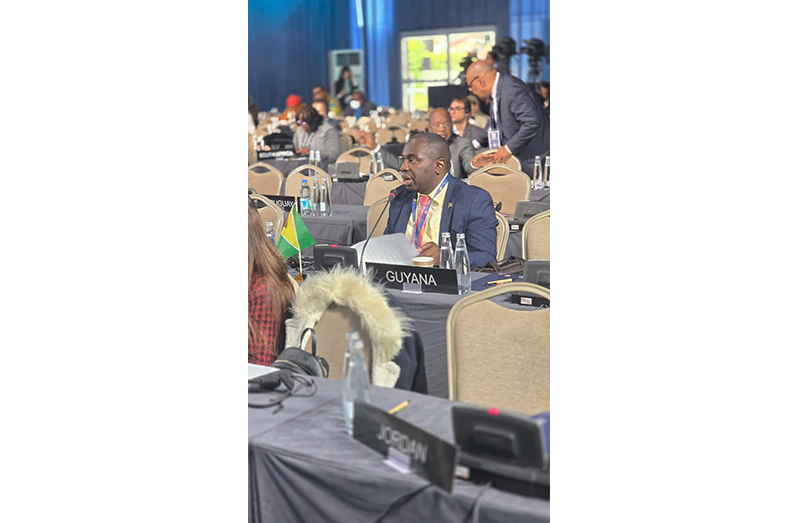
ARTIFICIAL intelligence is no longer a distant policy debate but a “present governance reality” demanding urgent legislative action, Minister within the Office of the Prime Minister Kwame McCoy has said, warning that the window to shape AI governance is rapidly narrowing.
Delivering high-level remarks at the 152nd Inter-Parliamentary Union (IPU) Assembly in Istanbul, Turkey, McCoy underscored that governments must move decisively to ensure that technological advancement is matched by responsive and accountable legislative frameworks.
“Artificial intelligence is no longer a future policy issue; it is a present governance reality shaping how citizens access information, services and opportunities,” the minister stated, while urging parliaments globally to “close the gap between technological advancement and legislative responsiveness, ensuring innovation is anchored in democratic accountability”.
He stressed that Guyana has already positioned itself to participate meaningfully in the global digital economy through sustained investments in connectivity and digital infrastructure over the past five years.
These include the establishment of three fibre optic submarine cable connections, expansion of high-speed broadband nationwide, and the licensing of low-earth orbit satellite services to reach remote communities.
According to McCoy, these developments have shifted connectivity from a long-standing constraint to a strategic enabler for economic growth and AI integration.
Beyond infrastructure, he highlighted the government’s aggressive push to digitise public services, noting that approximately 70 services are now available Online, including tax systems, citizen registration, and public benefit programmes. This, he said, reflects growing public trust and engagement with digital governance systems.
“Our model is clear: AI must be built on strong, inclusive digital public infrastructure, ensuring that innovation translates into real, everyday improvements in citizens’ lives,” he told the assembly.
However, the minister cautioned that alongside opportunity comes risk, pointing to the growing threat of misinformation, data privacy breaches, algorithmic bias, and emerging harms such as AI-generated non-consensual intimate imagery (NCII).
He described these as urgent issues requiring targeted legislative responses grounded in human rights and adaptable to rapid technological change.
“Parliaments must move beyond general AI discussions to establish specific legal protections, and ensure victim-centered remedies and enforcement mechanisms,” McCoy said, particularly noting the disproportionate impact of such harms on women and public figures.
He further said that for developing countries like Guyana, international cooperation remains critical.
This includes access to technical expertise, capacity-building for legislators, and greater inclusion in global AI governance frameworks, which, he warned, should not be dominated by major powers or private sector interests.
Looking ahead, McCoy outlined Guyana’s next phase of digital transformation, including accelerated 5G deployment, strengthened cybersecurity architecture, expanded digital skills training, and deeper public-private partnerships to drive innovation.
“These priorities reflect a deliberate shift, from expanding access to leveraging digital infrastructure for productivity, innovation, and AI integration, ensuring that adoption is inclusive, secure, and development-oriented,” he noted.
The minister also issued a clear call to action, asserting that governments must act collectively to ensure AI strengthens democracy, protects human rights, and expands opportunities for all.
“The window to shape AI governance remains open, but it is narrowing,” he warned, signalling Guyana’s readiness to collaborate internationally in advancing responsible and inclusive AI frameworks.




