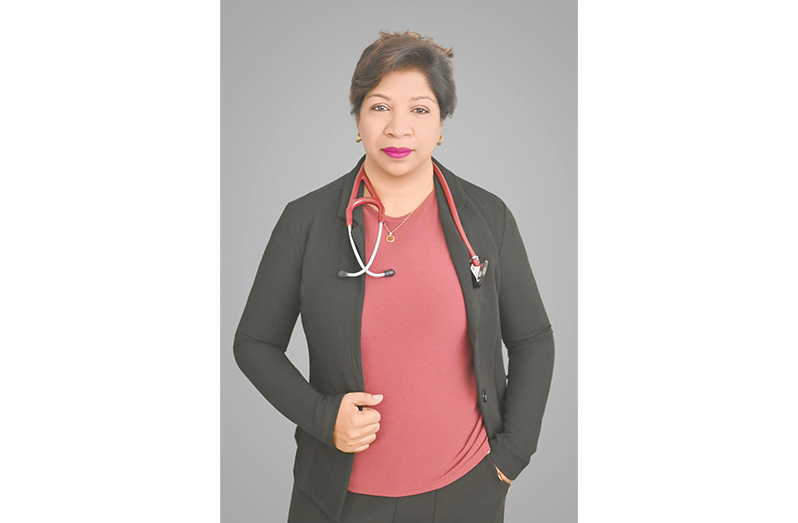
IN the halls of Georgetown Public Hospital Corporation, where long hours and critical decisions define daily life, one physician’s journey reflects dedication, resilience, and the steady transformation of healthcare in Guyana.
For Dr Kamela Bemaul-Sukhu, medicine became the realisation of a family dream. With no prior medical professionals in her family, her mother’s aspiration to become a doctor evolved into her own life’s mission.
After graduating in 2003, Dr. Bemaul-Sukhu entered the medical field during a period of national crisis. Severe flooding led to an overwhelming influx of critically ill patients at Georgetown Public Hospital Corporation, pushing the healthcare system to its limits.
Her work extended beyond the hospital, as she joined outreach efforts that required travelling by boat into flood-affected communities. There, she encountered patients who were isolated, ill, and unable to access necessities, deepening her understanding of the realities many Guyanese faced.
These early experiences shaped her approach to medicine and reinforced her commitment to patient-centred care.
At a time when structured postgraduate training was limited, Dr Bemaul-Sukhu became part of the first group of doctors to enter the internal medicine residency programme at Georgetown Public Hospital Corporation.
Without the multi-layered supervision systems available today, she and her colleagues often worked with minimal guidance, taking on significant responsibility early in their careers. This environment demanded both clinical skill and decisive leadership.
Balancing these professional demands with family life proved challenging. As a young mother during her residency, she navigated long hospital shifts, academic pressures, and the responsibilities of raising children. Careful planning and strong family support became essential in managing both roles.
Her decision to specialise in haematology was influenced by the limitations she witnessed in treating patients with serious illnesses, particularly cancer. Early in her career, the lack of available treatments meant that many patients received only supportive care. Experiences in both paediatric and adult medicine highlighted the urgent need for improved services in blood-related conditions.
Although she initially considered oncology, the length of overseas training required led her to focus on haematology, particularly non-cancerous blood disorders. At the time, there was no dedicated hematology specialist in Guyana.
Upon completing her training, Dr Bemaul-Sukhu returned to Guyana and established the country’s first hematology clinic at Georgetown Public Hospital Corporation. The clinic introduced a structured approach to diagnosing and managing blood disorders, significantly improving patient care.
Conditions such as sickle cell disease, which were previously managed with limited interventions, began receiving comprehensive attention. Patients now benefit from detailed diagnostic evaluations, screening for complications affecting major organs, and access to medications that reduce disease severity. Continuous monitoring and follow-up care have also become central components of treatment.
The impact of these changes has been evident across the healthcare system, with fewer emergency cases related to severe complications and improved quality of life for patients.
The clinic has also advanced care for individuals with bleeding disorders, including haemophilia.
Through collaboration with the World Federation of Haemophilia, patients now have access to specialised treatments that were previously unavailable in the country.
Additional partnerships with international institutions have strengthened local capacity, enabling healthcare professionals across multiple disciplines to manage complex cases more effectively.
These developments have made it possible to safely perform procedures that were once considered too risky, including surgeries for patients with bleeding disorders.
Despite her leadership role, Dr Bemaul-Sukhu remains actively involved in patient care. Her daily responsibilities include managing both inpatient and outpatient cases, often requiring her to balance clinical duties across different departments. The demands of the profession extend beyond standard working hours, with continuous monitoring and follow-up forming a routine part of her work.
Patient outcomes continue to serve as a primary source of motivation. Improvements in patients’ health, energy, and overall well-being reflect the progress made in haematology care and reinforce the importance of sustained effort in the field.
Over the years, Guyana’s healthcare system has undergone significant development. The expansion of medical training programmes, increased availability of specialists, and improved diagnostic and treatment capabilities have contributed to a higher standard of care. Services that were once unavailable are now accessible, and collaboration with international partners continues to enhance local expertise.
Today, the level of care provided in haematology and internal medicine is comparable to international standards in many areas, reflecting the progress achieved through years of dedicated work.
Dr Bemaul-Sukhu continues to emphasise the importance of early diagnosis and patient education. Understanding medical conditions and adhering to treatment plans remain key factors in improving health outcomes.
Her journey, from navigating floodwaters as a young doctor to establishing a critical medical specialty, highlights the impact of perseverance and vision. Through her work, haematology care in Guyana has been transformed, offering patients not only treatment, but a renewed sense of hope. (GPHC)